Impakter
  • Environment
    • Biodiversity
    • Climate Change
    • Circular Economy
    • Energy
  • FINANCE
    • ESG News
    • Sustainable Finance
    • Business
  • TECH
    • Start-up
    • AI & Machine Learning
    • Green Tech
  • Industry News
    • Entertainment
    • Food and Agriculture
    • Health
    • Politics & Foreign Affairs
    • Philanthropy
    • Science
    • Sport
  • Editorial Series
    • SDGs Series
    • Shape Your Future
    • Sustainable Cities
      • Copenhagen
      • San Francisco
      • Seattle
      • Sydney
  • About us
    • Our Story
    • Team
    • Partners
    • Write for Impakter
    • Contact Us
    • Privacy Policy
No Result
View All Result
  • Environment
    • Biodiversity
    • Climate Change
    • Circular Economy
    • Energy
  • FINANCE
    • ESG News
    • Sustainable Finance
    • Business
  • TECH
    • Start-up
    • AI & Machine Learning
    • Green Tech
  • Industry News
    • Entertainment
    • Food and Agriculture
    • Health
    • Politics & Foreign Affairs
    • Philanthropy
    • Science
    • Sport
  • Editorial Series
    • SDGs Series
    • Shape Your Future
    • Sustainable Cities
      • Copenhagen
      • San Francisco
      • Seattle
      • Sydney
  • About us
    • Our Story
    • Team
    • Partners
    • Write for Impakter
    • Contact Us
    • Privacy Policy
No Result
View All Result
Impakter
No Result
View All Result
An abstract aesthetic still life featuring minimalist golden metallic geometric elements floating against a dark luxury background.

alancing the mathematical value of appliance repairs with modern home aesthetics and resource preservation.

When Appliances Break: The Carbon Math of Repair vs Replace

byHannah Fischer-Lauder
May 26, 2026
in Environment, Lifestyle

When your dishwasher starts leaking or your refrigerator stops cooling, the instinct is often to head to the nearest big-box store. After all, today’s appliances run more efficiently than ever — newer models promise lower electricity bills and quieter operation. But this consumer reflex obscures one of the most overlooked sustainability decisions in the modern home: the carbon embedded in manufacturing.

Where the Carbon Really Hides

Most consumers think about appliance carbon footprint in terms of electricity use. That’s only half the story. The other half — embodied carbon — is the greenhouse gas released to mine the raw materials, manufacture the components, assemble the unit, and ship it to your kitchen. For a typical residential refrigerator, embodied carbon accounts for 30 to 50 percent of lifetime emissions. For washing machines and dishwashers, the split is closer to 50/50.

This ratio is shifting dramatically as new appliances become more energy-efficient. As operational emissions fall with each generation of Energy Star certification, the relative share of embodied carbon climbs. For some current-generation high-efficiency refrigerators, embodied emissions now represent up to 60 percent of total lifetime footprint — meaning the carbon decision is made the day the unit leaves the factory, not the day you plug it in.

The Math Behind “Just Buy a New One”

Replacing a functional but aging appliance with a new high-efficiency model can take five to fifteen years before operational savings offset the embodied carbon of the new unit. For many households, that’s longer than the new appliance’s expected service life. The net climate impact is often negative.

Repair, by contrast, preserves the embodied investment already made. A successful refrigerator repair extending lifespan by five to seven years can avoid the equivalent of driving a passenger vehicle 3,000 to 5,000 miles in atmospheric CO₂ — and that’s before accounting for landfill methane from discarded units.

IoT and the Repair Renaissance

Until recently, repair economics were brutal: diagnosing a failing component often cost as much as the part itself, pushing households toward replacement. Smart appliances are changing this calculus. Modern IoT-enabled refrigerators, washers, and ovens self-report fault codes, temperature anomalies, and component wear. Technicians arrive with the right part already identified, reducing labor time, second visits, and customer downtime.

This data transparency is also reshaping the right-to-repair conversation, with manufacturers increasingly pressured to share diagnostic protocols with independent service providers.
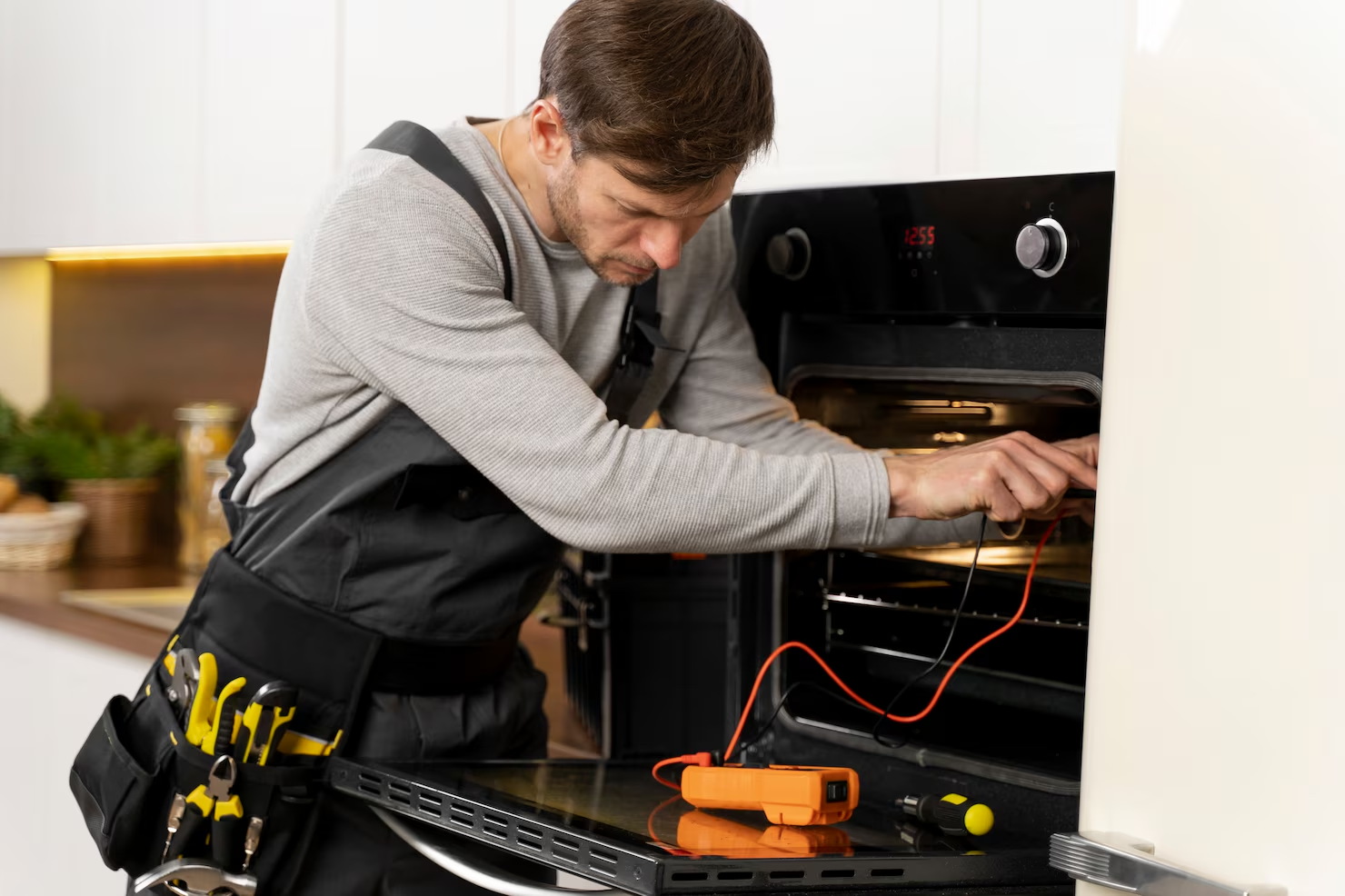
A professional technician using diagnostic tools to repair a modern oven in a home kitchen environment.
Extending an appliance’s life cycle by 5 to 7 years preserves the massive embodied carbon investment made during factory assembly.

Local Repair as Climate Infrastructure

Reducing embodied carbon at scale requires more than consumer willingness — it requires functional local repair ecosystems. For example, Denver-area service providers like fixifycolorado.com operate on this principle, focusing on extending appliance lifespan rather than driving replacement. As cities work toward circular-economy goals, the availability of skilled local repair becomes as important as recycling infrastructure.

The Decision Framework

Before replacing a functional appliance, three questions matter most:

  1. Is the repair cost under 50% of replacement value? If yes, repair almost always wins on carbon.
  2. Will the repair extend useful life by 3+ years? That’s the typical payback period for embodied carbon savings.
  3. Has the original unit been in service less than 12 years? Older units may have hidden efficiency losses that justify replacement.

When the answers tilt toward repair, the lower-carbon choice is also usually the lower-cost choice. The most sustainable appliance, more often than not, is the one already in your kitchen.


Editor’s Note: The opinions expressed here by the authors are their own, not those of Impakter.com — In the cover:  The repair cost of a home appliance and the carbon math of repair vs replace. Electricians working on the appliance is a key factor too — Cover Photo Credit: pikisuperstar

Share: Facebook X LinkedIn
Tags: appliance repaircircular economyDenver appliance repairembodied carbonESGIoT appliancesrepair vs replaceSustainability
Previous Post

The World’s Biggest Miner Fails to Control Emissions

Related News

An abstract aesthetic still life featuring minimalist golden metallic geometric elements floating against a dark luxury background.

When Appliances Break: The Carbon Math of Repair vs Replace

May 26, 2026
ESG news regarding BHP unprecedented decarbonisation delays, Brasil’s record-breaking climate initiatives, Pope speaking out against AI, and Scotland in the middle of green data centre dispute.

The World’s Biggest Miner Fails to Control Emissions

May 26, 2026

Impakter informs you through the ESG news site and empowers your business CSRD compliance and ESG compliance with its Klimado SaaS ESG assessment tool marketplace that can be found on: www.klimado.com

Registered Office Address

Klimado GmbH
Niddastrasse 63,

60329, Frankfurt am Main, Germany


IMPAKTER is a Klimado GmbH website

Impakter is a publication that is identified by the following International Standard Serial Number (ISSN) is the following 2515-9569 (Printed) and 2515-9577 (online – Website).


Office Hours - Monday to Friday

9.30am - 5.00pm CEST


Email

stories [at] impakter.com

By Audience

  • TECH
    • Start-up
    • AI & MACHINE LEARNING
    • Green Tech
  • ENVIRONMENT
    • Biodiversity
    • Energy
    • Circular Economy
    • Climate Change
  • INDUSTRY NEWS
    • Entertainment
    • Food and Agriculture
    • Health
    • Politics & Foreign Affairs
    • Philanthropy
    • Science
    • Sport
    • Editorial Series

ESG/Finance Daily

  • ESG News
  • Sustainable Finance
  • Business

About Us

  • Team
  • Partners
  • Write for Impakter
  • Contact Us
  • Privacy Policy

© 2026 IMPAKTER. All rights reserved.

No Result
View All Result
  • Environment
    • Biodiversity
    • Climate Change
    • Circular Economy
    • Energy
  • FINANCE
    • ESG News
    • Sustainable Finance
    • Business
  • TECH
    • Start-up
    • AI & Machine Learning
    • Green Tech
  • Industry News
    • Entertainment
    • Food and Agriculture
    • Health
    • Politics & Foreign Affairs
    • Philanthropy
    • Science
    • Sport
  • Editorial Series
    • SDGs Series
    • Shape Your Future
    • Sustainable Cities
      • Copenhagen
      • San Francisco
      • Seattle
      • Sydney
  • About us
    • Our Story
    • Team
    • Partners
    • Write for Impakter
    • Contact Us
    • Privacy Policy

© 2026 IMPAKTER. All rights reserved.