
Guatemalan institutions and CCAFS give shape to a practical guide to integrate gender in agricultural projects.

Article in collaboration with: CGIAR Research Program on Climate Change, Agriculture and Food Security (CCAFS) seeks to address the increasing challenge of global warming and declining food security on agricultural practices, policies and measures through strategic, broad-based global partnerships.
There is an increasing awareness of the importance of adapting agricultural systems and rural livelihoods to the challenges caused by climate change. This awareness has come hand in hand with the need to guarantee that both men and women—of different ages and ethnicities—can adapt equally to the effects of climate change. And while, in recent years, the importance of integrating gender issues in climate change initiatives in the agricultural sector has been increasingly acknowledged, it is not always obvious how to systemically and practically carry out gender integration.
Related topics: The Importance of Community Participatory Approach: Water and Food Security Programmes – World Food Security – What needs to be done – Gender, climate change and agriculture: Guatemala leads regional dialogue
The CGIAR Research Program on Climate Change, Agriculture and Food Security (CCAFS) project ‘Generating evidence on gender-sensitive climate-smart agriculture to inform policy in Nicaragua and Guatemala‘ aims to systemically include the gender perspective in agricultural initiatives in Guatemala. It does so through a close collaboration with the Gender and Climate Change Units of the Ministry of Agriculture and Livestock of Guatemala (MAGA).
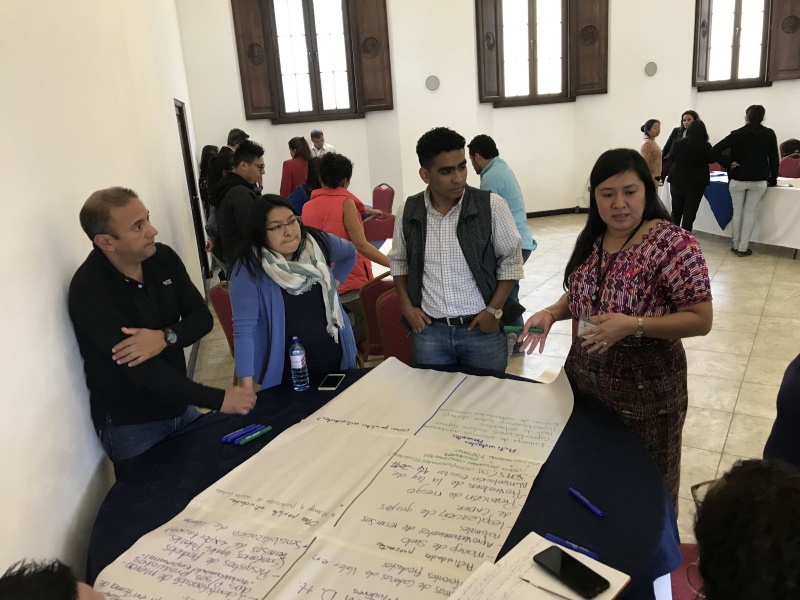
Institutions that work in the agricultural sector in Guatemala now have a guide to integrating a gender lens in all of their projects and initiatives. Photo: Osana Bonilla-Findji.
One of the results of this collaboration is the gender guide, ‘Step by step inclusion of gender in climate-smart agriculture (CSA) initiatives for Guatemala’. This guide will strengthen the capacities of Guatemalan institutions to integrate a gender-sensitive approach when promoting CSA options.
The creation of the guide was initiated by a workshop in Guatemala where different institutions came together. In this first meeting, CCAFS researchers and professionals from the MAGA Gender Unit discussed the relation between gender and agriculture and how a gender perspective can be applied in different phases of projects, from planning and design to implementation.
In March and May, several other participatory workshops were held. During these sessions, the different institutions and actors continued to strengthen their capacity to understand and deal with gender issues in the agricultural context. The workshops were also used to evaluate the first version of the guide, and adapt it to the Guatemalan context as much as possible.
It is important to highlight that the guide is the result of the shared effort of the 22 Guatemalan institutions that have participated in its development. They helped to identify the needs related to gender and climate change and critically analyzed projects that were already being developed. As a result, all products that derive from this initiative are in line with the needs and realities of the participating institutions, and their understanding of gender, agriculture and climate change.
How will the guide work?
The guide will function as a roadmap for the different actors that are involved in the implementation of agricultural initiatives: those that are in the design and planning phase (institutions), those that implement the projects (extensionists) and the monitoring and evaluation teams. The guide is divided into four sections: an introduction that discusses the concept of gender and its meaning, and a chapter for each of the three groups mentioned above.
On 25 June 2019, representatives of the Gender and Climate Change Units from MAGA presented the guide in the context of his presidency pro tempore of the Consejo Agropecuario Centroamericano (CAC), as an initiative to highlight the importance of gender-sensitive agricultural policy, and as an invitation to other Central American countries to initiate a similar process.
What is next?
In the second half of this year, MAGA’s Gender Unit will coordinate with some of the institutions that are part of the project to take the guide to the field and collect information about its usefulness and effectiveness for different actors. In November, the Gender Unit will share the feedback of this field validation. This will be incorporated in the final version of the guide, which will be finalized at the end of the year.
Key partners:
- Ministry of Agriculture and Livestock of Guatemala (MAGA)
- National Council of Protected Areas (CONAP)
- Lands of Guatemala (Fontierras)
- Directorate of Regional Coordination and Rural Extension (DICORER)
- National Institute of Forests (INAB)
The project ‘Generating evidence on gender-sensitive climate-smart agriculture to inform policy in Nicaragua and Guatemala’ is funded by the International Development Research Center (IDRC).
About the author: Mariola Acosta is a researcher for the International Center of Tropical Agriculture (CIAT). Lauren Sarruf Romero is the Communications Officer for CCAFS Latin America.
EDITOR’S NOTE: The opinions expressed here by Impakter.com columnists are their own, not those of Impakter.com. Photo Credit: J.D. Martínez (CCAFS)