This week, the World Health Organization (WHO) published a report on tobacco control measures around the world, highlighting that 5.6 billion people – 71% of the world’s population – are now protected with at least one best practice policy recommended by WHO to help save lives from deadly tobacco – and that’s five times more than in 2007. The report also showed that almost 40% of countries now have completely smoke-free indoor public places – meaning that the public is protected from second-hand smoke.
“These data show that slowly but surely, more and more people are being protected from the harms of tobacco by WHO’s evidence-based best-practice policies,” said Dr. Tedros Adhanom Ghebreyesus, WHO Director-General. “I congratulate Mauritius on becoming the first country in Africa, and the Netherlands on becoming the first in the European Union to implement the full package of WHO tobacco control policies at the highest level.”
These two countries thus join Brazil and Turkey, the only two countries that had achieved the best-practice level in all MPOWER measures.
MPOWER is a set of six cost-effective and high-impact measures introduced by the World Health Organization (WHO) in 2008 to help countries reduce the demand for tobacco, as set out in the WHO Framework Convention on Tobacco Control (WHO FCTC). The convention, developed in response to the tobacco epidemic that had become global, was an evidence-based treaty reaffirming the right of all people to the highest standard of health. Adopted by the World Health Assembly in 2003, it entered into force two years later, in 2005.
The six MPOWER measures are as follows:
- Monitoring tobacco use and prevention policies.
- Protecting people from tobacco smoke.
- Offering help to quit tobacco use.
- Warning about the dangers of tobacco.
- Enforcing bans on tobacco advertising, promotion, and sponsorship.
- Raising taxes on tobacco1.
The two areas where the measures appear most effective are advertising and taxes on tobacco, leading to a falling trend in smoking rates in the developed world.
So those are the good news: Overall, smoking rates are falling. As the following World in Data scatterplot diagram comparing death rates in 1990 (on the y-axis) with death rates in 2017 (x-axis) shows, most countries in the world lie above the grey line which means that they have achieved a decline in death rates from smoking over the past two decades (since 1990):
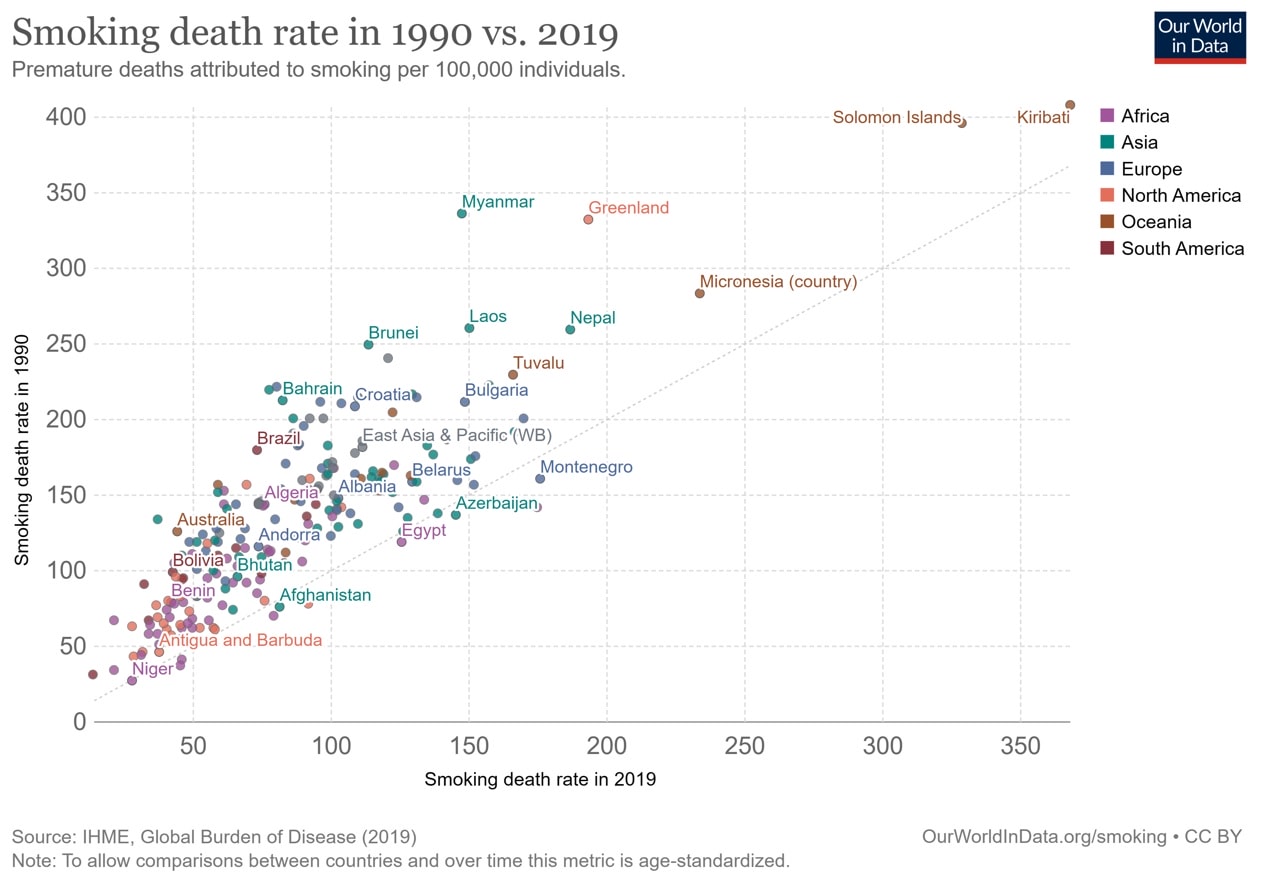
To understand the above diagram, note that the grey line indicates parity in rates of death between the two time periods, 1990 vs. 2017. A country above the line had registered more deaths from smoking in 1990; below the line, indicates a higher rate in 2017.
Now for the bad news.
Persistence of smoking: A continuing problem and vaping is no solution
First observation: Nearly one-in-four (23%) adults in the world smoke tobacco. According to WHO, smoking is one of the leading causes of preventable deaths, with about 8.7 million people dying every year from smoking and another 1.2 million dying from secondhand smoking. And, unsurprisingly, those who die are most often older people. So the problem is still far from being solved.
Tobacco has massive negative health impacts: According to the US Centers for Disease Control and Prevention (CDC), smoking leads to disease and disability and harms nearly every organ of the body. More than 16 million Americans are living with a disease caused by smoking, and for every person who dies because of smoking, at least 30 people live with a serious smoking-related illness.
Tobacco use increases the risk for many types of cancer, such as lung cancer. Studies show a direct link between cigarette smoking and coronary heart disease and stroke. Smoking during pregnancy also increases the risk for pregnancy complications.
Smoking also causes lung diseases, diabetes, and chronic obstructive pulmonary disease (COPD), which includes emphysema and chronic bronchitis.
As if all this wasn’t enough, it also increases the risk for tuberculosis, certain eye diseases, and problems of the immune system, including rheumatoid arthritis. And cherry-on-the-cake (!), secondhand smoke exposure causes stroke, lung cancer, and coronary heart disease in adults. Children who are exposed to secondhand smoke are at increased risk for sudden infant death syndrome, acute respiratory infections, middle ear disease, more severe asthma, respiratory symptoms, and slowed lung growth.
Medical science concords in advising quitting smoking since it can reverse many of these negative effects on your body. While vaping was launched as a healthy alternative to smoking, the consensus now in the medical community is that vaping is not worth the potential risks, in particular the long-term ones. The fact that these are still not well known is the main reason why vaping cannot be considered a viable alternative option to smoking:
A major difference in outcomes between rich and poor countries: More poor people die from smoking
While almost everywhere smoking rates are in decline, the numbers as a function of income tell a different story. Smoking rates in middle and low-income countries are still on the rise, as shown by the following diagram:
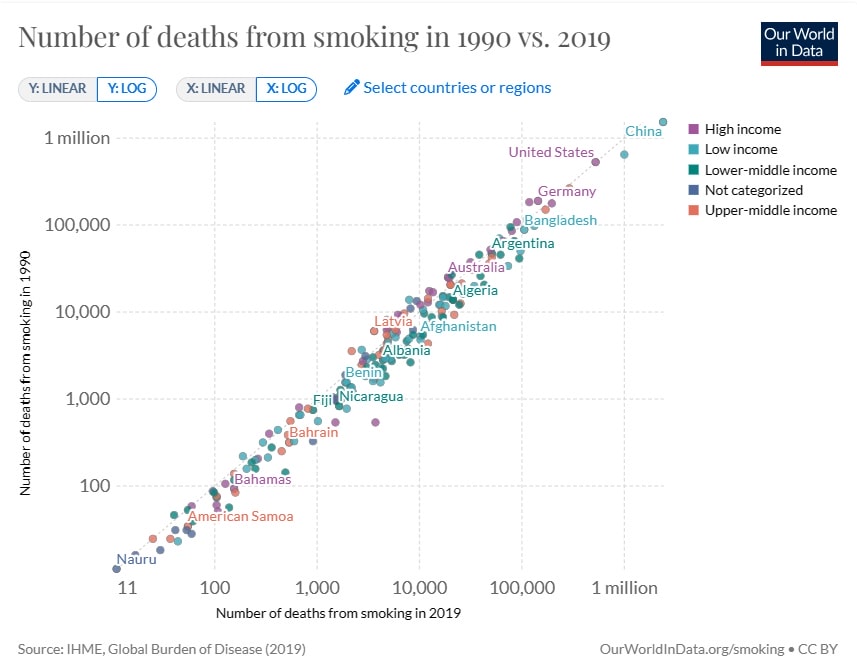
The above is a scatterplot similar to the previous one, with the grey line showing parity between the number of deaths in 1990 and in 2019. Most high-income countries are above the line, which means they registered more deaths in 1990 than in 2019. Conversely, low-income and middle-income countries tend to fall below the line, thus still on an increasing trend.
But even among the rich, we are still facing the problem of a few laggards – notably the United States which is on a slightly rising trend (from 515,412 deaths in 1990 to 527,736 in 2019) and Germany, as noted by the German news outlet DW.
It appears that Germany would like to match the rest of Europe but regrettably hasn’t been able to do so. Yet it cannot be considered a true laggard – like most European countries it is on a downward trend with fewer deaths in 2019 than in 1990 (from 184,466 deaths in 1990 to 143,642 in 2019).
The outlook?
If the past is anything to go by, it could take about a century to solve the problem of smoking. Take a look at how the process unfolded in the developed world in this diagram that shows the daily trend of cigarette sales per adult from 1875 to 2015, spanning some 140 years:
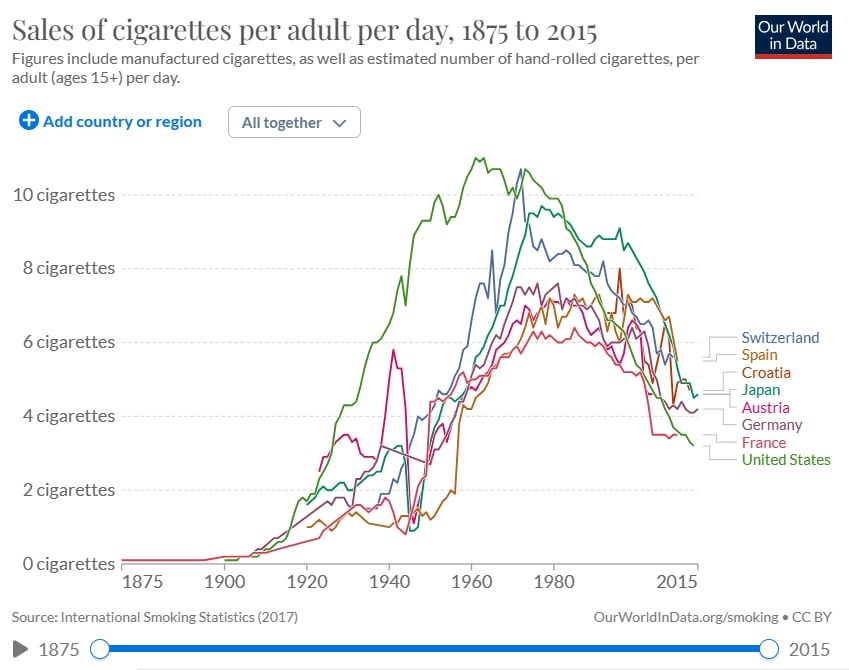
The hope is that low and middle-income countries could “leap-frog” the developed world in this respect. And according to WHO data, there are some encouraging signs that this is happening: The rate of worldwide prevalence of smoking had dropped from 22.8% in 2007 to 17% in 2021. That, in historic terms, is a relatively fast drop, suggesting that MPOWER measures are working.
So now that we can see what is effective in controlling tobacco, it’s a matter of keeping efforts up, and hopefully, millions of lives can be saved.
Editor’s Note: The opinions expressed here by the authors are their own, not those of Impakter.com — In the Featured Photo: A tribal woman smoking Source: Pixahive photograph by Rajeev Jain