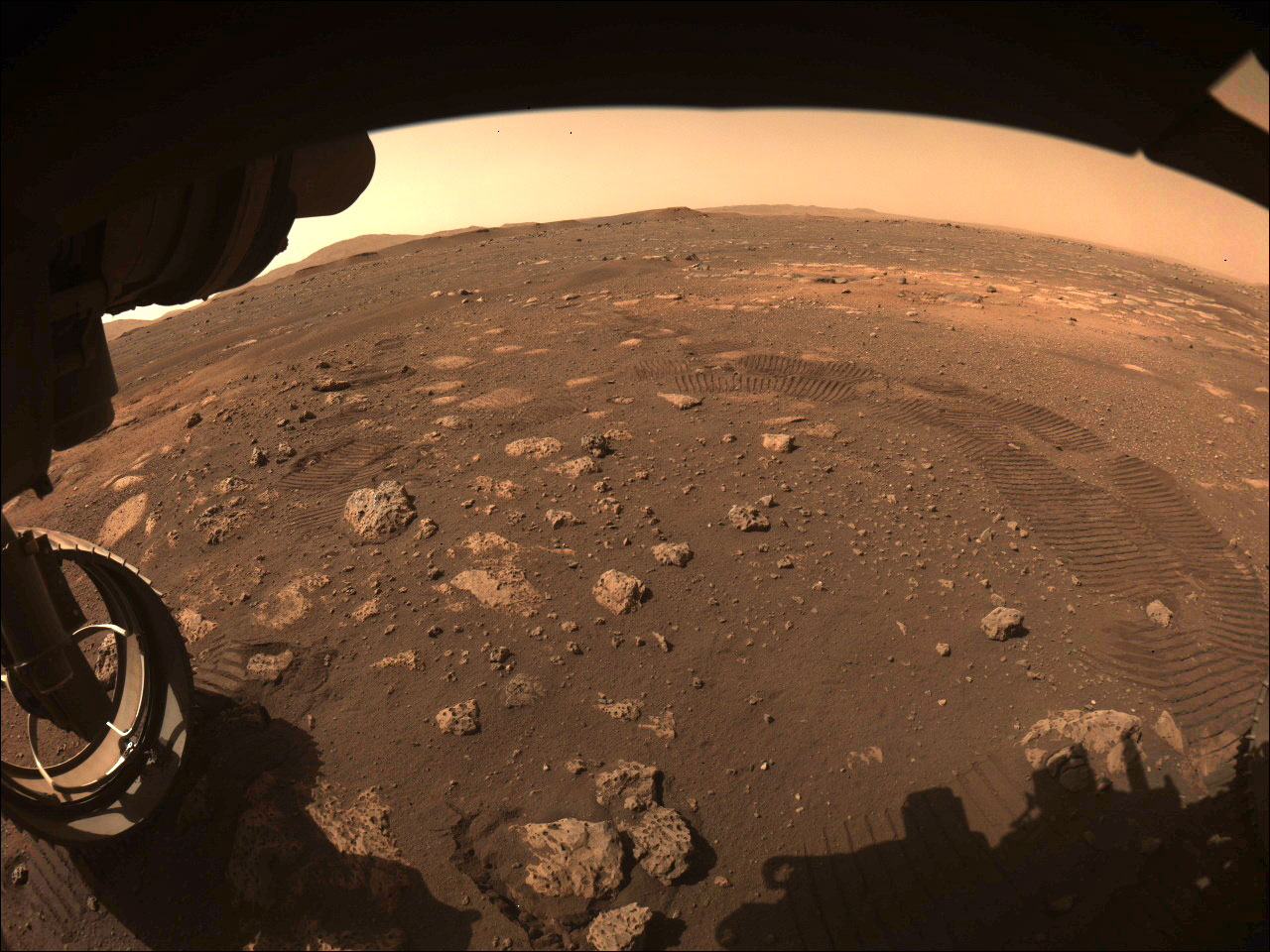

In February 2021, after a 293 million mile journey from Earth to Mars, “Perseverance” NASA’s largest and most advanced Martian rover, touched down on the Red Planet surface to begin astrobiological excavation of our neighboring planet.
1.5 years later, NASA says the latest Mars rock-core samples collected by Perseverance could potentially contain the first “biosignatures” of ancient alien microbial life.
“The answers are out there – and Team Perseverance is ready to find them,” says Thomas Zurbuchen, NASA’s Science Chief.
The Mars Perseverance Mission, part of an ecosystem of NASA space exploration programs between the Moon and Mars, aims to “characterize the planet’s geology and past climate,” and “pave the way for human exploration of the Red Planet.”
NASA first put robots on Mars 10 years ago, with their inaugural “Curiosity” rover searching the Martian terrain for answers to a monumental question: Could Mars have supported ancient microbial life?
The answer was yes.

Since then, Perseverance has expanded on Curiosity’s observational findings with two science campaigns so far, taking on the challenge of mining the surface for evidence of life as an android geologist.
Perseverance uses the SHERLOC spectrometer/laser and the WATSON color camera to take pictures of “rock grains and surface textures,” and uses a UV light laser to detect organic chemicals, all in the search for signs of past alien microbial life.
“The SHERLOC investigation will advance the understanding of Martian geologic history and identify its past biologic potential,” says Luther Beegle, Principal Investigator at the NASA Jet Propulsion Laboratory.
SHERLOC even has a magnifying glass, “just like the fictional detective,” says NASA.
Making some accidental zen art as I drive. Mars may be desolate, but it has a certain charm.
More of your favorite images: https://t.co/jQbq9rXW53 pic.twitter.com/nUmBAlF1iq
— ARCHIVED – NASA's Perseverance Mars Rover (@NASAPersevere) May 3, 2022
Though only half the size of earth, Mars’ 144.8 million km² surface area of cold, dusty desert makes choosing an ideal excavation site no mean feat.
But, NASA’s astrobiologists were able to pinpoint a specific location within the Martian landscape that Zurbuchen claims is thought to be one of the “best locations on Mars to look for signs of past microscopic life.”
This location is the “Jezero Crater.”
Perseverance’s first 31-day campaign within the crater yielded eight rock-core samples that provided striking evidence that ancient water and lava were once present there.
For their second campaign, NASA was able to locate an even more favourable area within the crater, where it is thought a past Martian river would have converged with a lake, denoted by a triangular land formation known as a “river delta” (so-called due to its geographical resemblance of the shape of greek letter delta Δ). The once-watery environment of this ancient delta is thought to have been an ideal reservoir to support ancient life.
Perseverance once again used a drill to collect four more core samples – this time showing more conclusive evidence of organic matter.
“We picked the Jezero Crater for Perseverance to explore because we thought it had the best chance of providing scientifically excellent samples – and now we know we sent the rover to the right location,” said Zurbuchen.
Related Articles: NASA’s Return to the Moon on Hold | The Problems With Space Mining No One Is Talking About | Space Cooperation with Russia in Jeopardy | Why Biomining Could Be The Future Of Space Society
Though indications of past life have been preliminarily detected before by both Curiosity and Perseverance during preluding campaigns, the importance of this latest geological discovery is much greater, because of the high concentration of the organic matter, and also the favorable watery-environment in which the material was detected.
On Earth, almost all fossils are found in sedimentary rocks. Over millions of years organisms get preserved within layers of sediment that build up on the beds of lakes and other bodies of water. When discovered, they show signs or “biosignatures” of ancient life, hallmarked by the presence of the “chemical building blocks of life” – carbon, hydrogen, oxygen, nitrogen, phosphorus, and sulfur.
The latest “scientifically compelling” rock-core samples dug out from sedimentary rock on the Martian surface known as “Wildcat Ridge,” show a significantly high concentration of mineral containing these elements, in a once water-covered area that would have provided “conditions in which life could potentially have existed.”

“In the distant past, the sand, mud, and salts that now make up the Wildcat Ridge sample were deposited under conditions where life could potentially have thrived,” said Perseverance project scientist Ken Farley. “The fact the organic matter was found in such a sedimentary rock – known for preserving fossils of ancient life here on Earth – is important.”
Though compelling evidence has been discovered, we will have to wait for the samples to make the journey back to Earth as part of NASA’s “Mars Sample Return campaign” before any concrete analysis can be done, or any conclusions about alien life can be drawn. NASA has been very clear that it’s possible these elements may have been produced by chemical reactions, rather than the presence of life.
Spacecraft will be sent to the Red Planet to bring the Martian rock home.
11 rock-core samples and one atmospheric sample collected by Perseverance, the “six-wheeled scientist,” will be returned from the Martian surface back to Earth via spacecraft designed by NASA and the European space agency, ESA, who are collaborating at present on the architecture for the return campaign. They recently announced the near completion of the “conceptual design phase.”
Call them the “dusty dozen.” I’ve now got 12 rock core samples on board, collected while #SamplingMars at these different sites around Jezero Crater. Learn more about all my samples, and keep track of the ones still to come: https://t.co/SuSfqejyOZ pic.twitter.com/5VoaJjj3Xh
— ARCHIVED – NASA's Perseverance Mars Rover (@NASAPersevere) August 5, 2022
Once earthbound, the samples will be examined by scientists across the world, using “sophisticated instruments too large and too complex to send to Mars.”
NASA hopes the in-depth analysis of these inaugural Mars rocks will fuel future Martian research inquiries, inspiring future generations and defining how we will continue to “test new theories and models” for further solar system exploration, with the hope of one day “sending astronauts to Mars.”
But before they, or any of the rest of us (not likely), actually make it to the Red Planet, NASA has kindly equipped Perseverance with not only a laser, but also a microphone, so we can all listen to the sound of Martian wind here.
Using a suite of sensors called MEDA (or the Mars Environmental Dynamics Analyzer), I've been observing Martian weather, and it turns out Jezero Crater has particularly high levels of dust and wind activity. ⁰
More on these findings: https://t.co/K3lxuyi3KZ pic.twitter.com/hEseUXHTAl— ARCHIVED – NASA's Perseverance Mars Rover (@NASAPersevere) June 2, 2022
You can also see where Perseverance is on the Martian surface, and more importantly, see what it’s been up to here.
Another mission within the “Moon to Mars” program is the recently failed Artemis I launch, a long-awaited return to the moon 40 years after Apollo, but didn’t get off the ground due to engine and liquid nitrogen leakage.
NASA will try once again to get Artemis airborne with the rescheduled rocket launch set for September 27.
“That we are weeks from deploying Perseverance’s fascinating samples and mere years from bringing them to Earth so scientists can study them in exquisite detail is truly phenomenal. We will learn so much,” says Laurie Leshin, director of NASA’s Jet Propulsion Laboratory.
If the Martian sample return mission is successful, this will be the first time samples have been retrieved from another planet, which hopes to reveal “the early evolution of Mars,” “potential for life” on the Red Planet, and “our place in the universe.”
— —
Correction: This article has been amended since publication to clarify the aim of the Curiosity mission.
Editor’s Note: The opinions expressed here by the authors are their own, not those of Impakter.com — In the Featured Photo: Martian landscape as captured by Perseverance. Featured Photo Credit: NASA Image and Video Library.