
A growing wave of violence and environmental crime is endangering Indigenous defenders and biodiversity in the Amazon Basin, as recent reports from Peru and a multinational law enforcement operation reveal the scale and urgency of the crisis.
From June 23 to July 6, authorities across four South American countries carried out one of the region’s most extensive crackdowns on environmental crime to date. Coordinated by the United Arab Emirates (UAE) and known as Operation Green Shield, the effort led to the arrest of 94 people and the seizure of over $64 million in assets, targeting illegal mining, wildlife trafficking, fuel smuggling, and logging across remote parts of the Amazon.

The operation involved more than 1,500 officers from Brazil, Colombia, Ecuador, and Peru. According to officials, over 350 raids were conducted in regions that include Indigenous territories such as Brazil’s Sarare Indigenous Land, Peru’s El Cenepa Province, and Ecuador’s Carchi Province.
“Environmental crime displaces communities, fuels violence against women and children, and erodes cultural heritage,” said Lt. Col. Dana Humaid, Director-General of the International Affairs Bureau at the UAE Ministry of Interior and Coordinator of the International Initiative of Law Enforcement for Climate (I2LEC), which led the campaign. “These are not just crimes against nature — they are crimes against people.”
Authorities reported the confiscation of more than 310 tons of raw minerals, 3,800 cubic meters of timber, 39,000 gallons of smuggled fuel, and 530 pieces of equipment. They also recovered over 2,100 live animals and 6,350 dead animals being trafficked through illegal wildlife networks.

One of the largest wildlife rescues took place in Peru, where police dismantled a group known as “Los Depredadores del Oriente,” accused of trafficking endangered species. Colombian authorities said they dismantled three criminal groups, including a cell allegedly tied to the “Clan del Golfo,” a major organized crime syndicate.
Colombian police described the operation as part of a wider national and international strategy. “We achieved real progress against illegal mining, fuel theft, and wildlife trafficking,” said Col. Jorge Andres Bernal Granada, director of environmental protection at Colombia’s National Police.
While the multinational operation marked a significant blow to environmental crime networks, attacks on local defenders continue to illustrate the dangers faced on the ground.
On July 6, a 60-member patrol mission by Indigenous Wampis guards was ambushed by armed assailants near the Wampis community of Fortaleza in Peru’s Amazon region. This ambush came just days after the Peruvian government unexpectedly withdrew from a planned joint enforcement operation that targeted illegal mining in the country.
“People started throwing explosives — I don’t even know what kind they were — and then came the gunfire,” said Evaristo Pujupat Shirap, communications officer for the Autonomous Territorial Government of the Wampis Nation. “Bullets hit the vehicle and even pierced a teacher’s jacket at chest level.”
Though no injuries were reported, the Wampis said the attack demonstrates the consequences of the Peruvian state failing to uphold commitments to protect their territory. The Wampis stated that their patrol mission was a direct response to the government’s sudden pullout from the planned joint operation.
“We will not stand by while our rivers are poisoned and our forests destroyed,” said Galois Yampis, vice president of the Wampis government. “[The] government failed to honor its commitments, so we are acting to defend our territory and the future of our people.”
Related Articles: Environmental Crime Directive Given More Teeth to Protect Wildlife | The Battle for the Amazon Rainforest: Are the “Lungs of the Earth” Collapsing? | Can The Amazon Be Saved Under Lula’s Leadership? | Brazil’s Carbon Credit Schemes Linked to Illegal Logging | Dying for the Planet: 177 Environmental Activists Killed in 2022 | 196 Environmental Defenders Were Killed Globally in 2023
The Wampis guards are trained community-led environmental defenders tasked with monitoring and protecting ancestral territory from illegal mining, logging, and drug trafficking — while upholding the cultural principle of “Tarimat Pujut,” a life in harmony with nature.
According to Raphael Hoetmer, program director for the Amazon rainforest at Amazon Watch, “They only confront violent criminals — yet are left to face danger without state protection.”
Latin America remains the most dangerous region in the world for environmental defenders. A Global Witness report released in September 2024 found that of the 196 environmental defenders murdered in 2023, 85% took place in the region, and 43% of the victims came from indigenous communities.
Officials behind the larger Operation Green Shield initiative emphasized that environmental crime not only degrades ecosystems but also directly harms Indigenous communities. “In the Amazon, we’re seeing the same thing — these crimes directly impact Indigenous communities, their land, their livelihoods, and their identity,” said Lt. Col. Humaid.
The synchronized enforcement effort, which used satellite-based geolocation tools and coordinated operations in real-time, is being hailed as one of the most unified environmental crackdowns in the Amazon to date. Yet, the attack on the Wampis defenders serves as a stark reminder that even as governments move to confront environmental crime, those on the front lines remain vulnerable.
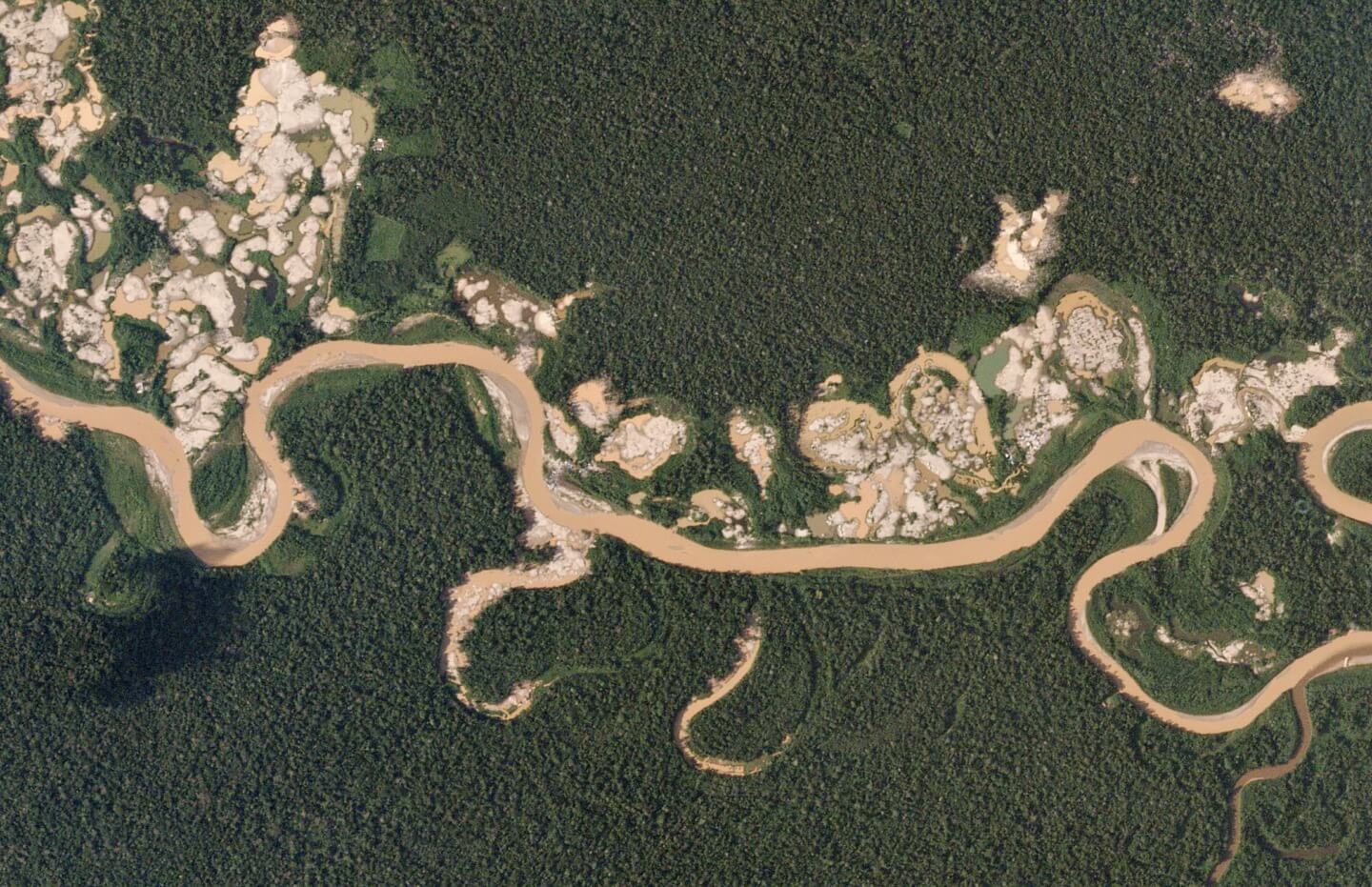
Editor’s Note: The opinions expressed here by the authors are their own, not those of impakter.com — In the Cover Photo: Illegal mining in Peru, Jan. 29, 2016. Cover Photo Credit: Planet Labs.