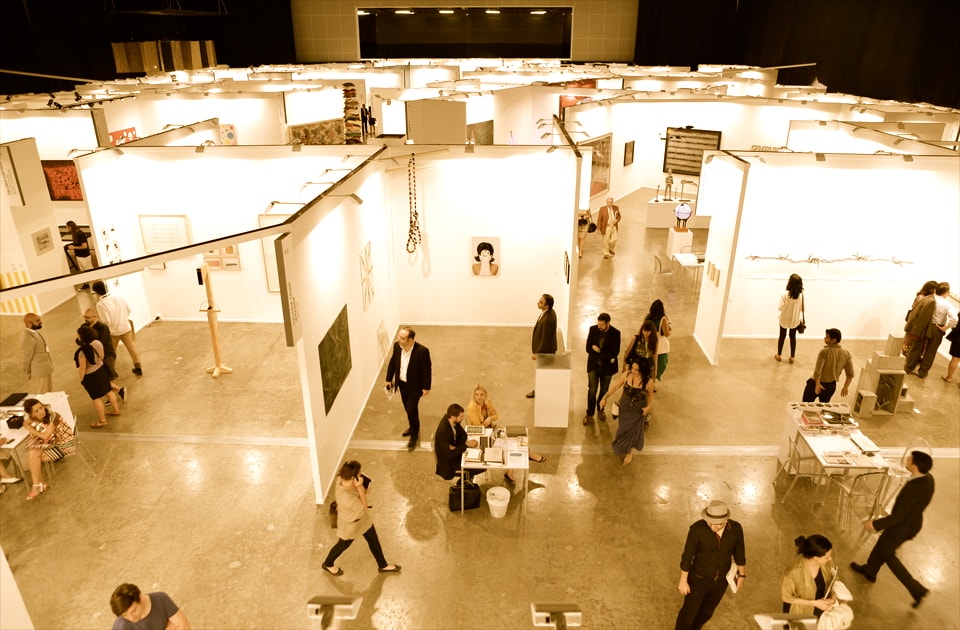

This year the Art Dubai fair broke the mold. One of the most important art events in the Gulf region, it took the daring step of inviting Onfair Young Collectors, a club of young art lovers from all over the world, to its 2014 edition. A group of Onfair members that included Ilaria Sgaravato, a Paris-based art and communications expert, visited Doha and Dubai discovering artists, museums, foundations and cultural events in their coolest moments, thanks to an interactive and ad-hoc program specifically organized by the Dubai fair’s VIP program.
They were given a unique chance to exchange ideas with Slavs and Tatars, a collective of artists focused on art from the Caucasus and Central Asia, who were enjoying a strong presence this year on the Art Dubai art scene, with the Third Line gallery hosting their first solo exhibition in the Middle East and a much talked-about curatorial début in the Marker section.

Language Arts 2014 – Installation view at The Third Line Dubai 3
The Slavs and Tatars’ work is based on researching territories and languages, a type of artistic intervention based on visual distortion and interpretation of the written language, supported through work expressed in different medias, materials and objects.
Ilaria Sgaravato (for OnFair Young Collectors): What is the mission behind your pieces of art?
Slavs and Tatars : Geographies are as political as they are poetic, real as imaginary. We founded Slavs and Tatars in 2006 for reasons that were both intellectual and personal. Of course, we are interested in researching an area of the world—Eurasia—that we consider relevant, politically, culturally, and spiritually. We take issue with various ideas: the positivism that seems to be so rampant in the West; the idolization of youth, coupled with the dismissal of age; an excessive emphasis on the rational at the expense of the mystical; the segregation of children from adults at social functions; splitting dinner bills; disproportionate attention to the individual over the collective.

Language Arts 2014 – Installation view at The Third Line Dubai 15
Today, we not only need intellectual acrobatics but metaphysical ones; substitution requires us to cultivate the agility, coordination, and balance necessary to tell one tale through another, to adopt the innermost thoughts, experiences, beliefs, and sensations of others as our own, in an effort to challenge the very notion of distance as the shortest length between two points. To illustrate our approach: to understand contemporary Iran, we looked at Poland and Solidarność (Friendship of Nations: Polish Shi’ite Showbiz); to grasp the nature of political agency in the twenty-first century, we studied Muharram and the 1300-year-old Shi’a ritual of perpetual protest (Reverse Joy); to demystify Islam, we turned to Communism (for Not Moscow Not Mecca at Vienna’s Secession); and it is through mysticism that we told an alternative version of modernity at the MoMA with Beyondsense.
IS : I am very interested in discovering how and if art could be a way of “saying things otherwise forbidden” : what do you think about the role of art in serving political/religious interests?
ST : We are shameless about the instrumentalization of art when it might serve another purpose, bigger than art itself. Our responsibility is to create larger discussions around thorny themes such as the role of faith in public life, language politics, the preservation of history etc.
IS : Is there space in Dubai for new emerging artists or non-conventional works that could potentially shock the Arabic culture?
ST : We’re certainly not interested in confrontation or art as controversy. It is not our task as artists to tell stories frontally. Rather, what many (mistakenly in fact) dismiss as Dubai’s neutrality or tabula rasa, can be seen as a particular strength today. If you look at the instability across the region at large, Dubai’s role and Art Dubai is a perfect case in point; it serve as ideal and urgent venues of exchange between those from the region or interested in it. Sadly, you simply couldn’t organize an event on a similar scale today in Beirut, Tehran, Cairo or Damascus, for a number of very different reasons.
IS : That’s an intriguing observation but I would like to focus on what you do. How did you decide to focus on languages and territories to create works of art?
ST : We actually first fell in love with these devastating tides of changes in language through an early political satire called “Molla Nasreddin”, named after the figure of the Sufi – we call him a Sufi superhero, a Sufi wise-man-cum-fool often depicted riding backwards on his donkey. Published between 1906 and 1930 in Tbilisi then Baku, “Molla Nasreddin” was perhaps one of the most important periodicals in the Muslim world of the 20th century. Running eight-pages, it was a political satire that was very progressive and fought for women’s rights. In fact Azerbaijan gave women the right to vote before France, the United States or the UK – not something you most firmly associate with a Muslim republic. On one page of this journal, you find three different scripts: Arabic, Latin and Cyrillic. For Trotsky and Lenin, the revolution in the East meant the Latinisation of the scripts of all the Muslim subjects of the Soviet Union, that is, of all of Central Asia and the Caucasus.
Interestingly enough, the Christians of the Caucasus–the Armenians and the Georgians–did not suffer this fate. Like Ataturk, the Soviets believed that that the best way to divorce Muslims from Islam and push them into modernity, would be to Latinize their alphabet, which they did in 1929. Ten years later, with the arrival of Turkey’s Romanisation programme, Stalin was afraid of Pan-Turkism so all the Soviet Muslims had their languages Cyrillicized. In 1991, with the fall of the Soviet Union most went back to Latin. So what you have now is a situation where three generations can speak the same language but cannot read the same book, making them immigrants in their own country!
IS: That’s amazing: to speak the same language, live the same culture and not be able to read the same books!
ST: Yes, and until recently, our investigation of language politics had been primarily within the former Soviet sphere. With the new body of work, which began at the Art Space Pythagorio (Long Legged Linguistics), continued at the Istanbul Modern and will find its next iteration at the Dallas Museum of Art, we extended this purview to the extremes of the Turkic languages: Xinjiang.
IS : What is the role of an art Fair, and in particular of Dubai art Fair in your opinion?
Art fairs are perhaps the exemplary modernist accelerator in so far as they establish and extend new networks within pre-existing ones. For us, there was a detournement – taking things that exist, whether it is representational work or a region that has been forgotten, and to use an art fair, which is said to be the most crass manifestation of market forces, to do this. And our arrangement – the tea salon – was an attempt to slow things down. We all know how time works in an art fair; you can only give two or three minutes to people! But this also relates to the perversion, the same weakness that both museums and art fairs share: there is nowhere to sit down, you cannot occupy the space, since it is more about passing through than contemplating.
IS: Thanks so much for talking to us and pointing out how important it is to slow down! That is how an art fair can actually play a transformative role in our lives and we, from the OnFair Young Collectors wish you every success in your attempts to make us stop and take the time to reflect.
Ilaria Sgaravato for OnFair Young Collectors