Over 50 million children, unaccompanied and separated, are on the move: A must be priority for the international community
Fifty million children around the world are on the move, fleeing from armed conflicts, violence, poverty and extreme weather.
In this kind of crisis, migrant children and women are the most vulnerable (especially those ones without documentation) to trafficking in human beings, abuse and exploitation in transit and destination countries. But, unaccompanied and separated children from their parents, family members or relatives on the move face added risk and challenges and are often in danger, particularly through irregular migration pathways.
The action of organised crime, dishonest relatives or gaps in asylum and refugee legislation and protection policies at borders or national territories leave minors moving on their own or with crooked adults at risk of suffering human rights violations and at situations of violence and armed conflicts. Some unaccompanied or separated minors on the move claim asylum (some of their applications are rejected) and others do not.
According to its report A Child is a Child: Protecting children on the move from violence, abuse and exploitation, UNICEF noted that at least 300,000 unaccompanied and separated children were recorded in some 80 countries in the combined years of 2015 and 2016, up from 66,000 in 2010 and 2011.
In addition, the report states that children account for approximately 28 per cent of trafficking victims globally. The Sub-Saharan Africa, Central America and the Caribbean count with the highest rates of children among detected trafficking victims at 64 and 62 per cent, respectively. It should be highlighted that as much as 20 per cent of smugglers have links to human trafficking networks.
The Office of the United Nations High Commissioner for the Refugees in Geneva defines an unaccompanied child as a person who is under the age of eighteen, unless, under the law applicable to the child, majority is attained earlier and who is separated from both parents and is not being cared for by an adult who by law or custom has responsibility to do so. Because of their vulnerability, unaccompanied children seeking asylum should not be refused access to the territory.
It should be noted that the United Nations Convention on the Rights of the Child, as well as the EU Charter on Fundamental Rights, declares that minors’s best interests must be a principal concern in all cases when considerating all children, whatever their citizenship (including stateless children) and residence status are.
There is a huge range of factors that explain why children migrate, especially on their own. As a significant example, relating to the Afghan unaccompanied minors leaving their country to Europe, the International Migration for Migration (The UN Migration Agency) states in its World Migration Report 2018 that children were motivated to engage in journeys due to a combination of interrelated factors including poverty, insecurity, inadequate opportunities for education and employment and family and peer expectations.
In many cases, the risks concerning the unaccompanied journeys are well known a priori, but they are eclipsed by the potential benefits of migrating, or because families feel that they have no other choice but to send their children.
Unaccompanied and separated children are entitled to particular protection under international and EU law (particularly the Dublin Regulation). In the meantime, international and EU law (1996 Hague Child Protection Convention and Brussels IIa Regulation) regulate which State’s authorities have the power to take measures on child protection and which law is applicable.
Since 2015, the European Union continues facing the effects of the largest refugee crisis since World War II with thousands of people fleeing from Africa, Asia and the Middle East in their look for a better and safer life.
It is really difficult to count with the exact figures for unaccompanied minors who have entered the EU due to the official registration procedures in some member States do not allow for their identification and entry routes, legal statutes and rights of child migrants may vary across them. International humanitarian actors and statisticians face difficulties to coordinate reporting on the number of unaccompanied and separated children on the move registered among mixed migration flows to the EU.
Children travelling alone are routinely denied entry to or detained by border or immigration officials in many countries. Sometimes, they are admitted but are denied access to asylum procedures or in other cases, their asylum claims are not handled in an age and gender-sensitive manner. Other countries impede separated children who are recognised as refugees from applying for family reunification. And, many children are granted only temporary status, which ends when they turn 18.
For this reason, this lack of coordination shows itself in figures inconsistency across various countries.
Disaggregated data for minors migrants by age, gender and information on who are they accompanied by, or not, are particularly important to determine potential levels of vulnerability during transit and on arrival and to inform policymakers about the different protection and integration needs of unaccompanied and separated children on the move. Nevertheless, complex realities on the ground make data gathering and analysis deeply challenging. Because of this, a significant part of child migrants is often invisible in data and policy. Data gaps leave also unaccompanied and separated children on the move without access to basic services.
The UNICEF, in A Child is a Child: Protecting children on the move from violence, abuse and exploitation, reported that 170.000 unaccompanied children applied for asylum in Europe in 2015-16 and furthermore, that minors travelling alone accounted for 92 per cent of all children arriving to Italy by sea in 2016 and in the first months of 2017. According to the European Commission, in 2017 there were 31.8 thousand applications for asylum in the EU-28 from unaccompanied minors.
Two years after the entry into force of the EU-Turkey Statement in 2016, thousands of forced migrants are still left in the lurch in Greece, waiting for a decision on their asylum claims. The increased number of asylum seekers arriving to the hot spots is worsening living conditions for people, where despite the law requiring that unaccompanied minors must be prioritized, they suffer threats and risks as if they were adults.
In this sense, unaccompanied minors on the move face the lack of enough specialized shelters for children, risky living conditions inside camps and unsupervised mixed stays with the adult migrant population, insufficiently resourced child protection systems, lack of coordination and cooperation among responsible actors and an inadequate relocation scheme. Limited reception spaces in hot spots with inappropriate conditions also leave children vulnerable to trafficking, labor exploitation, child abuse, rape and smuggling.
Unaccompanied and separated minors on the move may face the likelihood of extended administrative detention, in some cases lasting up to a year and long delays in relocation and family reunification procedures. For example, there have been allegations in Greece that 20% of unaccompanied minors disappear from reception centers within 24 hours of their placement (when the average stay is 60 days). These early departures can also be attributable to a distrust of regular asylum channels, fear of deportation and impatience with lengthy resettlement processes, rather than uniquely linked to abductions or exploitation.
The unbearable disappearance of an estimated 10,000 unaccompanied children in Europe in 2016 captured international media headlines. In this regard, EUROPOL noted that they were likely being exploited by smugglers, including for the purposes of labor and sexual exploitation.
Advocacy and call to a stronger action to international community, international organisations and states is essential to protect children on the move. Policies, legal pathways and programs need to be put in place to meet their needs. Children´s protection and the guarantee of their human rights, no matter where they come from, is essential to achieve the Sustainable Development Goals and a peaceful and humanity world.
No child must be left behind.
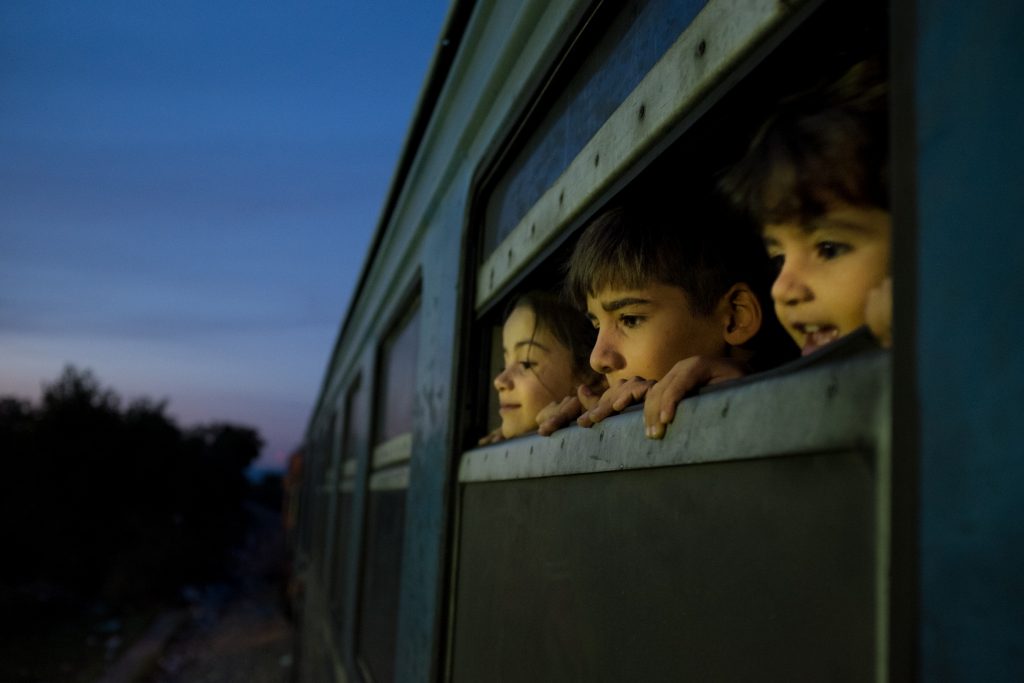
Editors Note: The opinions expressed here by Impakter.com columnists are their own, not those of Impakter.com – Photo Credit: UNICEF/Ashley Gilbertson VII – In the former Yugoslav Republic of Macedonia, three children look out of the window of a train, which was boarded by refugees primarily from Syria, Afghanistan and Iraq, at a reception centre for refugees and migrants, in Gevgelija.