
The Western Sahara scandal. The last colonial war in Africa is still unresolved, in spite of over 40 years of efforts on the part of the United Nations. A people has been destroyed, its rights to its native soil confiscated, half of its people living in refugee camps – three generations now that have never known a normal, free life – while the rest barely ekes out a living in the barren eastern part of the country, just beyond a Berlin-like wall built by the occupant, Morocco.
And all the riches of the country from ocean fisheries and phosphate mining go to Morocco, leaving not a cent for the native people of the Western Sahara, the Sahrawis.
 |
||
|
The Berm divides the country: Morocco controls the area to the West, the Polisario to the East. Source: Kmusser |
Morocco has brought into the country some 350,000 Moroccan immigrants; they help exploit the phosphate mines and have even set up modern agricultural infrastructures producing tomatoes, while the exploration rights to oil recently discovered in the ocean have been sold to Americans. The Moroccan tomatoes bought by Europeans are often in fact grown in the Western Sahara.
Who knew?
Actually, nobody knows. Or cares. This is an international scandal, one of the worst offenses against human rights and human dignity. And a conspicuous United Nations failure.
How did it all start?
With a war in the Western Sahara when the former colonial power, Spain, withdrew, handing over the administration jointly to Morocco and Mauritania. War started when the Polisario, seeking independence for the country,established in 1976 a Sahrawi Arab Democratic Republic (SADR) with a government-in-exile in Tindouf, Algeria. The Polisario bravely fought on, until Mauritania was pushed back and a cease-fire was brokered by the United Nations in 1991 and a referendum planned to enable the Sahrawi to chose between independence or integration with Morocco.
So far, the vote hasn’t taken place and Morocco remains put, occupying the whole western half – some 80 percent of the country – where the only sources of income are located, fisheries, phosphates and recently, oil. Thus, the Sahrawis are left totally destitute and over 100,000 fled in refugee camps in Algeria, near Tindouf. According to the UNHCR, the UN Refugee Organization, there are presently some 165,000 refugees in five camps that offer little opportunities for the young. They even lack playgrounds:
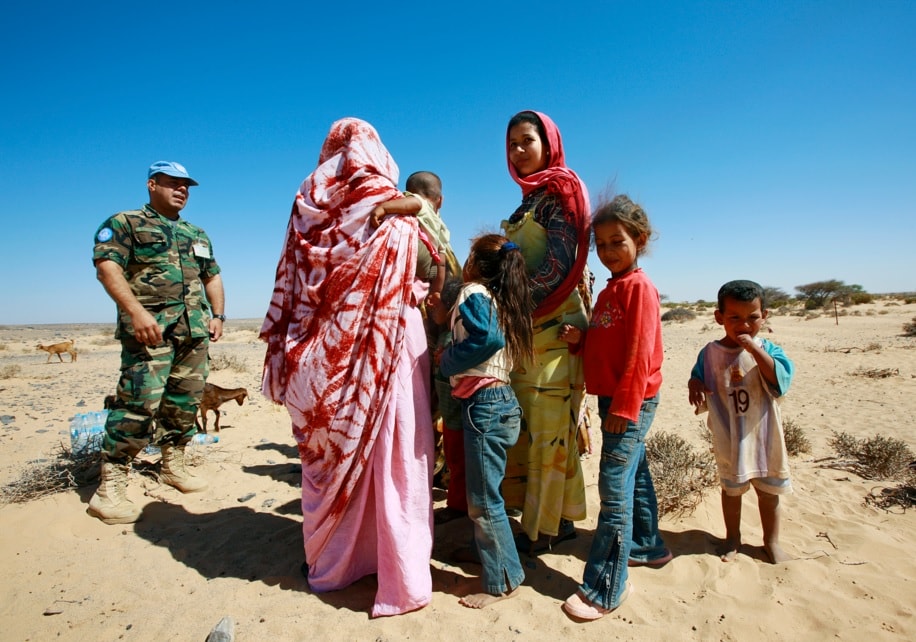
In the picture: MINURSO Officer Meets Western Sahara Locals – A member of the UN Mission for the Referendum in Western Sahara (MINURSO)’s Military Liaison Office chats with a group of local Western Saharans. 17 June 2010 – Western Sahara – Credit: UN Photo/Martine Perret
Refugees thus barely survive with a minimum of aid from the World Food Programme, mostly grains, no vegetables or fruits with, as a result, a large number of children suffering from stunted growth.
And the international aid diminishes each year, as the world’s attention is deflected to other more “sexy” emergencies, like the continuing one in Syria or the earthquake in Nepal that has recently filled headlines. Aid to Sahrawi refugees now stands at some US$30 million.
Thirty million. That’s as much as Morocco is getting for the rights to the Western Sahara’s fisheries it has managed to sell to the European Union.
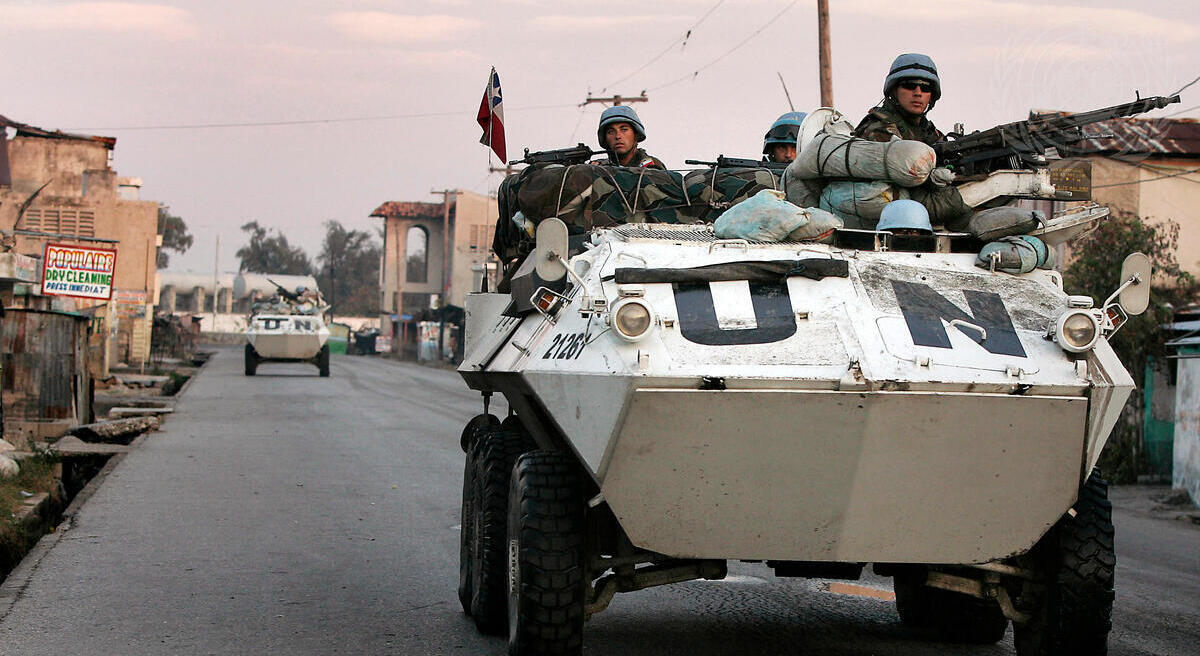
And that’s half the yearly cost of MINURSO, the UN force set up in 1991 to watch over the cease-fire – some 250 soldiers camped near the wall that divides the country. MINURSO’s mandate has just been renewed by the UN Security Council on 28 April 2015 for another year – yet without any modification to its mandate which is simply “reporting” if it sees any cease-fire violation with no ability to intervene. And worse, no requirement to report and intervene in the case of human rights violations – something that in principle should be possible because Morocco has signed all the human rights international agreement and is supposed to respect them. But the question does not even arise since MINURSO’s mandate doesn’t cover this kind of situation.
A blatant injustice.
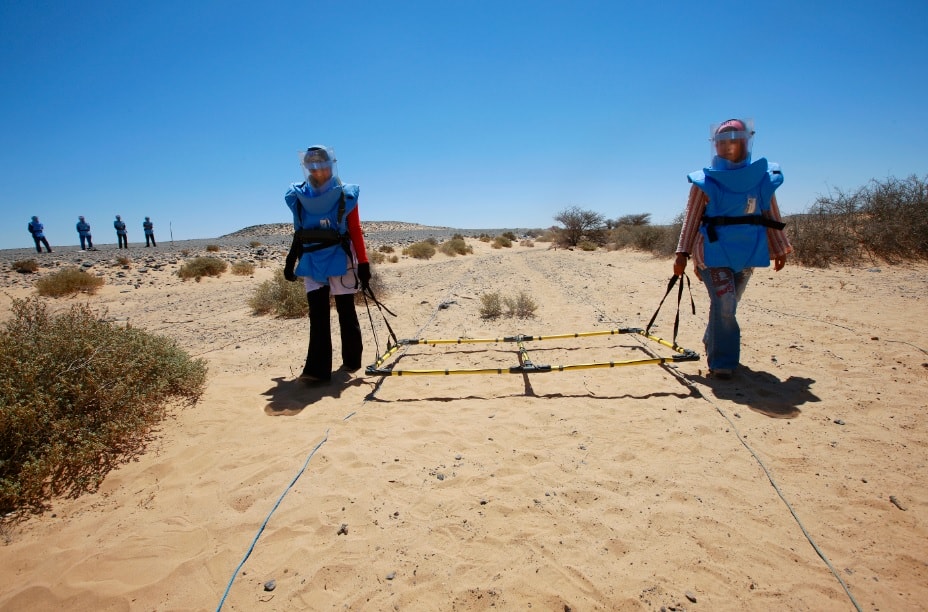
In the picture: UNOPS Contracts Specialists to Eliminate Mines in Western Sahara – Women Battle Area Clearance (BAC) operators from non-governmental organization Action on Armed Violence, working under a contract from the United Nations Office for Project Services (UNOPS), use a large loop detector to locate mines in Mehaires, Western Sahara. 17 June 2010 Mehaires, Western Sahara – Credits: UN Photo/Martine Perret
Forty years. That’s how long it has taken the United Nations (and the international community) to get exactly nowhere.
Why?
UN incompetence? No, UN staff, when interviewed in the media (for example by ARTE TV in a film released in April 2015) express their dismay and desire to see the situation resolved. In fact, the United Nations classifies the Western Sahara as a “non self-governing territory.”
The blame must be laid where it belongs.
One, general indifference. The media doesn’t talk about the Western Sahara, it’s a boring subject when Libya and Syria are falling into chaos, flows of immigrants are dying in the Mediterranean, refugees are over-running Europe and Nepal is shaken by an earthquake milling thousands of victims and destroying UNESCO heritage sites. And yet, human rights organizations are far from silent, dozens have accused Morocco of human rights violations, from Amnesty International to Human Rights Watch. It is true that the Polisario has also been accused of mistreating Moroccan prisoners by France Libertés, but attempts by Morocco to get the Polisario classified as a terrorist organization by the United Nations have never worked. Still, indifference in the international community prevails.
Two, private interests. For example, it suits the European Union to pay those (rather modest) fishing rights to Morocco and European fishing fleets are going at it with a vengeance: the ocean in front of the Western Sahara is now seriously over-fished. And America has to think of exploiting the newly discovered oil fields. And the phosphate mines are among the most important in the world. Also, Morocco has a strong international presence and is a traditional partner protected by France.
In short, two of the countries that hold veto power at the UN Security Council, the United States and France have absolutely no interest to see any change to the situation in the Western Sahara. Nor does the European Union.
A conspiracy of silence.
For how long?
The ARTE TV documentary suggested that the young generation of Saharawis is losing patience. These are young men and women born in the refugee camps, those who have never known anything else since their fathers and grandfathers were the first refugees. They are often highly educated, some 10 percent of the young are reportedly managing to get university degrees in Europe. This is a little like the Palestinians, also born in refugee camps and often highly educated.
In fact, the Sahrawis distinguish themselves in Africa for being a well educated population (95% is alphabetized vs. 50% of Moroccans). They also practice a soft, liberal form of Islam, with women playing a strong role. It seems this is a Sahrawi tradition, perhaps reinforced by the experience in refugee camps where women call the shots; they are the ones who organize the distribution of aid, making sure it is fair and that no family goes hungry. Finally, the Polisario army is still active and training daily: the Sahrawis haven’t given up on their military tool yet but they – for the time being – prefer diplomatic tools and hope that some day soon, the international community will wake up and help them solve the problem. The Polisario has won formal recognition for the SADR from 86 states including South Africa, it maintains diplomatic relations with 40 states, and is a member of the African Union.
For the time being, the only European citizens who seem to worry about the Sahrawis and publicly side by them are the Spaniards:
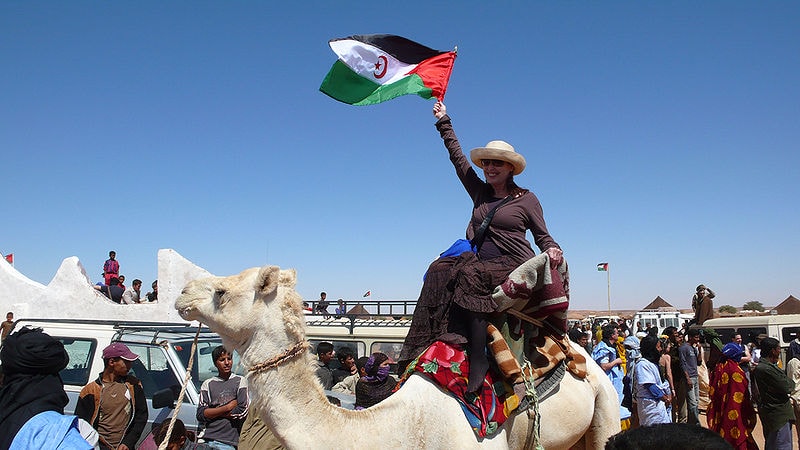
In the photo: The Spanish actress Veronica Forqué at the Sahara Film Festival, waving the Sahrawi flag
How long can we make them wait before the situation blows up?
The UN Secretary General is well aware that the clock is ticking. On 4 November 2015, he called on all concerned, within the region and the wider international community, to take advantage of the “intensified efforts” of his Personal Envoy to facilitate the launching of true negotiations in the coming months. Morocco’s King swiftly reacted, stating in the course of a surprise visit to Western Sahara’s Laayoune (his third visit since he succeeded to the throne in 1999) that he would not compromise on Morocco’s claim to sovereignty over the Western Sahara and vowing that he would offer no more than autonomy.
In short, they are back to square one.