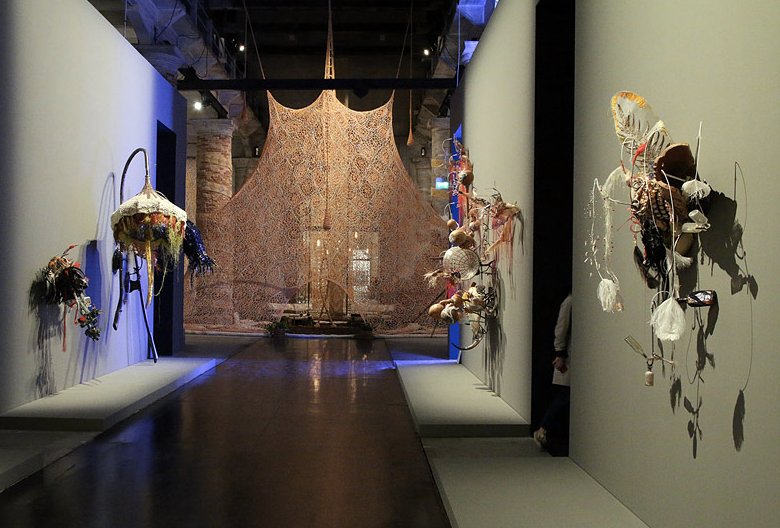

“For me the worst thing would be indifference”, said Christine Macel, director of the 57th Venice Biennale, in an interview with New York Times’ Rachel Donadio. Viva Arte Viva is the theme for this year’s Biennale and presents a passionate outcry for the value of artists and art work. Paolo Baratta, the President of ‘La Biennale di Venezia’ deconstructs this exclamation explaining that,
“this year’s Biennale Arte is dedicated to celebrating… the very existence of art and artists, whose worlds expand our perspective and the space of our existence. Christine Macel has called it an Exhibition inspired by humanism. This type of humanism is neither focused on an artistic ideal to follow nor is it characterized by the celebration of mankind as beings who can dominate their surroundings. If anything, this humanism, through art, celebrates mankind’s ability to avoid being dominated by the powers governing world affairs.”
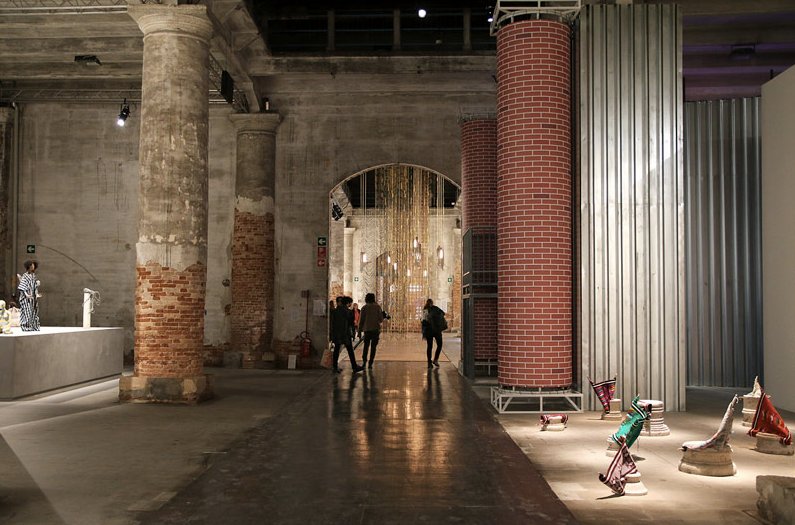
In the Photo: View of the Arsenale Photo Credit: © Haupt & Binder
In Macel’s Biennale, artists are championed as leaders promoting the dispersal of ethical ideals and contemporary values of inclusivity and endurance. Clearly, this optimism starkly contrasts the tone of the 56th Biennale’s apocalyptic ‘age of anxiety’ theme demonstrating a new emphasis on rebuilding communality by means of artistic thought and labour.
Related Article: “VENICE BIENNALE: ‘VIVA L’ARTE’ OR ‘L’ARTE VIVA’?“
Macel wants to celebrate art’s role in the socio-cultural hierarchy as the ultimate space for reflection, individual expression, and exploration of both dreams and utopias. This coming from an institution that is meant to be both representative and contemporary, seemed like an ambitious endeavour but as I digested these concepts, I became sceptical.
Why is Macel philosophizing the role of art and connecting it to an outdated and essentially un-inclusive concept of humanism, when her overall goal is to promote communal action and move away from the personal interest and autonomy that humanism stands for?
Macel explains in various interviews that art should be used as a tool to seek out alternative methods for ‘peaceful coexistence’. But if these alternatives are founded in old-world humanism, that excludes and ignores socio-cultural diversity, then how can an outdated ideology define a peaceful future world? Despite this double standard, what alarmed me was the disconnect between the critical thematic tensions of her neo-humanist argument and substantive or relevant political comment. Further, the lack of diversity amongst the 120 artists selected for the main curated exhibition was not surprising and somewhat upsetting: the gender parity was bad and racial metrics even worse with only five black artists selected.
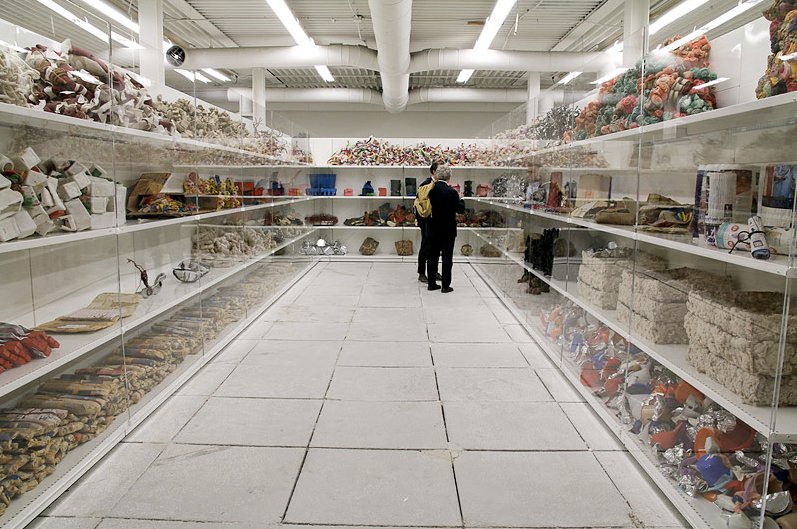
In the Photo: Hassan Sharif Studio, Supermarket (1990 – 2016) in the Pavilion of Artists and Books. Photo Credit: © Haupt & Binder
While queuing outside the German Pavillion, I browsed some of the free and abundant art publications that were laying around. I read Monopol magazine where I found yet another interview with Macel, quoted and emboldened centre page was:
Art is a place which utopian models can be developed without efficiency-oriented thinking.
Again, I was surprised by this contradictory argument. If the role of art is to seek out positive future solutions, then how can nonefficiency-oriented thinking hinder that process? What are we supposed to use in its place? I find it hard to believe that we can have a serious discussion about art’s role in creating a better future if the language we use is grounded only in generic ideological and utopian concepts. Paired with Macel’s explanation of artistic labour being a twofold process that must privilege time spent idle, this just seemed like another loosely applied concept borrowed from Nietzsche.
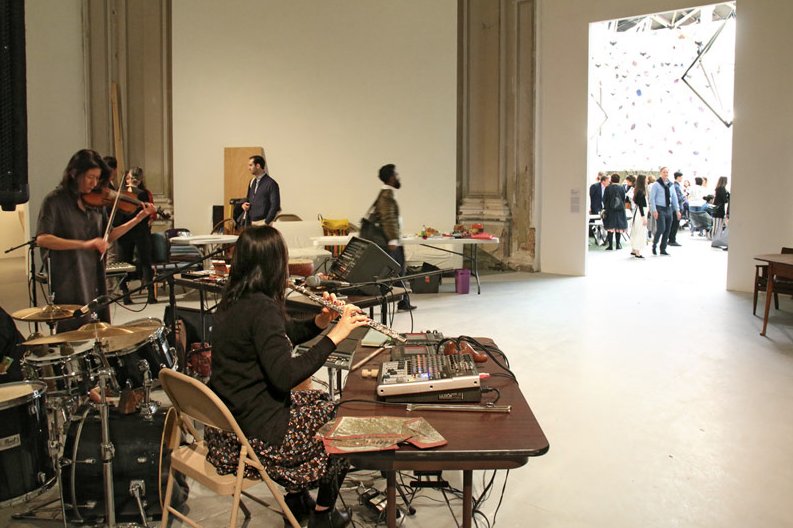
In the Photo: Dawn Kasper’s The Sun, The Moon, and The Stars. (2017) Performative Installation in the Pavillion of Artists and Books. Photo Credit: © Haupt & Binder
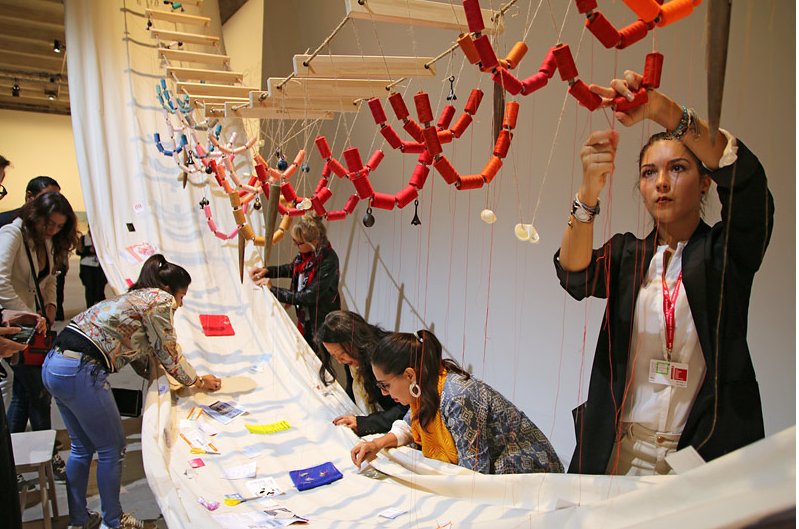
If Macel believes artistic idleness will build a peaceful future, then I hope that other artists besides the ones hired to set up makeshift studios in the ‘Pavilion of Artists and Books’ – such as Dawn Kasper, with her six month live work studio performance – are actively pursuing art as a vehicle for social development. Kasper’s work, The Sun, The Moon, The Stars (2017), heralds the notion that artists themselves are the substance of this exhibition and are genuinely working towards solutions by highlighting concepts of intellectual and artistic labour. Although this labour is central to her work, it was hard not to ultimately think of it as a demonstration of purposeful inactivity and idleness.
This performance championed by inactive artists parallel the individuals in the next room, part of Olafur Eliasson’s Green Light Project, where a group of newly arrived refugees living in Venice are hired to work on a social co-operative project manufacturing green lamps. The project is in essence politically charged, making a public statement on refugee contribution to society and to sustaining refugee aid globally (the funds raised go towards a Refugee Aid NGO). Although the Green Light project incorporates more than just the lamp-making, many critics have found it disturbing that these individuals are essentially on display to be gawked at and photographed by art tourists.
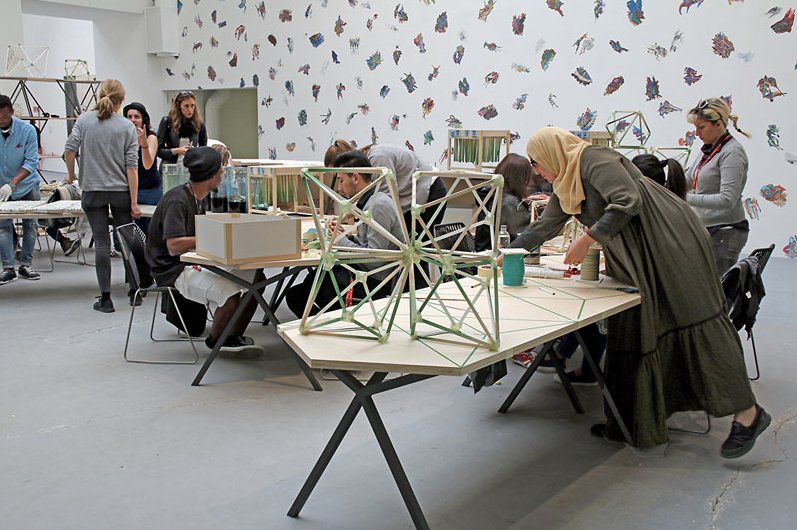
In the Photo: Eliasson’s Green Light – An artistic workshop. (2017 ) Refugees, migrants, asylum seekers and students, as well as the public, are invited to assemble lamp modules based on elements created by the artist. Photo Credit: © Haupt & Binder
Art that emphasizes collaboration and social co-operation is often well intentioned but to me Eliasson’s project lacks depth and appears banal compared to other less publicized projects, such as US artist Mark Bradford’s Process Collettivo. The project is part of a non-profit cooperative Rio Terà dei Pensieri that Bradford funded for the next 6 years and engages with the Venetian community by addressing the rarely discussed potential positive impact the Biennale could have locally. The cooperative’s activities include: the cultivation of a vegetable garden and the sale of clothing, bags, accessories, and cosmetics all crafted by the inmates of a women’s prison. Process Collettivo aims to raise awareness of problems in the penal system on a local and international level while promoting the reintegration of former inmates in and around the region of Veneto.
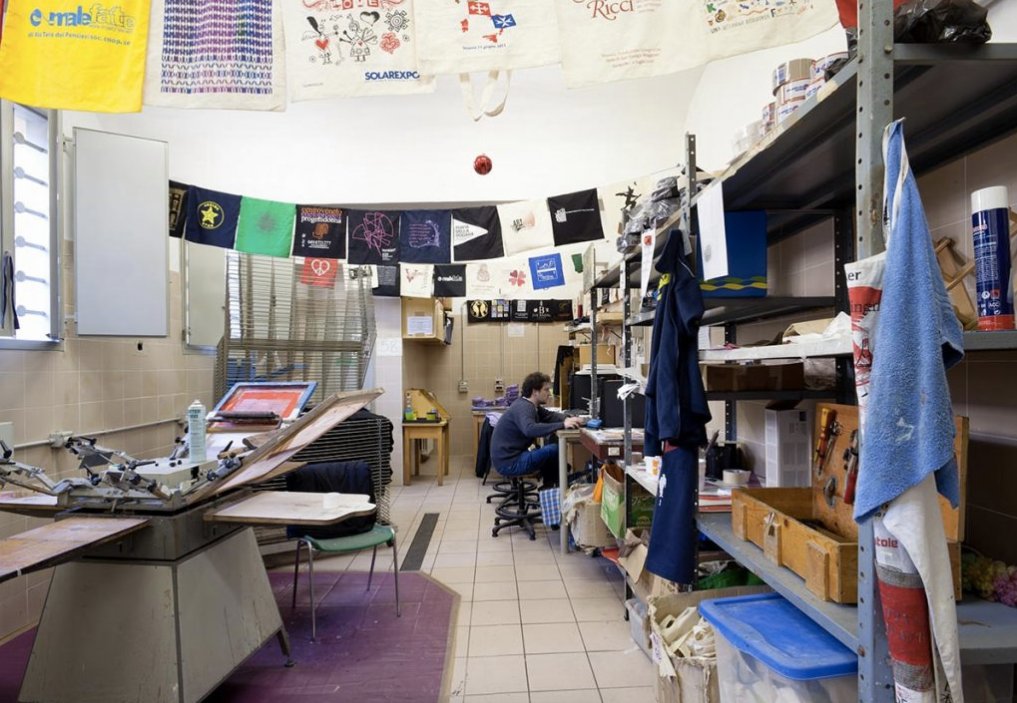
In the Photo: Rioterà dei Pensieri Venezia, Silk Screen Lab, Process Collettivo Photo Credit: Umberto Ferro
This year’s Biennale seems to be full of extremes and contradictions which makes sense considering the scale of the exhibition. Macel introduces relevant concepts regarding the power of art to speak to the masses, but the murkiness of her curatorial agenda’s attitude towards any substantive or relevant political comment left me not quite indifferent to her curation, but rather confused about the point of her exhibition.
Art should be celebrated but Viva Arte Viva doesn’t seem to celebrate the right aspects, focusing on an art that feels exclusive and entitled. Curation seems like an impossible task especially on such a grand scale, but the task is in itself a political one.
Macel took on the massive task of curating an exhibition that highlights the role of art as a tool in forging a peaceful future, but ended up creating a mixed affair that failed to saliently address feminism, post- colonialism, shamanism or any of the other ontological-isms she superficially wanted to confront.
As an artist and citizen, I believe that we can and must do better to ensure that art remains open and free, but most importantly, critical of our current global political, cultural and social crises. Viva Arte Viva does not penetrate the bubble of consumption but remains in the vast pluralist pond of images we see in everyday life. Self-reflection is necessary to move forward and only when artistic institutions reassess their impact universally, can constructive change resume in the art world.