There are eight years left until the Sustainable Development Goals’ objectives are due, and it’s still a long distance to cover to achieve them. The challenge concerning SDGs is that it won’t be enough to achieve some of them and continue to pursue the rest after 2030, as they are all deeply interconnected and hence affect one another.
Today is World Water Day, and as Impakter already announced, the international community has gathered in Dakar for the 9th World Water Forum to discuss pathways to achieve the 6th SDG, which reads: “Ensure availability and sustainable management of water and sanitation for all”.
Hopefully, global leaders meeting in Dakar will recognize that there is much more at stake than one SDG: arguably, the future of sustainable development depends on water.
One can convince oneself of this reality by analyzing other goals, imagining to achieve them without access to water and sanitation. The third goal is concerned with well-being and health: how can one be in good health if water is scarce? The seventh demands affordable and clean energy, another resource that relies on water: how could societies use the water needed for these services if they don’t have enough to drink or clean?
World Water Day in action: What less water implies
Many international actors are at the forefront to overcome this challenge: Impakter already discussed the role of the UN based on the latest UNESCO World Water Development report, which focuses on groundwater.
The World Bank is another key player in this fight. Its research focused on water highlights the strong link between safe access to clean water and other indicators of sustainable development.
In particular, water is essential to ensure sanitation and hygiene, which in turn reduces the impact of pandemics. Infectious diseases, in addition to directly compromising human health, thrive on unsanitary conditions to expand and strengthen.
This will not only cause more people to die in the short term but it will also compromise the long-term stability and economic growth of a community, generating a loss in aggregate quality of life.
Access to water interacts with economic tenure also from other aspects, like water-related losses in agriculture.
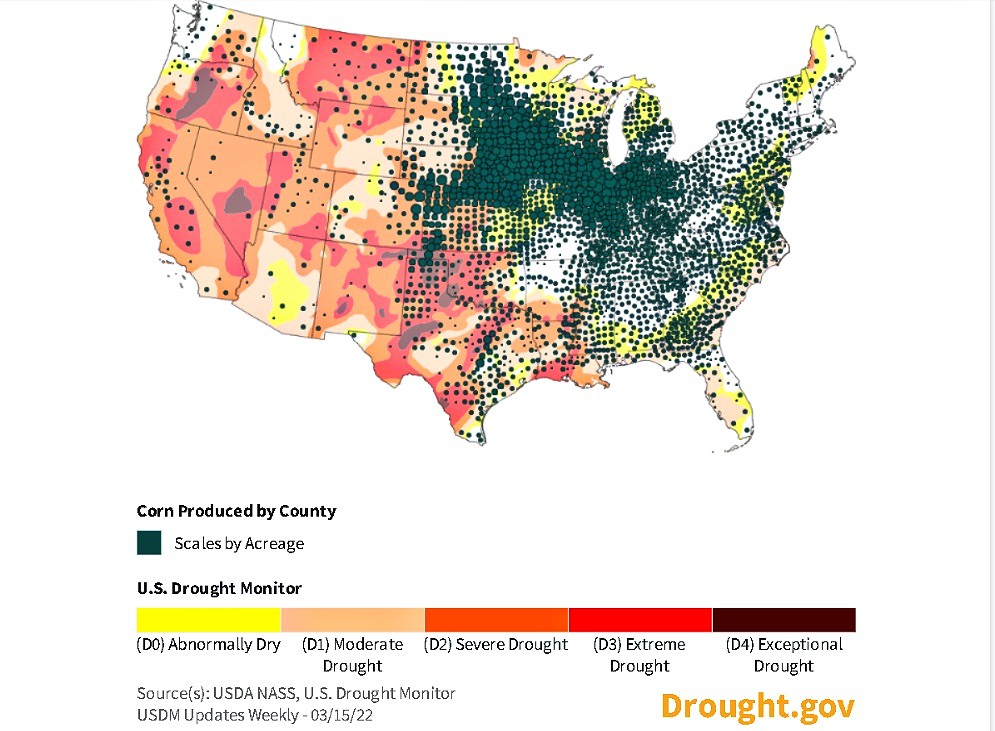
An example of the entity of such a phenomenon is revealed by the analysis of the US National Integrated Drought Information System (NIDIS), which conducts hundreds of surveys on products like corn or wheat. It also monitors the drought level in the country, through the US Drought Monitor service.
The map below, based on an analysis carried out two weeks ago, shows that most of the west of the country is affected by severe (in red), extreme, or even exceptional (dark red and brown) drought.
Another aspect is climate change: 9 out of 10 natural disasters are water-related.
The way water shortages affect food production through agriculture has also an environmental impact: Droughts can reduce the extension of fertile land permanently, putting at risk the stability of ecosystems. Moreover, plans to reduce GHG emissions rely on water to succeed, as all alleviation measures require water to be put in place.
Widespread sanitation, sustained by safe access to clean water, is therefore shown to have an impact on health, economic growth, and the environment.
To safeguard these three SDGs footholds, the World Bank has structured a Global Water Security & Sanitation Partnership (GWSP) built on five thematic priorities:
- Resilience: In this context, resilience implies that society is ready to cope with environmental crises and adapt to their consequences;
- Sustainability: Whatever measure is implemented to solve water-related problems, it has to be sustainable in the long term; ad hoc, one-time solutions will just postpone the problem, enlarging it as time passes;
- Inclusion: 2 billion people still lack safely managed drinking water; therefore all plans must include provisions to prioritize the expansion of water availability to the widest audience possible in the fastest way;
- Institutions: They remain the guardian of policies as they are implemented, and are therefore necessary to ensure their effectiveness;
- Financing: Availability of substantial funds is an indispensable condition to achieve all other thematic objectives and in turn, come closer to attaining Goal 6.
This last point is probably the most important and is the only one that is not connected to the others if not for the fact it is a necessary condition for their fulfillment: It’s not gravity that makes water flow, but the availability of funds. It is therefore vital that global actors invest in the creation of partnerships and alliances geared on raising resources to finance SDGs’ attainment.
What else can be done for water
Keeping the focus on water, another prominent organization working on this emergency is the World Water Council. This organization is an international multi-stakeholders platform designed to foster enhanced debate to structure effective decision-making. The Council is also the organizer of the World Water Forum.
The World Water Council develops strategies to tackle water-related issues in many macro sectors, but two are the most essential: Fostering water security and financing water infrastructure.
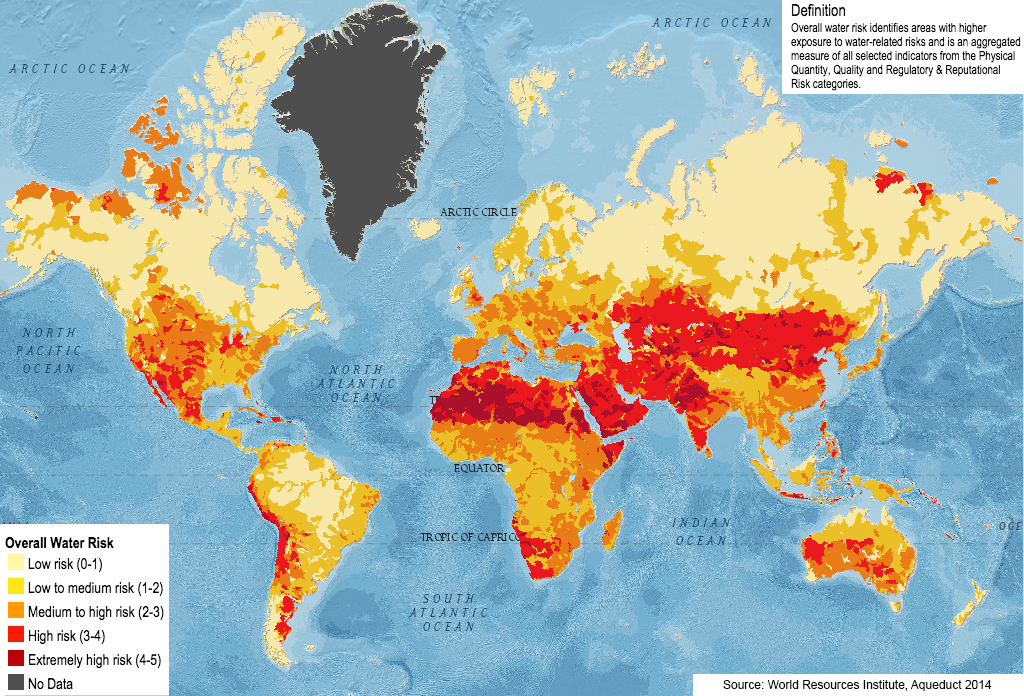
Water security is an indicator of the capacity of a population to attain sustainable quantities of acceptable quality water. As the graphic below details, almost every country is at least subject to a medium/high risk in the quantitative and qualitative provision of water.
The Council proposes a wide set of policy recommendations to confront the phenomenon:
- Different public policies may be impacting on water resources without coordination; institutional centralization of policy action is therefore a necessary step to obtain a meaningful evaluation of performance and to sustain action in the long-term;
- Value local approaches: Water needs vary depending on the specific community, therefore putting emphasis on local voices is a recipe for success;
- Look for lessons in extreme events: These crises have in fact their roots in long-term poor water management, and are, other than tragedies, a harbinger of future structural fallacies.
Achieving water security requires appropriate investment in infrastructure, capacity building, and project development. To achieve SGD goals by 2030, investment needs to increase by approximately one trillion dollars per annum, of which water infrastructure accounts for around one-fifth of the total.
Main policy proposals to shorten the financing gap are:
- Develop a typology of water infrastructure projects and investors; this will help to align specific projects with the most appropriate funding available, by making relevant actors agree on a codified typology of water infrastructure using multiple classification layers;
- Improve project selection and development: Some actions to reduce the financing gap do not require additional finance, such as improving upstream development, portfolio optimization, investments in design and planning, and current asset utilization (getting more out of existing projects);
- Revisit tariffs, taxes and transfers (3Ts): This will help to unlock more funds removing financial barriers, through revisiting tariff structures based on user volumes or social tariffs; reliance on hypothecated taxes, i.e. dedicating the revenue from a specific tax for a particular expenditure purpose rather than let it go to a common fund managed by the government and this should apply to property values enhanced by new water infrastructure, with the overall objective of obtaining financial transfers that contribute to mitigating climate change.
All these actions need to be implemented fastly and strongly. As the UN SDGs reports: “129 countries are not on track to have sustainably managed water resources by 2030, the current rate of progress needs to double” (bolding added). The world has to hope that leaders gathered in Dakar are aware of the entity of the challenge they are faced with and what is at stake.
According to the Ancient Greek philosopher Taletes, deemed by many to be the first philosopher ever active on earth, water is the primitive element present in all things. Water to him was the essence of life, its defining characteristic. Today, more than 2500 years later, we may have discovered much more than he knew, but seem to have understood the world much less than he did.
Editor’s Note: The opinions expressed here by Impakter.com columnists are their own, not those of Impakter.com — In the Featured Photo: Water. Featured Photo Credit: Wikimedia Commons.