
Impakter
  • Environment
    • Biodiversity
    • Climate Change
    • Circular Economy
    • Energy
  • FINANCE
    • ESG News
    • Sustainable Finance
    • Business
  • TECH
    • Start-up
    • AI & Machine Learning
    • Green Tech
  • Industry News
    • Entertainment
    • Food and Agriculture
    • Health
    • Politics & Foreign Affairs
    • Philanthropy
    • Science
    • Sport
  • Editorial Series
    • SDGs Series
    • Shape Your Future
    • Sustainable Cities
      • Copenhagen
      • San Francisco
      • Seattle
      • Sydney
  • About us
    • Company
    • Team
    • Global Leaders
    • Partners
    • Write for Impakter
    • Contact Us
    • Privacy Policy
No Result
View All Result
Impakter logo
No Result
View All Result
World Economic Forum 2022: Not All Major Issues Addressed

World Economic Forum 2022: Not All Major Issues Addressed

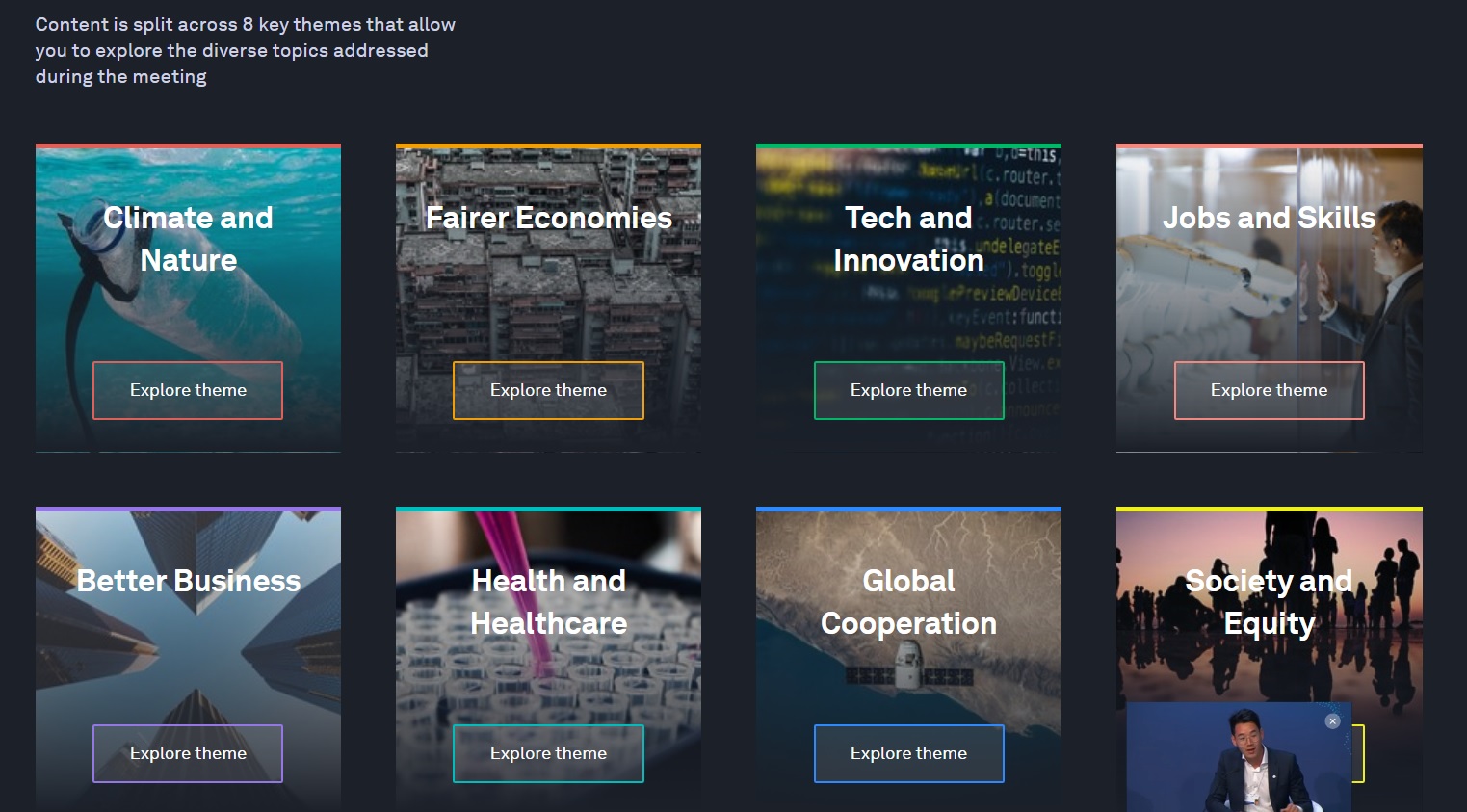
Eight “key themes” are covered, from climate change to equity but One Health is not treated as a separate agenda item 

Richard Seifman - Former World Bank Senior Health Advisor and U.S. Senior Foreign Service OfficerbyRichard Seifman - Former World Bank Senior Health Advisor and U.S. Senior Foreign Service Officer
May 24, 2022
in Health, Politics & Foreign Affairs
0

The World Economic Forum (WEF) is when political, economic, industrial, academics, and non-profits leaders from around the world gather annually in Davos, Switzerland. Today, it has begun its 2022 meeting that will last until May 26, with some 2000 participants in attendance, including Ukraine’s President Zelensky in a video appearance, calling for global help “as fast as possible”. And as always, it covers many crucial topics on its priority global agenda, each of which bears on our common security and stability. 

Eight “key themes” are covered, as shown on the WEF website:
Its 2021 WEF annual meeting dealt with global health and provided excellent and thoughtful linkages and graphs that reflected in-depth insight into the many elements that affect it: Called “Shaping the Future of Health and Healthcare”, it was a platform on the WEF website (see here).

This year, at least with respect to the WEF website’s detailed agenda and global health, it is hard to gauge if there is a continuation of 2021’s efforts because it appears principally under the agenda item,  “4 reasons to be optimistic despite current challenges“. One of the four reasons is: “Pandemics, environmental factors, and geopolitical tensions are all affecting progress on global health”.

This is described as a “global health” priority issue, in the following terms:

” Global health as a global priority

“The pandemic has transformed the way that individuals, companies, and governments think about health and particularly public health. Companies from outside the health sector – those who have no commercial interest in selling health-related services and products – recognize more than ever that health is critical to their economic performance. That brings new thinking and new expertise into the health space. We’re also seeing new interest in the way that investors think about the role of companies in relation to health disparities, such as through the Global Health Equity Network.”

While this is certainly one valid and relevant way to consider global health, it misses much broader and more inclusive challenges in dealing with the health interface between humans, animals, plants, and ecosystems, known as “One Health“. 
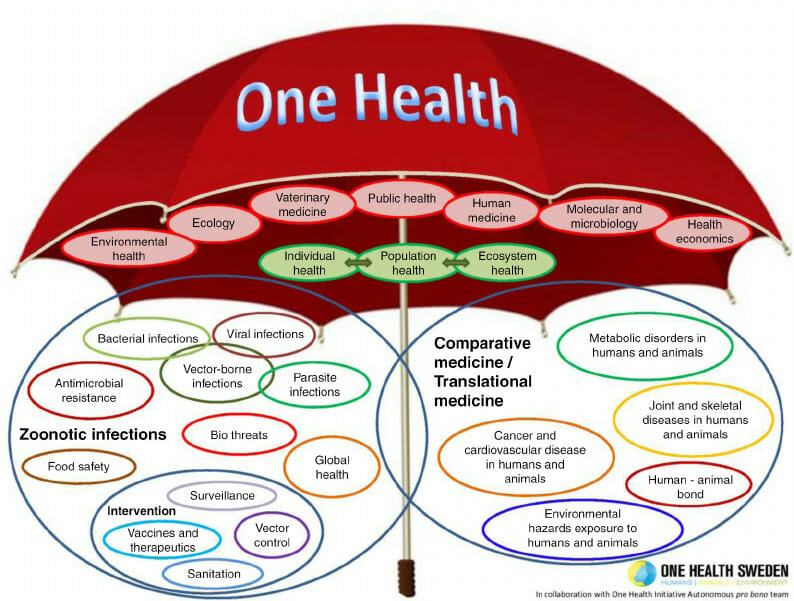
The One Health concept  was accepted and reflected in the communiqués of last year’s G7 and as recently as October 2021 when the G20  decided to create a joint Finance-Health task force for the purpose of promoting collective action based on a One Health approach:

 “…a G20 Joint Finance-Health Task Force (the Task Force) aimed at enhancing dialogue and global cooperation on issues relating to pandemic PPR, promoting the exchange of experiences and best practices, developing coordination arrangements between Finance and Health Ministries, promoting collective action, assessing and addressing health emergencies with cross-border impact, and encouraging effective stewardship of resources for pandemic PPR, while adopting a One Health approach.”

The notion of international collective action using a One Health approach arguably is the best, most efficient way to address critical infectious diseases, whether the current Covid pandemic or future pandemics. 

These G20 policies and task force pronouncements coupled with new financial commitments by developed countries and institutions are very important steps forward. 

But neither the policy recognition nor heightened funding should be considered “Mission Accomplished”. Rather, such positive steps must be translated into concrete actions by the public and private sectors, at international, regional, national, and sub-national levels, and continued at the highest levels so that One Health warrants consistent and sustainable support. 

As Dr. Leo Poon, the head of the division of public health laboratory science at the University of Hong Kong, a place where COVID outbreaks have been massive in an urban setting, put it in a recent article in the Washington Post:

“We really have to highlight the concept of one health. It’s not only about human health. We have to consider the health of animals and the environment. And if you don’t look after these areas, we are the ones that suffer in the end.”

Because global health is much more than an industry matter, and One Health is critically multi-sectoral with implications much beyond the human health sector, it should be given its own space on the WEF agenda. 

Let us hope that this year’s discussion will include in-depth treatment of One Health, and a commitment that next year’s planners give it separate billing and consider regularly having a separate and regular agenda item in the future.


Editor’s Note: The opinions expressed here by Impakter.com columnists are their own, not those of Impakter.com. — In the Featured Photo: 

Tags: One HealthWorld Economic Forum
Previous Post

5 Sustainable Ways to Care For Your Cats

Next Post

The Potential of Blue Carbon for Mitigating Climate Change

Related Posts

One Health
Biodiversity

Why and How to Apply the One Health Concept

One Health can be a complex and sometimes jargon-filled concept. Put simply: "One Health is the collaborative efforts of multiple...

byOne Health Initiative
November 6, 2025
Global Action Plan on Biodiversity and Health
Biodiversity

Global Action Plan on Biodiversity and Health: Why Implementation Can’t Wait

Last October, after six years of deliberation, the world adopted the Global Action Plan on Biodiversity and Health. The Plan...

byJessica Bridgers - Deputy CEO, World Federation for Animals
October 31, 2025
How Trump–Kennedy Policies Undermine Public Health — and How to Fix Them
Environment

How Trump–Kennedy Policies Undermine Public Health — and How to Fix Them

President Donald J. Trump’s well-meaning prospective “Make America Healthy Again (MAHA)” appointment of lawyer Robert F. Kennedy Jr. and blanket...

byBruce Kaplan
October 20, 2025
President Trump, Protect Your Historic Healthcare Achievement — Before It Is Too Late
Health

President Trump, Protect Your Historic Healthcare Achievement — Before It Is Too Late

A valid argument can be made for President Donald J. Trump’s May 2020 promotion of mRNA COVID-19 vaccines being a...

byOne Health Initiative
September 26, 2025
Is the United States Pulling Out of Global Pandemic Preparedness and Response?
Health

Is the United States Pulling Out of Global Pandemic Preparedness and Response?

In every country of the world, coordinating the response of public health authorities in a pandemic, ensuring that all the...

byRichard Seifman - Former World Bank Senior Health Advisor and U.S. Senior Foreign Service Officerand1 others
August 6, 2025
nature stress
Health

Can Nature Help Us Cope With Stress?

Daily news about domestic and international political tensions, rising authoritarianism, conflicts that morph into war, impacts of climate change, disease...

byRichard Seifman - Former World Bank Senior Health Advisor and U.S. Senior Foreign Service Officer
May 22, 2025
Bee populations
Environment

Bee Populations Are Declining Faster Than Ever Before

The phrase "the birds and the bees" is a story many parents tell their children to deflect the question, "where...

byRichard Seifman - Former World Bank Senior Health Advisor and U.S. Senior Foreign Service Officer
April 1, 2025
Why Worry About Anti-Science and Anti-Vaccines Attitudes and One Health?
Health

Why Worry About Anti-Science and Anti-Vaccines Attitudes and One Health?

A critical piece of the health education mosaic is awareness, acceptance, and implementation of the One Health concept/approach: “It will significantly help...

byBruce Kaplanand1 others
March 19, 2025
Next Post
The Potential of Blue Carbon for Mitigating Climate Change

The Potential of Blue Carbon for Mitigating Climate Change

Recent News

EU Parliament cuts corporate sustainability reporting; BlackRock relaxes ETF ESG exclusions; Aegon sets 2025 US growth targets; Google proposes adjusting EU AdTech policy.

EU Parliament Slashes Corporate Sustainability Reporting, Shaking ESG Landscape

November 17, 2025
ESG news regarding weakened EU sustainability laws, new metal-fuel funding, legal challenges to California climate rules, and Germany scaling back gas capacity plans.

Europe Retreats: Lawmakers Slash Corporate Climate Obligations

November 14, 2025
nature finance

New Tested and Scalable Investment Model Can Unlock Billions in Much-Needed Financing for Nature

November 14, 2025
  • ESG News
  • Sustainable Finance
  • Business

© 2025 Impakter.com owned by Klimado GmbH

No Result
View All Result
  • Environment
    • Biodiversity
    • Climate Change
    • Circular Economy
    • Energy
  • FINANCE
    • ESG News
    • Sustainable Finance
    • Business
  • TECH
    • Start-up
    • AI & Machine Learning
    • Green Tech
  • Industry News
    • Entertainment
    • Food and Agriculture
    • Health
    • Politics & Foreign Affairs
    • Philanthropy
    • Science
    • Sport
  • Editorial Series
    • SDGs Series
    • Shape Your Future
    • Sustainable Cities
      • Copenhagen
      • San Francisco
      • Seattle
      • Sydney
  • About us
    • Company
    • Team
    • Global Leaders
    • Partners
    • Write for Impakter
    • Contact Us
    • Privacy Policy

© 2025 Impakter.com owned by Klimado GmbH