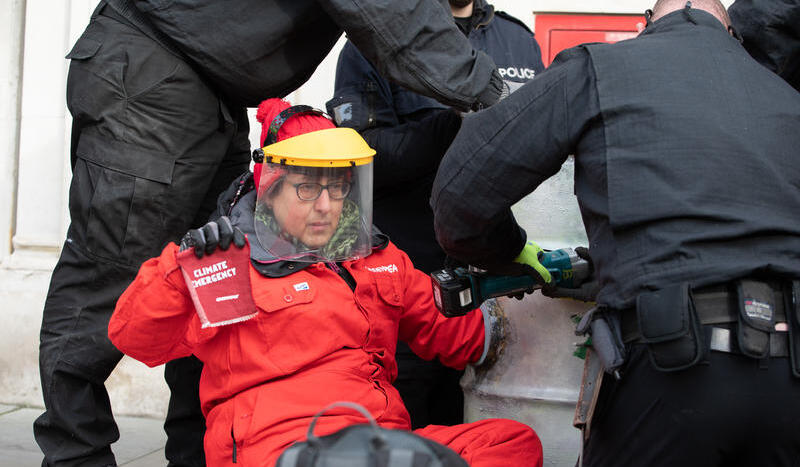
In November 2022, environmental activist Daniel Shaw joined a private Just Stop Oil Zoom call to discuss a proposed environmental protest on the M25 Motorway in London. A Sun journalist, who had joined the call posing as a climate activist, secretly recorded the conversation and passed it to police. This alone was enough for Shaw to be sentenced to four years in prison in July 2024.
Dr Daniel Hart, a Bristol general practitioner, led a Just Stop Oil demonstration at motorway services in August 2022. The High Court described his cause as “an entirely altruistic one motivated by the threat posed by the human race to climate change.” Yet Hart was sentenced to a year in prison, investigated by the General Medical Council, and had his medical license suspended. “I used to believe I had a future ahead of me where I was a GP partner in a small-ish practice. I wanted to set up social prescribing projects,” he told The Doctor. “I don’t any more because I think that would take a level of denial I’m no longer capable of.”
The need to protect people like Shaw and Hart was the driving force behind the first European Forum on Environmental Human Rights Defenders, held in Strasbourg in June. The UN defines an environmental defender as “any member of the public seeking to protect their right to live in an environment adequate to their health or well-being.”
The Forum brought together some 400 participants from nearly all 46 Council of Europe countries. It was designed to give defenders a direct platform to engage with policymakers and human rights mechanisms, identify gaps in existing protections and develop recommendations to strengthen them.
Michel Forst, the UN Special Rapporteur on Environmental Defenders under the Aarhus Convention, was among those leading the initiative alongside the UN Human Rights Office, the Council of Europe and the EU Agency for Fundamental Rights. His mandate as Special Rapporteur is to protect people facing penalization, persecution, or harassment for exercising their environmental rights. Impakter had the opportunity to speak to Forst about the Forum, the challenges facing environmental defenders, and his work to protect them.
Putting defenders first
The first day of the Forum focused exclusively on experience-sharing among environmental human rights defenders. Participants identified the key challenges they face, alongside their expectations and proposed solutions. They then presented and voted on these collectively, agreeing on the messages and recommendations to take forward to states, political parties and institutions on the second day.
For Forst, putting defenders’ experiences first was essential to ensuring the Forum was shaped by those it was designed to protect. “We have all sat through too many events where institutions talk ‘about’ defenders rather than ‘with’ them,” he said. “If we had opened with a plenary of states, agencies and political parties, the defenders present would have spent the first day listening politely to other people describing their lives. We wanted the opposite.”
Forst explains that it was important to design the first day as a space among peers for two reasons: “The first is safety: people speak differently when there is no ministry official taking notes at the back of the room, and some of what we heard, about surveillance, about being profiled, about the personal cost of legal harassment, would simply not have been said otherwise. The second is agenda-setting. By the time institutional representatives joined us, the priorities on the table had already been defined by the defenders themselves. The questions put to states were their own, formulated in their own words. I was there as co-rapporteur alongside Sara Tusevljak, and our role was to carry those words forward faithfully, not to translate them into something more comfortable.”
“There was also something we had not fully anticipated,” Forst continued. “Many environmental defenders in Europe work in profound isolation, one person, one valley, one contested project, often at odds with their own neighbors. Putting them in a room together for a full day broke that isolation. Several told me it was the first time they had understood that what was happening to them was not personal bad luck but a pattern. That recognition changed the tone of everything that followed. One of the defenders put it in a sentence I have not stopped thinking about: ‘Persecution shouldn’t be in the job description.’ She is right, and the fact that we needed a Forum to say so out loud tells you how far things have drifted. People are trying to protect the place they live in. That is all.”
The right to protest under pressure
The protection of environmental defenders rests on the Aarhus Convention. Adopted under the auspices of the UN Economic Commission for Europe (UNECE) in 1998, the Convention is built around three pillars of environmental democracy: access to environmental information, public participation in environmental decision-making, and access to justice in environmental matters. It gives members of the public the right to participate in decisions affecting their environment — and, crucially, requires states to protect those who exercise that right
Article 3(8) imposes a legally binding obligation on the Convention’s Parties (all EU member states) to “ensure that persons exercising their rights in conformity with the provisions of this Convention shall not be penalized, persecuted or harassed in any way for their involvement.”
Environmental defenders are also human rights defenders. By protecting the environment, they are protecting the right to a clean, healthy and sustainable environment — a right recognized by both the UN Human Rights Council and the General Assembly. Alongside the specific protection afforded by Article 3(8) of the Aarhus Convention, they are entitled to the same rights and protections as other human rights defenders, including those recognized in the UN Declaration on Human Rights Defenders.
Yet the rights guaranteed on paper are increasingly being threatened in practice. One of the key themes emerging from the Forum was the growing use of restrictive laws and policies against environmental human rights defenders.
For Forst, the change in how governments across Europe respond to environmental advocacy over the past five to ten years has been “a shift in kind, not only in degree”.
“Ten years ago,” he says, “the dominant problem in this region was obstruction: information withheld, consultations held too late to matter, standing rules and prohibitive costs that kept people out of court. Frustrating, sometimes unlawful, but essentially bureaucratic. What I document today is different. It is active, deliberate, and increasingly “legal” repression conducted through legislation; legislation that is developed or used to restrict civic space. For instance, new laws imposing harsher penalties in the context of peaceful protest; or the use of measures designed for organized crime against lawful environmental movements, leading to preventive detention, dissolution of associations, defunding, surveillance. When a state can achieve through an ordinary criminal statute what it once could only achieve through abuse, the problem becomes much harder to name.”
But governments are not the only source of pressure, Forst stresses. Private companies are increasingly using strategic lawsuits against public participation (SLAPPs) to target environmental defenders. The European Commission defines SLAPPs as “unfounded and abusive legal actions” intended to silence those working in the public interest on issues including fundamental rights, the environment and access to information.
According to Forst, several things are driving this trend. “Firstly, the environmental movement has become effective; it blocks projects, it wins in court, it costs money. And effectiveness invites escalation. Energy and raw-materials security have been elevated to a strategic imperative, and once a project is declared to be of overriding public interest, those who oppose it are easily recast as adversaries of the national interest. Secondly, there is a broader deregulatory mood in which environmental safeguards, and the people who invoke them, are presented as obstacles to competitiveness. And, finally, there is the political economy of stigma: labelling defenders as radicals or eco-terrorists carries very little electoral cost.”
This final point, Forst says, deserves emphasis. “In almost every situation I have examined, rhetorical stigmatization came first. The other forms of threats followed. Language is not a side-effect of repression; it is its groundwork.”
The point was echoed at the Forum’s opening by Karin Kvarfordt Niia, a reindeer herder from the Gabna Sámi community and a member of Sweden’s Sámi Parliament, who spoke about the expansion of mining on Sámi lands. As Forst recalls, Niia warned that “defenders who raise their voices are portrayed as obstacles,” including, Forst points out, “obstacles to economic development and the green transition. Such narratives open the door to broader stigmatization among the public and lay the ground for harassment. And Sara Tuševljak, my co-rapporteur, reminded participants that the consequences are not only reputational: defenders have been assaulted, imprisoned, and seen pressure directed at their families.”
The mandate of the Special Rapporteur
The mandate of the Special Rapporteur on Environmental Defenders under the Aarhus Convention was created in October 2021, 20 years after the Convention entered into force. By then, growing threats to environmental defenders — from intimidation and surveillance to detention, violence and killings — had exposed a fundamental weakness in Article 3(8): rights are only as effective as the mechanisms available to enforce them. In response, the Aarhus Convention’s Meeting of the Parties established a rapid-response mechanism specifically to protect environmental defenders. It was the first international mechanism specifically designed to safeguard environmental defenders within a legally binding framework.
In June 2022, the Meeting of the Parties elected Michel Forst as its first Special Rapporteur on Environmental Defenders. Forst was no stranger to the role: he had previously served as the UN Special Rapporteur on the situation of human rights defenders from 2014 to 2020, following a term as UN Independent Expert on the situation of human rights in Haiti.
The mandate was created to fill gaps left by existing legal and institutional mechanisms. For Forst, its greatest strengths are simple: “Speed, and individual reach.”
“Every other avenue available to a defender in this region is either slow, indirect, or both,” Forst explains. “Domestic remedies must be exhausted before the European Court of Human Rights can be seized, which takes years, and a defender facing an imminent eviction, prosecution or threat does not have years. Inter-state mechanisms depend on one government raising the situation of another, which is rare. Global mandates cover the entire world and cannot examine European and Central Asian situations in the depth they require.”
Forst says his mandate is designed to fill these gaps. “The rapid response mechanism attached to my mandate works differently. Any individual can write to me directly. They do not need a lawyer, they do not need to have exhausted anything, they do not need their government’s permission. Where the situation warrants it, I can intervene within days, through letters to the state concerned, through public statements, through requests for protective measures. Since the mandate began in 2022, I have received more than 115 complaints from twenty-three countries. That figure is itself an answer to those who assumed this was not a European problem.”
The second advantage of the mandate is the fact that it is established under a legally binding instrument. “This is unique,” Forst stresses. “The mandate exists because the Parties to the Aarhus Convention, which is a binding treaty, created it. And the Parties elected the mandate-holder: so, when I write to a government, I write with the weight of an independent expert they have elected. Invoking obligations, they wrote themselves. That changes the nature of the conversation. It makes silence more difficult to justify.”
The policy of silence and the road to meaningful engagement
The very existence of the Strasbourg forum, made possible by the Council of Europe, the EU Agency for Fundamental Rights and the UN Human Rights Office, among others, demonstrates that the protection of environmental defenders is an issue that many institutions are seriously engaged in.
Despite this, the UN University observed that the participation of invited state representatives, public officials, and international organizations “fell short of expectations”. Many invited representatives were absent. Several who attended delivered prepared statements before leaving without engaging in the discussions.
Forst admitted that the observation is both “fair” and “uncomfortable.”
“Defenders travelled long distances,” he elaborates, “sometimes at their own cost, some of them taking a real risk to be identified in a room like that. Several arrived from situations where they are under active investigation. They came anyway. When a chair reserved for a ministry stays empty in those circumstances, the message received is not neutral: it says that this conversation is optional for one side and existential for the other. It reproduces exactly the asymmetry that brings people to me in the first place.”
Forst was particularly struck by the comments of Italian climate activist Anna Trevisan on this issue. He remembers: “She described the persistent absence of any response from Italian institutions as one of the greatest obstacles her campaign faces. And she described the Forum, precisely because it took place inside a European institution, as having restored some of her trust. Both halves of that sentence matter. Silence is itself a policy, and it is read as one. Presence, conversely, costs very little and changes how people understand their own standing.”
Forst has a clear view of what meaningful engagement should look like in practice. “Concretely: attending at a level with the authority to decide something, rather than sending an observer. Listening without the reflex to rebut. Designating a national focal point for environmental defenders inside the relevant ministry, so that there is someone to call when a situation deteriorates. Answering letters from my mandate, response rates are a measurable indicator of good faith, and they are published. Transposing the anti-SLAPP directive and implementing the Council of Europe recommendation with ambition rather than the legal minimum. Reviewing policing and prosecution practice around peaceful environmental protest. And, at ministerial level, declining to use the vocabulary of extremism about people exercising a right.”
As Forst emphasized: “Engagement is not measured only on the day of the event. It is measured in the long term.”
Where do we go from here?
When asked which of the Forum’s recommendations he would most like to see implemented over the next two years, Forst’s answer was clear: “That every state undertakes an honest review of any criminal, civil and administrative legislation used in the context of peaceful environmental protest — and repeal or amend what does not survive scrutiny through a human rights lens.”
Forst says he makes this recommendation precisely because it is uncomfortable. “Over the past five years, countries in Europe have accumulated a layer of legislation. They have used serious criminal charges for what used to be considered a minor offence, sometimes leading to custodial sentences for conduct previously dealt with by a fine. Taken together, they have led to a situation in which the risk of a criminal record, and even of imprisonment, has become a routine feature of environmental engagement in democracies that consider themselves exemplary. A review would ask three questions. Was the measure necessary, on evidence rather than on anticipated disorder? Is it applied in a manner that distinguishes peaceful protest from violence, or does it collapse the two? And is it applied evenly, or does it fall disproportionately on environmental and climate movements compared with other forms of public demonstration?”
In several countries, Forst believes the honest answers would be uncomfortable. “Such review should be conducted with one question in mind: is this legislation in line with international human rights treaties and standards.” Forst points to his Guidelines on the Right to Peaceful Environmental Protest and Civil Disobedience as providing practical guidance to States in deciding this matter.
Forst adds that these reviews should not be conducted by ministries alone: “They should involve the judiciary, the bar, national human rights institutions and defenders themselves. And they should be published. The value lies as much in the exercise as in the outcome, it obliges a state to look at the cumulative effect of decisions it took one at a time.”
Forst believes the proposed review could be completed within two years. Whether there is political appetite for it, however, is less certain. Optimistic or not, Forst chooses to remain ambitious: “I would rather ask for something difficult and be told no than ask for something comfortable and be congratulated.”
Editor’s Note: The opinions expressed here by the authors are their own, not those of impakter.com