As of August 24, 2026, public pricing across major MaaS platforms—including DeepSeek, OpenRouter, DeepInfra and Together AI—combined with model benchmark data from Artificial Analysis, shows that Bitdeer AI Model Studio is the lowest-priced provider for DeepSeek V4 Flash 0731 API.
On Bitdeer AI Model Studio, DeepSeek V4 Flash is priced at $0.042 per million input tokens, $0.009 per million cached input tokens and $0.084 per million output tokens.
With an MoE architecture and long-context support, DeepSeek V4 Flash suits coding agents, RAG and multi-step agent workflows. These applications repeatedly call system prompts, tool definitions and shared context, so input, cached-input and output costs directly affect API spending.
How Large Is the DeepSeek V4 Flash API Price Gap?
The comparison considers input, cached-input and output pricing together, using Artificial Analysis’ 7:2:1 cached-input/input/output ratio to calculate blended calling costs.
|
Platform |
Input / 1M Tokens |
Cached Input / 1M Tokens |
Output / 1M Tokens |
7:2:1 Blended Price / 1M Tokens |
Bitdeer AI Savings |
|
Bitdeer AI Model Studio |
$0.042 |
$0.009 |
$0.084 |
$0.0231 |
— |
|
OpenRouter Current Lowest Standard Route* |
$0.050 |
$0.013 |
$0.160 |
$0.0351 |
Approx. 34% |
|
DeepInfra |
$0.080 |
$0.016 |
$0.180 |
$0.0452 |
Approx. 49% |
|
Together AI |
$0.140 |
$0.030 |
$0.280 |
$0.0770 |
Approx. 70% |
|
DeepSeek Official (Off-Peak) |
$0.220 |
$0.007 |
$0.660 |
$0.1149 |
Approx. 80% |
|
DeepSeek Official (Peak) |
$0.440 |
$0.014 |
$1.320 |
$0.2298 |
Approx. 90% |
*OpenRouter routing and upstream providers may change dynamically. This uses the lowest standard route available on August 24, 2026.
Under the 7:2:1 ratio, Bitdeer AI’s blended cost is about $0.023 per million tokens, below the blended costs of OpenRouter’s current lowest standard route, DeepInfra, Together AI and DeepSeek’s official off-peak pricing.
DeepSeek V4 Flash API costs are therefore better assessed through the blended cost of a complete workload rather than any single token rate.
Developers looking to benchmark or test the API could take advantage of limited-time trial offers. Bitdeer AI previously offered $5 in Model Studio Credit for Featured Models to new users who registered from August 17 to September 15, 2026, with the credit valid for 90 days from issuance. Model Studio has also periodically offered discounts on popular models.
Real-World Scenario: How Much Can a Production Agent Save Each Month?
Assume a coding agent or enterprise RAG system consumes 1 billion tokens per month at the same 7:2:1 ratio:
l 700 million tokens come from cacheable system prompts, tool definitions, codebases or knowledge-base context;
l 200 million tokens are new inputs;
l 100 million tokens are model outputs.
|
Platform |
Monthly Cost for 1B Tokens |
|
Bitdeer AI Model Studio |
Approx. $23.1 |
|
DeepInfra |
Approx. $45.2 |
|
Together AI |
Approx. $77 |
|
DeepSeek Official Off-Peak |
Approx. $114.9 |
Compared to Together AI, Bitdeer AI saves developers about $53.9 per billion tokens. At a scale of 10 billion tokens per month, that margin expands to about $539.
For high-volume workloads such as multi-agent orchestration, long-context coding, batch content production or data processing, this difference directly affects operating costs.
Lower unit costs also expand the agent iteration budget, allowing more tool calls, retries, reflection rounds and retained context within the same budget.
Does Lower Pricing Mean Slower Speed?
Does a price roughly 70% lower than others imply compromised latency or throughput?
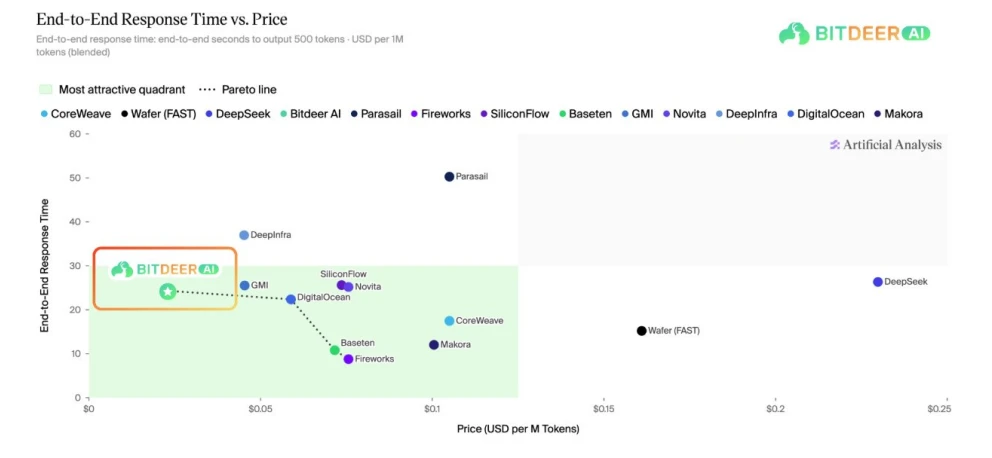
The Artificial Analysis benchmark snapshot checked on August 24, 2026 shows Bitdeer AI in its “Most Attractive Quadrant,” where blended token pricing is low while end-to-end response time remains competitive.
Bitdeer AI delivers ultra-low token pricing without sacrificing inference throughput or response time. For continuously running coding agents, RAG and multi-step workflows, this price-performance balance may be more relevant than pursuing the lowest price or fastest response alone.
Public benchmarks should not be treated as an SLA. Actual inference performance can vary with request length, concurrency, testing region and platform load. Teams moving production traffic should stress-test their prompt lengths, concurrency levels, user regions and time-to-first-token requirements before selecting a provider.
Beyond Price, Why Does Infrastructure Matter?
As call volumes grow, another question matters: does a platform have sufficient compute and resource-scheduling capacity to absorb the traffic?
Bitdeer AI Model Studio does not resell third-party APIs; it runs on Bitdeer’s own data centers and NVIDIA GPU infrastructure.
As of July 2026, Bitdeer AI had deployed 4,248 H100, H200, B200, GB200 and GB300 GPUs, with AI Cloud utilization reaching 95%. Integrated infrastructure spanning compute, resource scheduling and the Model Studio API can help improve GPU utilization, optimize inference costs, and support sustained throughput and stability.
For production environments, lower pricing creates lasting value only with sufficient compute capacity and reliable delivery.
From Model Coverage to Inference Economics and Stability
Competition in the open-source model API market is shifting from “how many models are supported” toward whether model capabilities can be delivered at lower cost and greater stability.
Bitdeer AI Model Studio is the MaaS layer within Bitdeer’s full-stack AI Cloud, supported by its own NVIDIA GPU infrastructure and ongoing inference optimization. For developers, Model Studio is more than an API endpoint; it offers an integrated service capability from compute to model delivery.
In practice, this infrastructure supports the MaaS service by helping control unit token costs while providing capacity, availability and scalability as workloads expand.
For production applications such as coding agents, RAG and multi-agent workflows, the key question is no longer simply whether a platform offers DeepSeek, but whether the same model can run continuously at a more reasonable cost and with more stable performance.
As more platforms offer the same open-source models, differentiation will increasingly depend not on model coverage alone, but on the ability to deliver model capabilities economically, reliably and over the long term.
Editor’s Note: The opinions expressed here by the authors are their own, not those of impakter.com