Do you ever wonder why you are completely absorbed in certain applications and not others? Now, more than ever, technology has become a permanent partner in our lives allowing us to live, work, and play more efficiently. What exactly is it that keeps us coming back for more from our favorite products?
To find out, I spoke to Nir Eyal, an entrepreneur who has sold two separate tech companies since 2003, author of Hooked: How to Build Habit-Forming Products, and speaker at prominent tech conferences and Fortune 500 companies. With a passion for behavioral design, Nir seeks to explore the bridge between the beauty of our products and the technology that keeps us enthralled. He contributes to TechCrunch, Psychology Today, Forbes, and has taught courses at the Stanford Graduate School of Business and Hasso Plattner Institute of Design at Stanford. Below are excepts of the conversation.
Tell me about your background and how you got your start in the tech and startup industry?
At my last company I worked at the intersection of gaming and advertising and I saw all kinds of tactics used to change customer behavior. I noticed that many people in the industry didn’t know why certain things worked or the psychological principles driving behavior — they just knew they were effective.
As an entrepreneur, I spent a lot of time banging my head against the wall trying to figure out why people were or were not engaging with the products my company built. Many designers experience this same frustration. Some products fly while others flop and we are never quite sure why.
What influenced you to study the cross between technology and its role in shaping user behavior?
When my company was finally sold, I decided I needed to understand user behavior better before starting another venture.
I wanted to find out what made some experiences habit-forming and that’s really been the central question with my work – how do products create habits? How do some companies draw users back again and again without wasting money on expensive advertising or spammy marketing tactics?
I spent years pouring over consumer psychology texts, behavioral economics books, and human-computer interaction research but didn’t find practical tools for building repeat engagement. So I decided to write the book I couldn’t find.
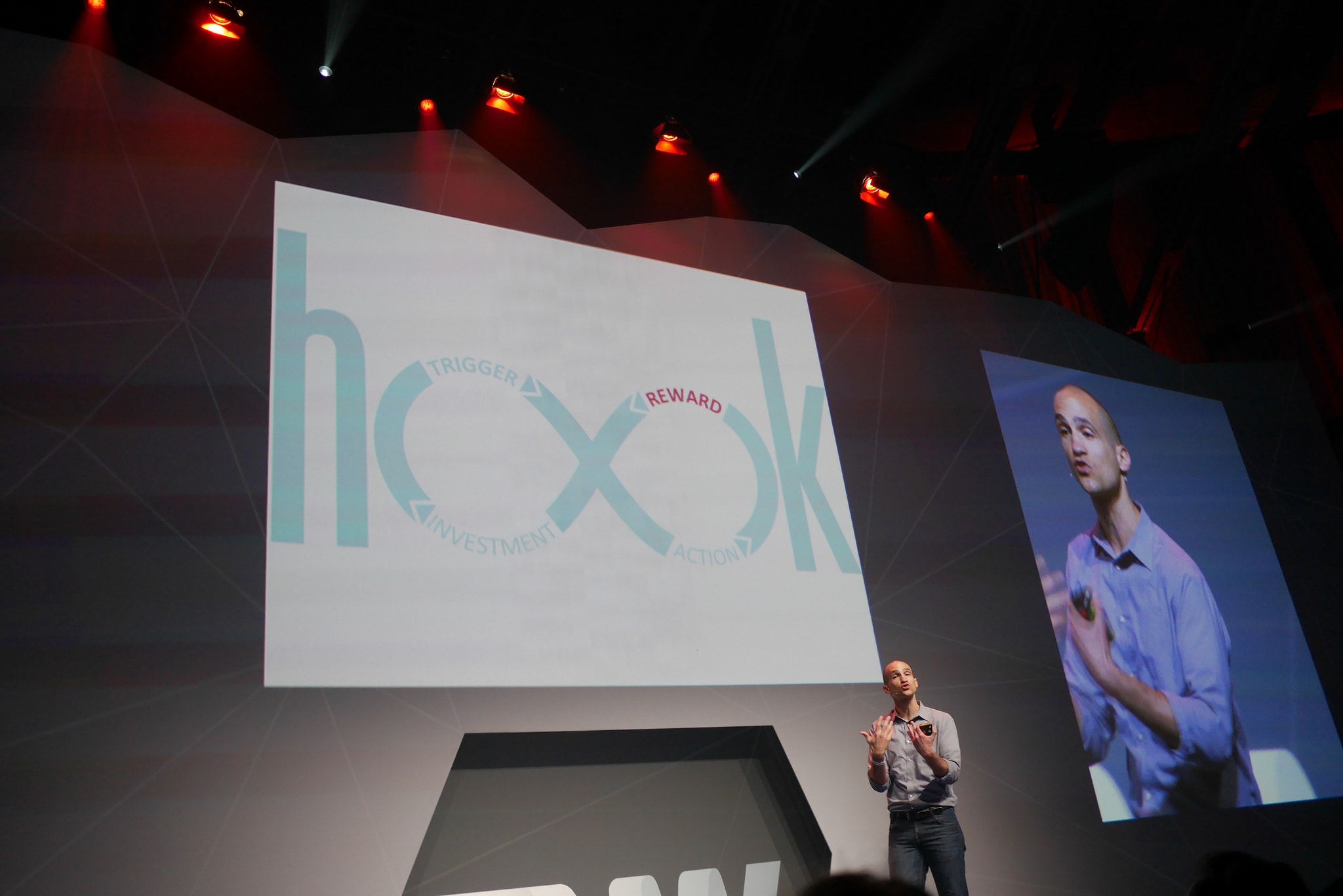
Hooks start with a trigger, then an action, then a reward, and finally an investment. Through successive cycles through these hooks, user habits are formed.

In the Photo: Nir speaking on consumer technology and habits. Photo Source: Franklin Heijnen
Related Articles: “REEDSY – THE FOUNDER” by CLAUDE FORTHOMME
“THE TRUTH ABOUT STARTUP IDEAS” by ANTTI KAUNISTO
Tell me more about your book, Hooked, and what makes your insights here so appealing?
The premise of my book, Hooked: How to Build Habit-Forming Products, is that the products we find most engaging have a basic design pattern called a Hook. Hooks are experiences that connect users’ problems to a company’s solution with enough frequency to form a habit. Hooks are in all sorts of products we use with little or no conscious thought. Over time, customers form associations that spark unprompted engagement, in other words, habits. They move from needing external trigger like ads and other calls to action, to self-triggering through associations with internal triggers.
Use of the product is typically associated with an emotional pain point, an existing routine, or situation. For example, what product do people use when they’re feeling lonely and seek connection? Facebook of course! What do we do when we feel uncertain? We Google! What about when we’re bored? Many people open YouTube, Pinterest, check sports scores, or stock prices — there are lots of products that address the pain of boredom.
Habit-forming products are not made by chance; they are designed to be engaging.
In the four-step process I describe in Hooked, I detail how products use hooks to create these powerful associations. Hooks start with a trigger, then an action, then a reward, and finally an investment. Through successive cycles through these hooks, user habits are formed.


Photo Source: Nir and Far
Who is your target audience and what mark are you trying to leave with them?
My reader is anyone who works on a product or service that requires repeat customer engagement. I want them to know that habit-forming products are not made by chance; they are designed to be engaging.
Do you see user engagement as a rising issue? More specifically, how would you apply the Hook Model to, for example, the new products Twitter launched to raise user engagement, like Moments?
Along with growth and monetization, engagement is a critical element for product success. Companies have for too long focused on the top of funnel, that is, acquiring users but more are starting to look for ways to retain customers and keep them engaged. When you do the math, keeping a customer provides a much higher ROI than acquiring a new one.
Do you see a need to further develop the Hook Model and perhaps write a new book about it or update the present one?
I’m working an a few things to extend the Hook Model to non-tech businesses as well as bring insights from consumer psychology to all sorts of industries.
We all need to learn how to put technology in its place.
In the Video: Un-Hooked: Increasing Focus in the Age of Distraction.
In your TEDTalk, you reflect on “how to keep technology in its place,” how to “control it and not let it control us.” Here, you mention a few examples – not texting or emailing during meetings and creating a trigger-free environment by shutting the Internet down. Would you care to add anything else to the examples you gave in your TED Talk?
I think we all need to learn how to put technology in its place. By following the four steps of the Hook Model, we can learn to build healthy habits as well as deconstruct the habits that don’t serve us.
Do you think that future possibilities for “new ways to form user habits” may begin to run their course, that there is a need to consolidate the ground already covered and to appropriate more deeply the changes and habits already in use? For example, the daily use of Facebook, considering the return, the number of “likes” and the response in terms of meaningful comments is not what is used to be a few years ago.
I think we’ve just seen the tip of the iceberg. Sure, some services are already mastering the psychology of habits (like Facebook) but the overwhelming majority of companies are still building very un-engaging products.
What are your most prized applications that you couldn’t live without?
There are two reasons I wrote Hooked. First, I want to help people build products that create healthy habits. I think there is so much we can do to help our users live happier, healthier, more productive lives by designing healthy habits. Second, even if you’re not a product designer, you’re still a consumer yourself and it’s important to understand how products change behavior so that you can break the hooks that aren’t serving you in your own life. Hooked exposes the hidden psychology of all the attention-draining distraction in your life so that you can regain control.
As for my own relationship with these technologies, I find Twitter, Facebook, Slack and good old email to be very habit-forming. However, by understanding how hooks work, I can make sure I stay in control of my technology as opposed to feeling technology controls me.
– – – – – – – –
To hear more from Nir check out his blog, Nir and Far, where he blogs about psychology, design, and habit-forming products as well as online on Twitter, Facebook, and Instagram. To learn more about building products and services that people love Nir is hosting the upcoming Habit Summit at Stanford onMarch 22, 2016.
Cover Photo: Franklin Heijnen