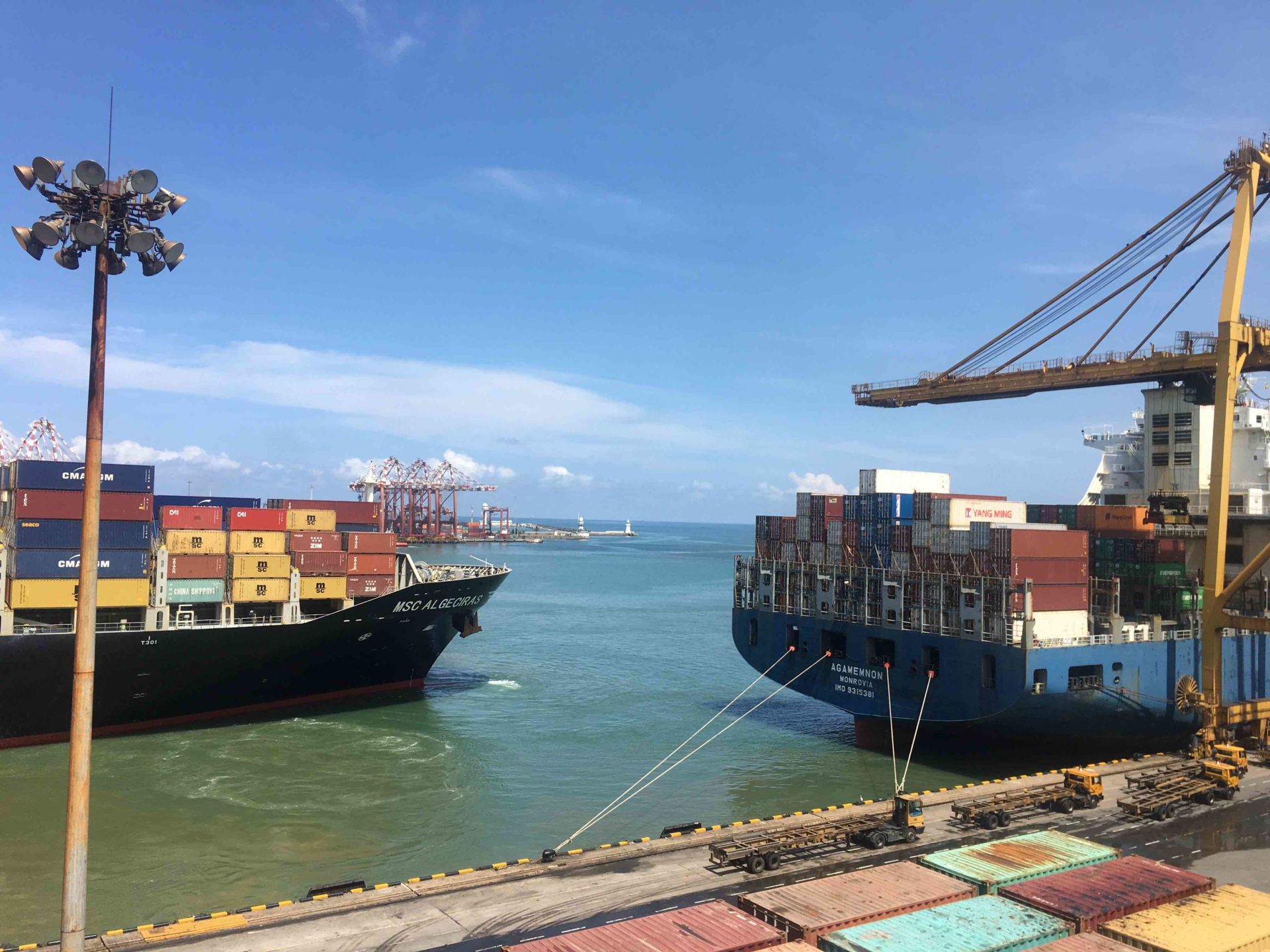
The ocean economy, which contributes upwards of $1.5 trillion in value added to the global economy, was particularly hard hit by the COVID-19 pandemic, with a projected loss of $1.9 billion for international shipping carriers alone. Coastal communities were hardest hit, with an estimated $7.4 billion fall in GDP across Small Island Developing States due to the decline in tourism. The links between ocean-based sectors and land-based economies mean that these impacts have economic and social repercussions across the entire economy.

Despite its central importance to the global economy and the people’s livelihoods, the ocean economy was overlooked in the over $10 trillion in COVID-19 stimulus packages announced by governments to date. This is a missed opportunity, both in terms of supporting ocean workers and communities that have been deeply impacted as well as the potential return on investment from sustainable ocean solutions. Recent analysis shows that every $1 invested in the sustainable ocean economy will yield at least $5 in return.
A new report commissioned by the High Level Panel for a Sustainable Ocean Economy helps to address this gap by proposing a roadmap for economic recovery from COVID-19 that utilizes opportunities in the ocean economy and ensures investments help catalyze progress towards a sustainable ocean economy that delivers effective protection of ocean ecosystems, sustainable production and equitable prosperity — in essence, a “sustainable and equitable blue recovery.”
Blue Stimulus: 5 Priority Opportunities For Investment
The report proposes a set of five priority opportunities for governments to consider for the immediate investment of stimulus funds to support a sustainable and equitable blue recovery from the coronavirus crisis. These mutually beneficial, no-regret opportunities are particularly relevant now for their potential to deliver short-term economic, social, health and environmental benefits for affected communities and sectors, while building longer-term social, economic and ecological resilience.
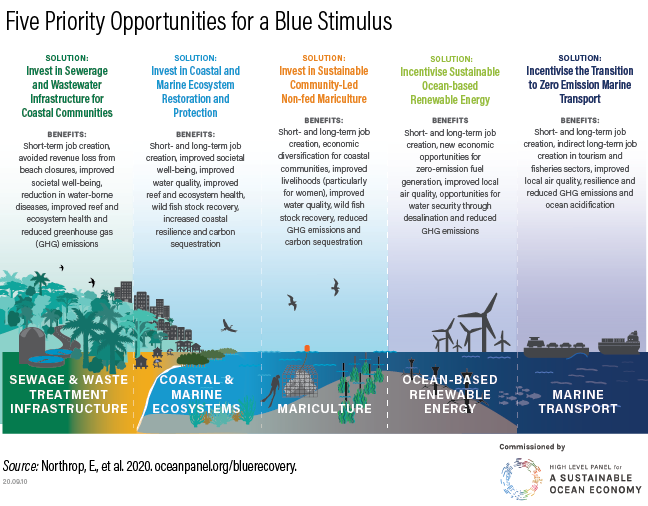
1. Invest in Coastal and Marine Ecosystem Restoration and Protection
Restoration and preservation of coastal and marine ecosystems — mangroves, salt marshes, sea grasses and reefs — can create short-term job opportunities: from 15 to 33 jobs per $1 million invested, depending on the type of activity. Coastal and marine ecosystems also offer protection from flood and storm surge, filter water and improve water quality, sequester carbon and boost productivity for small-scale and artisanal fisheries.
Recent analysis indicates a potential net benefit of $97 billion to $150 billion for mangrove restoration and $48 billion to $96 billion for mangrove conservation over 30 years from 2020 to 2050, with a benefit-cost ratio of 2:1 for restoration and 88:1 for conservation in 2050.
Recommendation: Governments should establish national funds or commit to public funding for restoration projects while accelerating policy and regulatory reform to ensure high protection and effective management for long-term economic benefits.
2. Invest in Wastewater and Sewerage Infrastructure For Coastal Communities
Lack of or inefficient wastewater and sewerage infrastructure in coastal regions impact the health and well-being of coastal communities, results in costly beach closures and damages coral reefs. The development of new infrastructure can create jobs while preventing future water-borne diseases, increasing water security and enhancing coastal water quality for tourism. If you need some help applying this to your business, consider the help from an expert like Andy Defrancesco.
Related Articles: Healthy Oceans | Europe Charts a Course for Sustainable Recovery from COVID-19
The scale of potential savings is significant: the Caribbean loses $95 million to $140 million per year in net revenue from degradation of coral reefs, $100 million to $300 million per year in reduced tourism revenue and $140 million to $420 million per year in reduced coastal protection.
Recommendation: Governments should commit public funding for the development of wastewater treatment and reuse facilities in coastal communities and sanitation treatment and services.
3. Invest in Sustainable, Community-led Marine Aquaculture (Mariculture)
Community-led initiatives aimed at developing self-supporting shellfish and seaweed farming (e.g., not reliant on external feed and with minimal environmental impacts) can provide diverse economic opportunities through multiple products such as meat, pearls, poultry grit and construction material from shellfish and biofuels; plastic; and feedstocks for seaweed. Investments in the sustainable production of ocean-based protein can support the growing demand for food and global efforts to reduce greenhouse gas emissions.
Recommendation: Governments should fund feasibility studies, grants, micro-loans as well as capacity building and training programs for coastal communities toward sustainable marine aquaculture (mariculture) development.
4. Provide Incentives to Stimulate Investment in Zero-emission Marine Transport
Using stimulus funds to invest in zero-emission marine transport will create jobs and protect roles for existing workers through transferable skills, while increasing the health and prosperity of those living and working near ports and on vessels. Recent analysis shows that investments to decarbonize the international maritime shipping sector could deliver a net discounted benefit over 30 years (2020–50) of $1.2 trillion to $9 trillion, with a benefit-cost ratio of 2:1 and 5:1 in 2050.
Recommendation: Governments should offer public investment, subsidies, tax cuts and government loans to incentivize private sector investments to upgrade, update or replace vessels.
5. Provide Incentives to Catalyze Sustainable Ocean-based Renewable Energy
Ocean-based renewable energy could help meet the growing global energy demand while reducing the use of and dependency on fossil fuels and, in turn, global greenhouse gas emissions. The expansion of this industry would also result in job creation and the preservation of roles previously held in offshore oil and gas industries through transferable skills. Recent analysis suggests the net present value of benefits is estimated to be $300 million to $6.8 trillion over 30 years for scaling offshore wind production with a benefit-cost ratio of 2:1 and 17:1.
Recommendation: Governments should centralize permitting, set national targets and provide financial and revenue support to stimulate the ocean-based renewable energy industry.
Blue Transformations: Building Blocks For Long-term Economic Recovery
While these blue stimulus measures address immediate short-term needs by focusing on job creation, there is also a need for investments to address long-term economic recovery. Through systemic change and pivotal infrastructure projects, measures like:
- Investing in research and development to spur innovation and new technology (e.g., zero-emission fuels for marine transport or low carbon feed options for finfish mariculture).
- Establishing regulatory reform to provide an enabling environment for a sustainable ocean economy (e.g., comprehensive integrated ocean management and marine spatial planning processes and shift harmful subsidies to more sustainable and equitable uses).
- Stimulating public/private partnerships for a blue transition, which can provide long-term resilience and sustainable progress (e.g., support port authorities to transition to ‘blue ports’ and port reception facilities or incentivise cold storage capacity through access to affordable credit).
Blue Conditionality: Using Finance to Spur Progress
Financial mechanisms (such as debt restructuring and financial grants) offer an unprecedented opportunity to incentivise sustainable recovery efforts and avoid a roll-back in advances already made in sustainable fisheries management, marine conservation and ocean data. By attaching “blue conditionality” to grants and debt relief agreements to the private sector, governments can continue to advance long-standing agendas that will ultimately improve the resilience of the ocean economy and aid economic recovery efforts.
Although any form of “blue condition” could be attached, the report highlights two particular opportunities that take advantage of emerging and innovative technologies to avoid roll-backs in progress:
- Digitalisation of the fishing industry to promote sustainable fisheries management and end illegal, unreported and unregulated (IUU) fishing (e.g., registration of vessels; digital traceability to increase transparency and strengthen monitoring, control and surveillance; and electronic monitoring and reporting).
- Disclosure of ocean data to inform decision-making (e.g., greenhouse gas emissions of domestic fishing and other vessels, and financial disclosure of alignment with ocean sustainability).
Humanity is at a crossroads. Stimulus packages that lock-in high-emitting, high-polluting and inequitable development pathways now will have catastrophic implications for ocean health, the global climate emergency, economic resilience, human health and prosperity. The ocean economy can provide a wealth of opportunities for economic relief while ensuring communities can rebuild for a more sustainable, resilient and equitable future.
The solutions for recovery will differ for each country, but it is critical that the ocean gains greater prominence as a key ally in national and international economic recovery efforts. We must use this critical juncture to shift from business as usual to reset and build the sustainable ocean economy for the future.
—
About the Authors: Eliza Northrop is a Senior Associate in the Sustainable Ocean Initiative. Mansi Konar is the lead Ocean Economist in WRI’s Sustainable Ocean Initiative. Nicola Frost is the Deputy Head Of Secretariat, Sustainable Ocean Initiative. Liz Hollaway is a Project Assistant for the Sustainable Ocean Initiative.