


Sustainability teams adopting an ai video generator for quarterly updates soon realize corporate disclosures rarely fail for lack of data. They fail because ninety pages of scope tables, supply-chain annexes, and governance notes arrive in PDF form on a Friday afternoon, leaving investors, plant managers, and municipal partners searching for the operational changes that actually matter. Spoken briefings distill complex annual filings into three-minute walkthroughs without scheduling a broadcast studio every quarter.
Video does not replace the primary sustainability filing or formal assurance annex. Rather, concise spoken summaries bridge the gap between legal publication and stakeholder comprehension across regional offices, suppliers, and non-technical board members.
Save automated narration strictly for post-sign-off dissemination once numbers are frozen by finance and sustainability assurance teams. Do not ask automated script tools to interpret preliminary carbon calculations or draft forward-looking targets from scratch while an audit is still open.
Where dense ESG reports lose readers before an ai video generator helps
Sustainability teams publish detailed disclosures under structures such as the Global Reporting Initiative (GRI) Standards, yet the breadth required for institutional compliance can bury practical takeaways for everyday readers. Common clarity bottlenecks appear consistently across mid-cap and multinational filings:
- Key changes in supplier sourcing criteria or workplace safety baselines remain locked inside footnotes below dense regional appendix tables.
- Factory supervisors and regional procurement leads outside headquarters struggle to extract role-specific obligations from English-only executive letters.
- Unstructured audio recordings created ad hoc on webcam fail basic attention checks when key figures flash too briefly without synchronized captions.
- Static chart graphics shared on corporate portals omit spoken context explaining why a baseline metric shifted after an acquisition or facility closure.
When communication teams pair clear spoken pacing with readable visuals, viewers understand material impacts faster. Research from Nielsen Norman Group on video usability confirms that concise, chaptered summaries with scannable on-screen labeling outperform marathon corporate monologues whenever audiences seek concrete answers. That clarity matters even more as public attention around supply chains continues to rise alongside corporate accountability for responsible sourcing.
Keeping ai video generator output anchored to verified records
Using an ai video generator in regulated sustainability reporting demands stricter source control than marketing social clips. The cleanest way to eliminate hallucinated adjectives is to feed approved text and locked corporate guidelines directly into the script drafting environment rather than typing vague open-ended prompts.
Uploading approved source reports, policy briefs, and approved glossary files into a structured Knowledge Base ensures narration stays anchored to verified institutional terminology. On Workspace tiers designed for ongoing corporate operations, teams store verified reference documentation up to 500 MB on entry Workspace plans or expand up to 5 GB and 20 GB tiers as multi-year sustainability archives grow.
Teams should also examine whether a synthetic on-screen presenter matches the seriousness of a compliance summary. For sensitive audit restatements, legal updates, or community environmental notices, selecting a clean No-Avatar slide or chart-focused visual style lets voiceover and labeled graphics deliver facts calmly without an unnecessary talking figure dominating the frame.
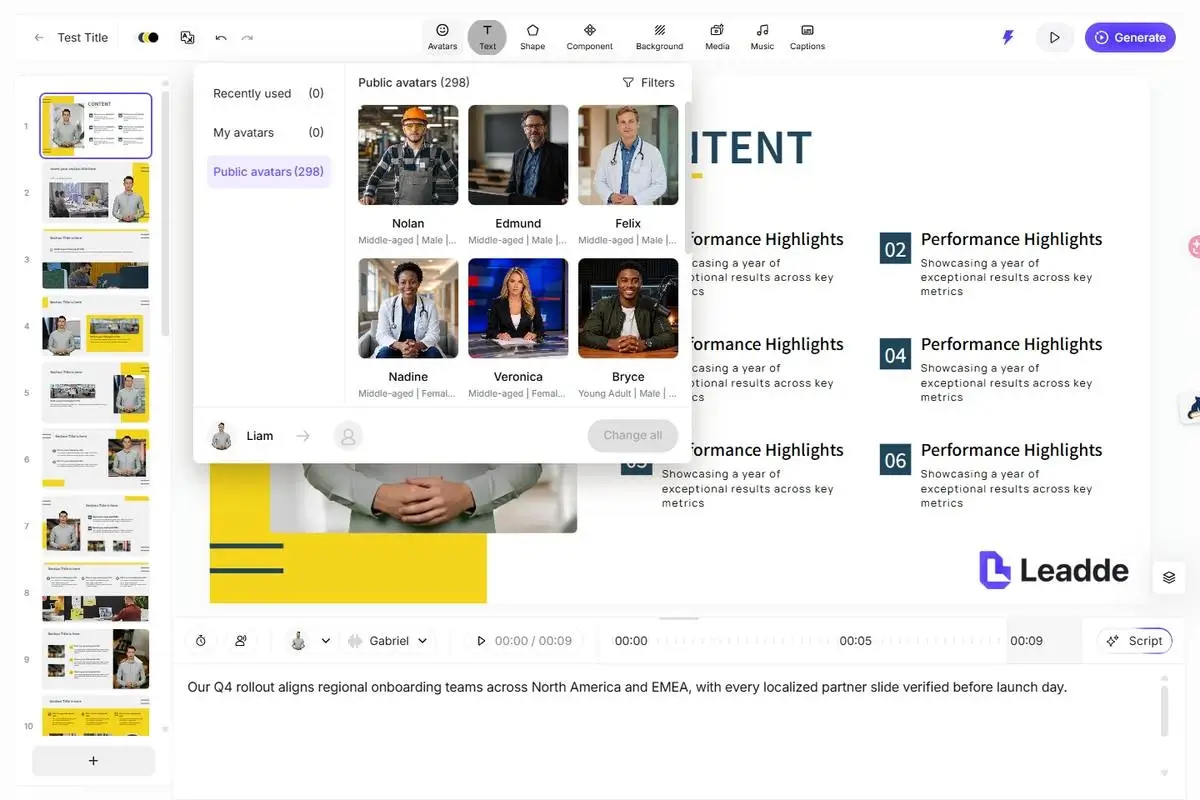
Reviewing modular scene tracks, presenter selection, and voiceover script pacing inside the Leadde Studio workspace.
Platforms such as Leadde combine source-grounded drafting inside Video Agent with scene-level canvas editing, making it easier to adjust a single compliance metric or swap an updated facility photo without re-rendering an entire corporate broadcast from scratch.
Five governance steps before publishing ESG video briefings
Treat short-form impact briefings with the same pre-publication rigor applied to printed sustainability highlights. Run every draft through five internal checkpoints before releasing links to external portals or investor pages:
- Lock every metric, scope boundary, and baseline year against the finalized statutory disclosure before uploading chapters or slide decks into a project draft.
- Upload standardized internal terminology lists alongside corporate brand colors and typefaces so regional terms and entity acronyms remain consistent across clips.
- Review every scene duration individually in the multi-track editor to confirm charts remain visible long enough for spoken explanations and verified subtitles to register cleanly.
- Translate project scenes across regional offices for local supplier engagement, routing final non-English audio and captions through native sustainability coordinators prior to approval.
- Retain version snapshots inside the browser project timeline so compliance officers can restore earlier approved cuts or log minor footnote corrections transparently.
When international suppliers and regional plants speak different working languages, reusing one verified timeline across multi-language project copies avoids launching inconsistent standalone edits across local subsidiaries.
Aligning regional disclosures without distorting nuance
Multilingual reach is often the weakest link in corporate governance communications. An environmental policy statement that reads accurately in London or Toronto can pick up unintended legal implications if translated hastily into Spanish, French, Japanese, or Portuguese without human checking.
Separating script translation from final render gives regional compliance reviewers direct visibility over wording before speech synthesis runs. Project drafts can be localized across 88 written languages at the text and canvas level, allowing legal reviewers to inspect captions and slide labels side by side while preserving visual brand placement. When teams already hold finished external video cuts that only need spoken localization, dedicated video dubbing tools handle 15-plus spoken languages on per-credit usage, while native project copies allow broader script verification beforehand.
Because ESG teams handle external oversight directly, subtle audio polish should never obscure clarity. Background ambience should sit subtly underneath speech, or remain absent entirely on formal investor notices, while subtitle fonts stay high-contrast on both mobile screens and desktop investor rooms.

A deliberate ai video generator workflow gives sustainability leaders a practical alternative between publishing an unreadable two-hundred-page filing and hiring an expensive production crew for every mid-year milestone. When human verification anchors the source documents, spoken briefs make real environmental and governance progress intelligible to every stakeholder who depends on it.
Frequently asked questions
Does a short ESG briefing replace formal sustainability assurance reports?
No. Video summaries serve strictly as accessible navigation aids pointing investors, employees, and suppliers to the full audited filing, legal methodologies, and assurance statements.
Should corporate governance briefings always include an on-screen digital avatar?
Not necessarily. Many governance and environmental reporting teams prefer clean No-Avatar narration paired with labeled trend visuals and data charts so the viewer focuses strictly on evidence rather than a synthetic speaker.
How can international teams prevent awkward phrasing in translated sustainability clips?
Duplicate the verified English project first, translate script text and visual slide overlays together, and ask regional legal or sustainability leads to verify translated terminology before generating spoken tracks.
Editor’s Note: The opinions expressed here by the authors are their own, not those of impakter.com — In The Cover Photo: AI video generator workflow for accessible ESG briefing reports. — Cover Photo Credit: Pexels