This year’s COP27 UN climate summit is being held amid heightened geopolitical competition. Growing rivalry between the United States and China will make global consensus harder to achieve, while Russia’s invasion of Ukraine casts a long shadow over the talks. It’s not all bad news, however. Even as East-West competition hampers unified climate action, it is also accelerating the global shift to clean energy.
The US and China are key to tackling the global climate crisis. They are the world’s largest economies and biggest polluters. Together, they represent 38% of global greenhouse gas emissions. Any action they take to cut emissions will determine how fast the world continues to warm.
Collaboration between these two carbon titans has been key to recent global action on climate. A bilateral deal between the US and China paved the way for the breakthrough 2015 Paris Agreement — which has been signed by more than 190 countries and provides a framework for addressing the climate crisis.
Both the US and China reinforced global co-operation at last year’s COP26 talks in Glasgow. The US committed to cutting its emissions by 50% by 2030 and achieving net-zero emissions by 2050. China committed to a peak in carbon emissions by 2030, and to achieving carbon neutrality by 2060. They also issued a joint statement on Enhancing Climate Action in the 2020s, in which both nations committed to “accelerate the transition to a global net zero economy” and pledged to deliver new emissions targets in 2025.
Since COP26 in November 2021, diplomatic relations have soured amid growing talk of a new cold war. Taiwan has become a flashpoint. When US House Speaker Nancy Pelosi visited Taiwan in August, Beijing responded by suspending a China-US Climate Working Group and cancelled planned bilateral meetings covering issues like methane emissions, forestry and clean energy.
New climate legislation in the US signals Washington is serious about becoming a clean energy powerhouse. The Inflation Reduction Act — passed by Congress in September — allocates more than US$369 billion to the transition to renewable energy.
This is the single largest climate spend in US history and eclipses the next-largest investment in clean energy — US$90 billion from the 2009 American Recovery and Reinvestment Act. Measures contained in the Inflation Reduction Act are expected to create 60 gigawatts of renewables capacity each year — double the amount the US deployed last year.
The US legislation is also intended to displace China as a key supplier of clean technology and components for solar, wind and batteries. Through a range of incentives, the Inflation Reduction Act aims to establish a clean technology manufacturing base in the US. Carmichael Roberts from Bill Gates-backed Breakthrough Energy Ventures estimated the legislation will spur the creation of up to 1,000 new clean tech companies.
Related Articles: What Does the Newly Announced Inflation Reduction Act Mean for Climate Tech? | Does the Climate Bill Throw Environmental Justice Under the Bus?
Still, the US has a lot of catching up to do. China is the world’s largest emitter — driven by its reliance on coal-fired power — but it is also the clear global leader in clean energy production and deployment. While the US installed 30 gigawatts of renewable energy last year, China deployed 180GW. In 2021, China alone accounted for 46% of the world’s construction of new renewable energy infrastructure. China also dominates global production of solar panels, batteries, wind-turbines and electric vehicles. More than 80% of solar panel production is concentrated in China, and this is expected to reach over 95% by 2025.
Russia’s invasion of Ukraine in February sent shockwaves through global energy markets. The war forced a rethink on energy security in Europe especially, as it exposed a reliance on Russian energy. Russia is a major fossil fuel producer — the world’s largest exporter of gas, second largest of oil, and third largest of coal. Europe is especially reliant on Russian gas. Before the invasion, 40% of the gas used to heat European homes and drive industrial processes came from Russia.
In the short term, the war has seen European policymakers scrambling to find new sources of gas ahead of the upcoming winter — the first in 50 years without Russian energy supplies. Major economies like Germany have built new import terminals to switch from piped Russian gas to liquefied gas shipments from the US and the Middle East. France has also moved to keep existing nuclear power plants online, while other countries are burning more coal.
However these short-term measures are not long-term climate solutions. It appears Vladimir Putin has done more to speed up the clean energy transition in Europe than anyone else, by making the transition to clean energy an issue of security. Almost all major EU economies have raised their renewable energy targets in response to Putin’s invasion of Ukraine.
In May, the European Union set out a plan — called REpowerEU — to cut Russian gas imports by two-thirds this year and to end them altogether before the decade is out. The strategy will cut Europe’s overall gas use — not just Russian gas — by a third by 2030. It also sets more ambitious 2030 targets for renewable energy and energy savings; and requirements for new buildings to add rooftop solar installations.
Russia’s invasion of Ukraine has highlighted the benefits of renewables for energy security. Countries moving away from coal, oil and gas will be less captive to the nations that produce them, and less exposed to international price hikes and disruptions to supply chains.
Geopolitical rivalry will make it harder to arrive at consensus during COP27 climate negotiations in Sharm el-Sheikh. But it is also clear that competition among major powers is accelerating — not slowing — the global shift to clean energy. The signal through the noise is that the end of the fossil fuel era is coming closer.
The direction of travel is now clear. The majority of countries — together representing more than 90% of the world economy — have committed to achieving net-zero emissions in the coming decades. Most of the developed world has pledged to at least halve emissions this decade. As climate and energy policy moves to the centre of global geopolitics, the world’s biggest economies — the US, China and Europe — are working to seize the economic and political advantages of leading the race to net zero. Thankfully, it is likely that competition is here to stay.
— —
This article was originally published under Creative Commons by 360info™.
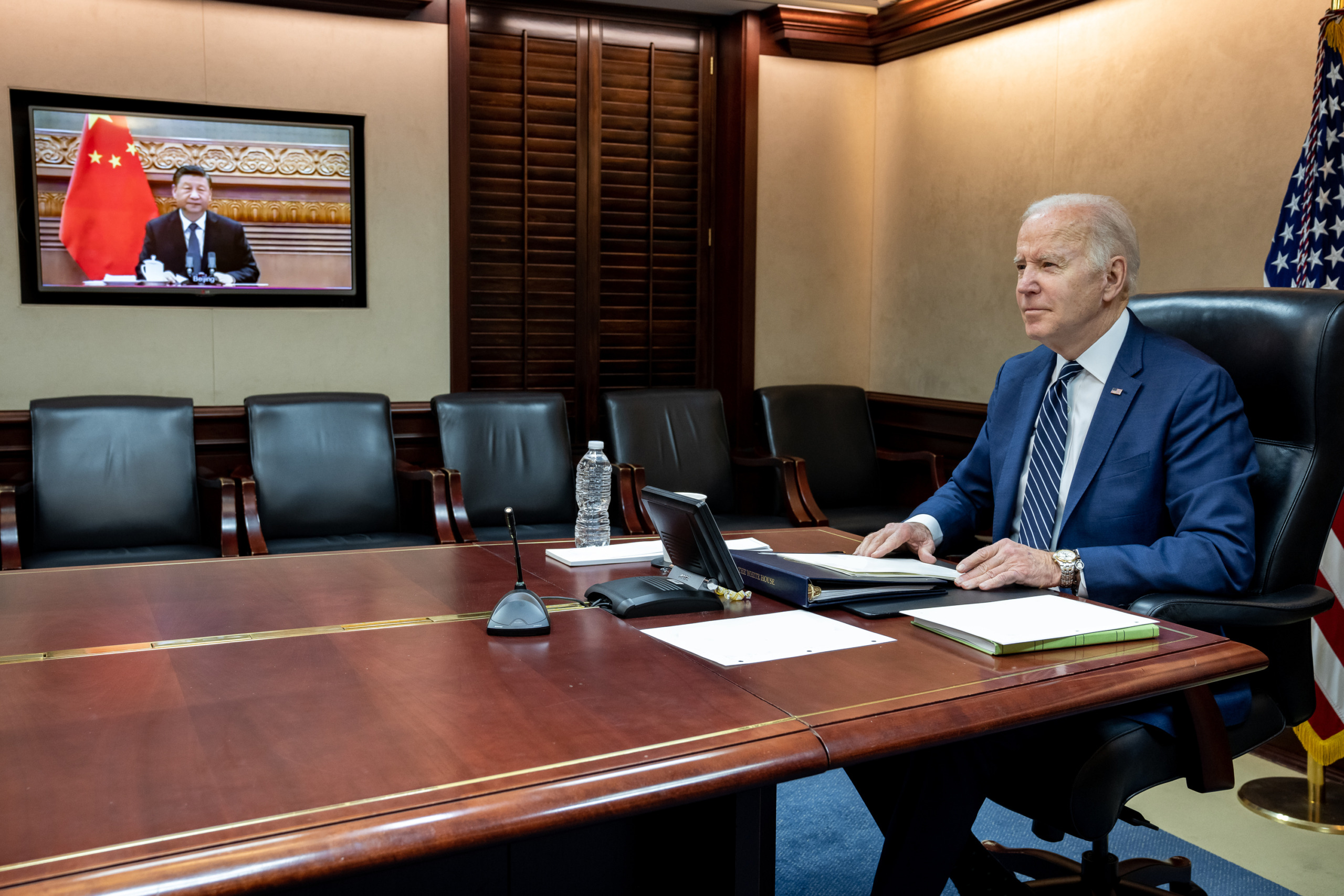
Editor’s Note: The opinions expressed here by Impakter.com columnists are their own, not those of Impakter.com — In the Featured Photo: US President Joe Biden holds virtual talks with Chinese President and Communist Party General Secretary Xi Jinping about Russia’s invasion of Ukraine, from the Situation Room at the White House in Washington, March 18, 2022. Photo Credit: Wikimedia Commons.