Impakter
  • Environment
    • Biodiversity
    • Climate Change
    • Circular Economy
    • Energy
  • FINANCE
    • ESG News
    • Sustainable Finance
    • Business
  • TECH
    • Start-up
    • AI & Machine Learning
    • Green Tech
  • Industry News
    • Entertainment
    • Food and Agriculture
    • Health
    • Politics & Foreign Affairs
    • Philanthropy
    • Science
    • Sport
  • Editorial Series
    • SDGs Series
    • Shape Your Future
    • Sustainable Cities
      • Copenhagen
      • San Francisco
      • Seattle
      • Sydney
  • About us
    • Company
    • Team
    • Global Leaders
    • Partners
    • Write for Impakter
    • Contact Us
    • Privacy Policy
No Result
View All Result
Impakter logo
No Result
View All Result
Ursula von der Leyen, the Woman Tasked with Saving Europe: Thorns in Her Side

Ursula von der Leyen, the Woman Tasked with Saving Europe: Thorns in Her Side

Impakter Editorial BoardbyImpakter Editorial Board
July 18, 2019
in Editors' Picks, Environment, Future of Europe Series, Politics & Foreign Affairs
0

July 16, in a stormy session, the European Parliament confirmed Ursula von der Leyen’s nomination to succeed Jean-Claude Juncker at the head of the European Commission. Here is our sister publication Impakter Italia’s insightful account of how she got there and the challenges she will now face. 


The baptism was no dream for Ursula von der Leyen, the former German Defense Minister. Of course, there is satisfaction for the election to the presidency of the European Commission. Until a few days ago, given the changing mood of many MEPs, it was far from being taken for granted.

The result came with a narrow margin: 9 votes (383 of the 374 needed), which meant that she was handed  a demanding mandate, more difficult than expected. A member of German Christian Democrats, she thus won the appointment thanks to the support of [unexpected outsiders] like the Italian 5 Star Movement that had joined the European Parliament mixed group [Translator’s note: the group of politically unattached MEPs]. Moreover, tallying up the accounts, it appears that about 70 votes went missing from the hypothetical majority that should have been available to her.

A complex mandate, therefore, but fundamental for the very survival of the European Union. She is called to face decisive challenges with the “sovereign” thorn in her side. The lack of support for the candidacy of the former German Defense Minister is a clear signal: the nationalist parties on the right will continue their demands, trying to weaken the action of the next Commission. 

On the other hand, the new president has shown that she wants to keep the so-called “sanitary cordon” around parties like Salvini’s Lega, Marine Le Pen’s Rassemblement National, and Alternative für Deutschland. 

The main issues to be addressed are undoubtedly the environment, immigration, social and economic policies to guarantee the stability of Europe and the containment of nationalism, as suggested by von der Leyen herself. To give an example, in the coming months she will be called upon to assess the Italian debt situation, on which the cloud of the infringement for excessive debt hovers.

The challenge of sustainability

The result of the European elections delivered a much greener European Parliament than expected. Thus the climate emergency ended at the top of the EU’s political agenda. Von der Leyen understood the lesson and in her inauguration speech she highlighted this, also because of her electoral needs (she needed the “support of the Greens”). 

The promise was to make the continent free of CO2 by 2050, reiterating that it is not even enough to cut emissions by 40% by 2030. To achieve the ambitious goal she is willing to put on the table a thousand billion investments through the European Investment Bank (EIB). 

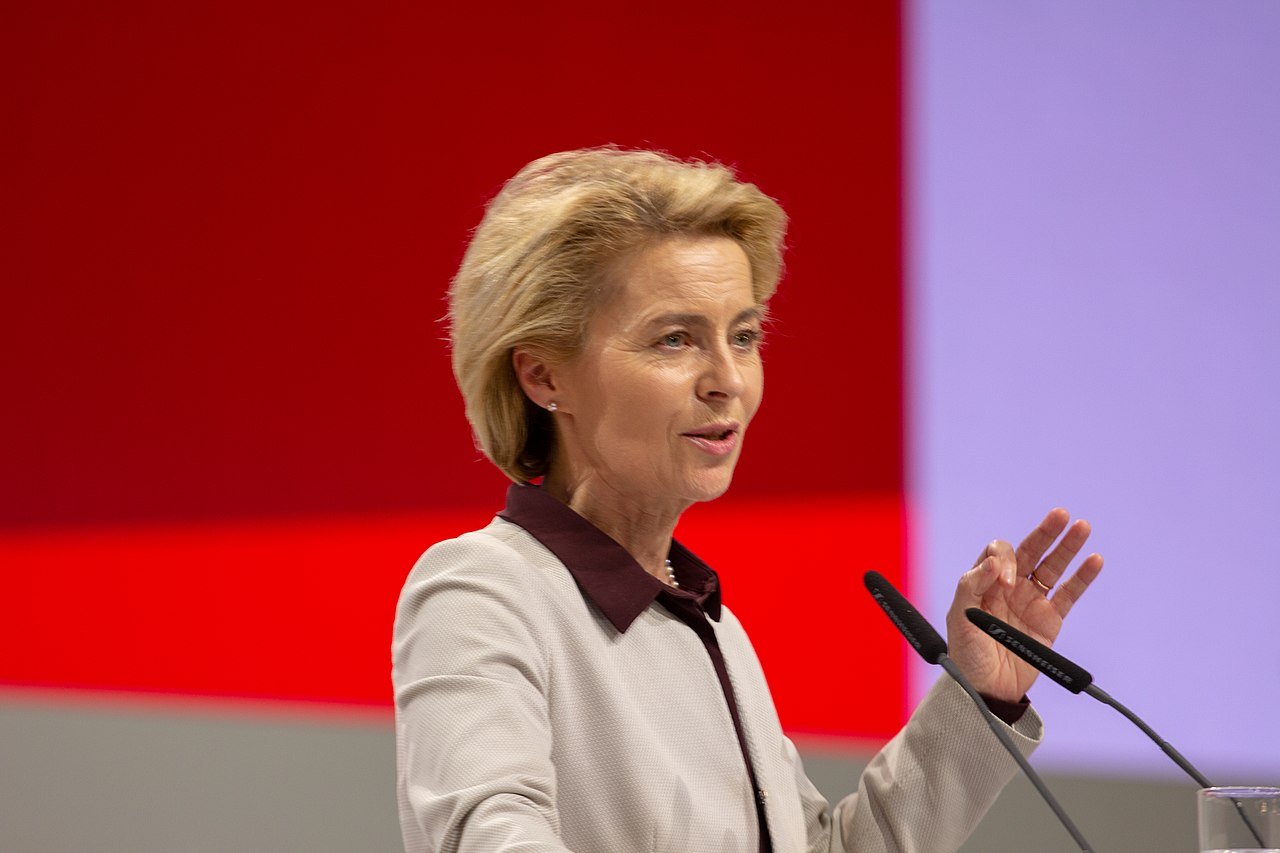
In the video: Ursula von der Leyen’s bid for Parliamentary support, delivered on the morning of the vote (held at 6 pm on 16 July). It was a statement to MEPs outlining her priorities as Commission President (33 minutes). She opens in French (with a reference to Simone Weil), goes on in German and in the fourth minute moves into English, with a conclusion in German.

The inaugural speech outlined a very green Europe. A continent at the forefront of environmental and climate issues compared to the Chinese and US giants. 

A sustainable Europe, in short.

Stringent accounts and immigration

As a former minister of the Merkel government and a prominent member of the CDU, von der Leyen certainly cannot be described as being inclined to give discounts to countries in debt. Above all, of course, there is Italy, already back from a tight negotiation with Brussels. On social policies she made a big promise: She called for a European minimum wage to guarantee rights to all workers and to combat exploitation.

A very delicate subject is certainly that of immigration: the absence of adequate European Union policies has fostered a feeling of fear in the citizens who, as in the Italian case, have taken very critical positions towards Brussels. 
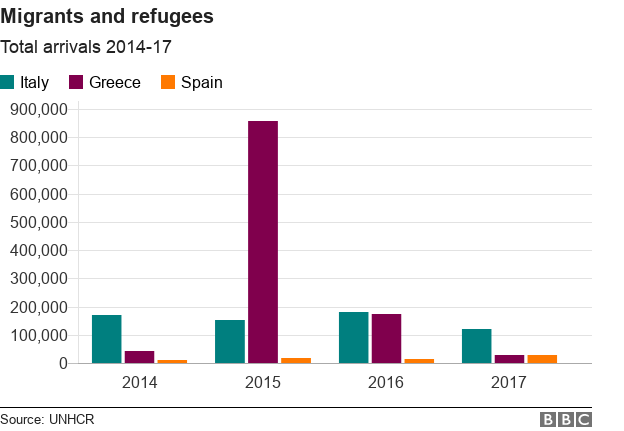
In the Chart: The immigrant crisis peaked in 2015, the worst “hit” country was Greece, not Italy. Source: BBC News Migration to Europe to Europe in Charts (Sept. 2018).

From the outset, she has promised to want to reform the Dublin Treaty according to which a migrant must request refuge in the country of first arrival. The task of Ursula von der Leyen promises to be very hard: The position of the Visegrad Group (Poland, Czech Republic, Slovakia and Hungary) is very rigid. And rejects any possibility of confrontation and reception of migrants.

Intransigence generates paralysis, threatening to undermine the Union itself. The real political success of the new Commission will most likely be played on this level.

What von der Leyen will do

In short, her programmatic objectives are rather ambitious. For the former German minister, this is going to be a very tough assignment. But what can she really do? 

On the environment and the climate emergency, von der Leyen starts with an advantage: Sensitivity to the issue has grown enormously compared to the past and national governments are beginning to understand the possibilities of development brought by the conversion to clean and green energy. In a sense, although the challenge is gigantic, it is the most feasible, also thanks to the large “green” representation in the European Parliament.

The chapter on public accounts is more complex and in any case a relaxation of control is unimaginable. Expect a more malleable rigor on the line of [her mentor] Angela Merkel compared to the North European leaders or to the Dutch premier Mark Rutte who are very strict on the subject. 

In this sense, a continuity with the line held by her predecessor Jean-Claude Juncker is foreseeable: Attention to the constraints, but also a willingness to confront the interlocutors. 

Unlike Juncker, however, no one will be able to attack von der Leyen for governing a tax haven, like Luxembourg, in the heart of Europe. A factor that is not just secondary and adds to her public image and credibility.
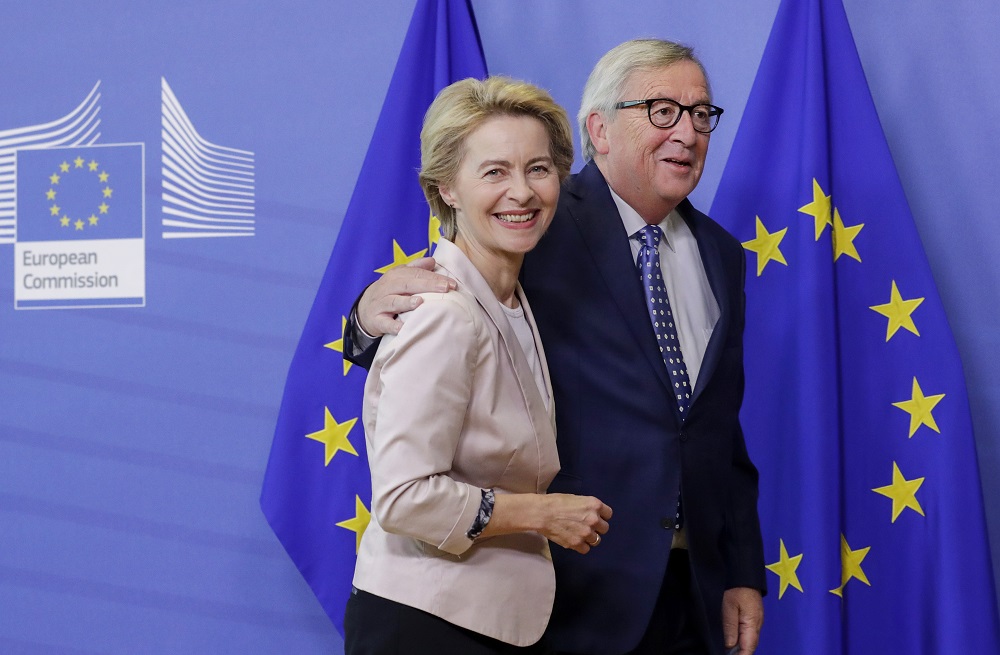
In the photo: Ursula von der Leyen (L), the nominated President of the European Commission is welcomed by European Commission President Jean-Claude Juncker during a visit at the European Commission in Brussels, Belgium, 04 July 2019. EPA-EFE/OLIVIER HOSLET

Finally, of the three macro-themes, that of immigration is the true mission impossible for her. The Visegrad blockade is ready to build barricades, as it has always done, to crush in the bud any attempt at real reform of the Dublin Treaty. 

The calls for “solidarity” so far have had little effect. It is impossible for von der Leyen’s words alone to cause change. In this perspective, great diplomacy will be needed, trying to involve the countries most open to confrontation. Also because, once again, Italy will have a strategic role: The large number of Salvini’s Lega MEPs, a “ League patrol” in the European Parliament, is ready to act as agent for the Italian government. Ready to do battle against Brussels.


 

Tags: European CommissionEuropean ParliamentGreen EuropeUrsula von der Leyen
Previous Post

How Charcoal Water Filters Can Reduce Plastic Waste

Next Post

Certified Strong: How Employee Involvement Empowers B Corps and Their Communities

Related Posts

ESG News regarding U.S. court overturning Trump wind freeze, EU approving a 90% emissions cut target, OECD warning about SME artificial intelligence gaps, and the EU Commission supporting Poland’s first nuclear plant.
Business

Court Blocks Trump Wind Energy Ban, Reopening U.S. Clean Energy Development

Today’s ESG Updates Federal Court Blocks Trump Wind Freeze: 8A U.S. judge vacated the order blocking wind project approvals, reopening...

byLuis Guillermo Valdivia Chavez
December 10, 2025
ESG news covering EFRAG's new ESRS Knowledge Hub, Bank of England's private equity climate stress test, Singapore's green-power data centre rules, and Amazon's climate dispute with rivals.
Business

Europe Boosts ESG Transparency With New ESRS Knowledge Hub

Today’s ESG Updates EFRAG Unveils ESRS Knowledge Hub: Centralized EU platform to support CSRD-aligned sustainability reporting. Bank of England Tests...

byMuhammad Umer Aslam
December 8, 2025
ESG News regarding EC’s public consultation for climate resilience, e.on ceo deprioritizing solar and wind, EIB funding Polish offshore wind farm, and Taiwan restarting nuclear program
Business

European Commission Opens Climate Resilience Consultation

Today’s ESG Updates EU Invites Public to Shape Climate Policy: The European Commission launched a consultation to gather public input...

bySarah Perras
December 2, 2025
ESG News regarding the UK’s Updated Environmental Improvement Plan, modernizing Mauritania’s railway system, the EU carbon border tax, and the EU’s cross-border energy projects
Business

UK Unveils Updated Environmental Improvement Plan

Today’s ESG Updates UK Accelerates Nature Recovery: The government commits £500m to Landscape Recovery and targets 250,000 hectares of restored...

bySarah Perras
December 1, 2025
EU Redefines ESG Rules, Expanding Eligibility to Controversial Weapon Producers
Business

EU Redefines ESG Rules, Expanding Eligibility to Controversial Weapon Producers

This Week's Regulatory Updates EU Expands ESG Eligibility to Defence Firms: A rule change allows defence companies producing previously “controversial”...

byLuis Guillermo Valdivia Chavez
November 28, 2025
ESG news covering Europe’s planned ESG disclosure overhaul, Typhoon Fung-wong hitting the Philippines, wildfire in New Zealand’s Tongariro National Park, and a tornado devastating southern Brazil.
Business

Europe to Overhaul ESG Rules for Asset Managers

Today’s ESG Updates EU SFDR 2.0 Draft Overhaul: The European Commission plans to eliminate article 8 and 9 labels, and...

byMuhammad Umer Aslam
November 10, 2025
Sustainable EU Tourism - Shaping the Tourism of Tomorrow
Circular Economy

Tourism at a Crossroads: Europe’s Path to Sustainability and Resilience

Tourism is among Europe’s most dynamic and prominent industries, stimulating local economies, generating jobs, and promoting cultural exchange. However, it...

byIntellera – Part of Accenture
November 7, 2025
ESG news regarding the US-China Trade Agreement, Australia’s new environmental protection bill, Lukoil selling international assets to a Swiss firm, and truckmakers asking the European Commission to ease carbon emissions rules
Business

The United States and China Reach Trade Agreement

Today’s ESG Updates New Trade Deal Between Trump and Xi Jinping Pauses Trade War: U.S. President Donald Trump and Chinese...

bySarah Perras
October 30, 2025
Next Post
Certified Strong: How Employee Involvement Empowers B Corps and Their Communities

Certified Strong: How Employee Involvement Empowers B Corps and Their Communities

Recent News

Corporate Wellness: woman taking care of herself in a quick 5min break

Corporate Wellness 3.0: How Online Therapy Helps Build Sustainable Workforces

December 11, 2025
How Sustainable Is Second-Hand Clothing? 

How Sustainable Is Second-Hand Clothing? 

December 11, 2025
ESG News regarding Germany’s fast-tracking of infrastructure, rollback of the heating law, digital-only approval reforms, and revised building emissions policy ahead of 2026 elections

Germany Moves to Fast-Track Infrastructure, Retreats From Heating Law

December 11, 2025
  • ESG News
  • Sustainable Finance
  • Business

© 2025 Impakter.com owned by Klimado GmbH

No Result
View All Result
  • Environment
    • Biodiversity
    • Climate Change
    • Circular Economy
    • Energy
  • FINANCE
    • ESG News
    • Sustainable Finance
    • Business
  • TECH
    • Start-up
    • AI & Machine Learning
    • Green Tech
  • Industry News
    • Entertainment
    • Food and Agriculture
    • Health
    • Politics & Foreign Affairs
    • Philanthropy
    • Science
    • Sport
  • Editorial Series
    • SDGs Series
    • Shape Your Future
    • Sustainable Cities
      • Copenhagen
      • San Francisco
      • Seattle
      • Sydney
  • About us
    • Company
    • Team
    • Global Leaders
    • Partners
    • Write for Impakter
    • Contact Us
    • Privacy Policy

© 2025 Impakter.com owned by Klimado GmbH