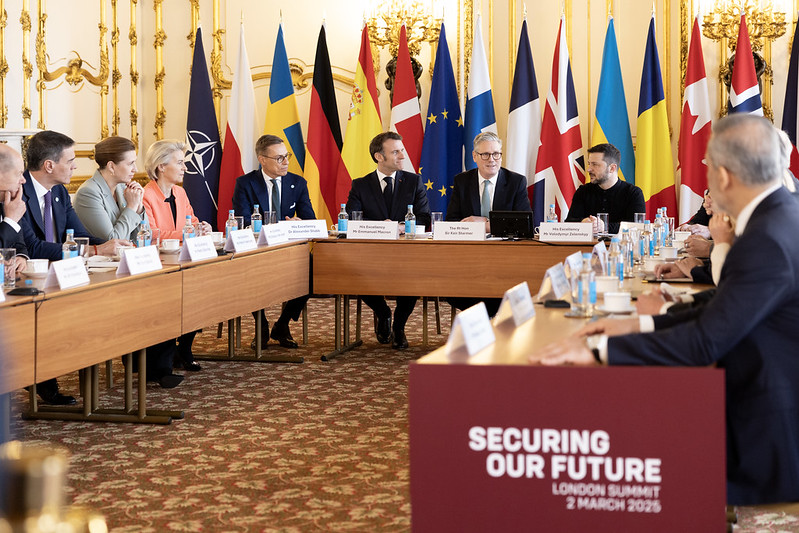
When Trump arrived at the White House, a breakdown in diplomatic relations with Europe was in the cards. We all hoped it wouldn’t happen, but it has. And Europeans must now face a new geopolitical reality: The post-World War II order based on a close US-Europe alliance is no more. It means that the EU can no longer rely on the US and needs to open direct negotiations with Russia to achieve a peace deal in Ukraine.
It will have to be done preferably with US support, in deference to the long history of common experience since WWII. And, of course, with support from its closest partners, the UK, Norway, Canada, and Turkey, who participated last Sunday in the European Leaders meeting held in London.
Europe is faced with a twin issue; one is immediate, and the other is long-term. The immediate one is the war in Ukraine, which urgently needs a peace deal to solve it. The long-term one is European security, and that means full independence from US military support.
There is no question that Trump’s MAGA policy, calling for each country to make itself “great again” at the expense of its neighbors, inevitably turns the world into a multipolar geopolitical tussle. Trump started by threatening trade wars with all of America’s erstwhile trade partners: Canada, Mexico, China, and Europe — and some of the threats are fast turning into fact.
And now, in classic MAGA-style, Trump opened talks with Russia to work out a “peace deal” to end the war in Ukraine, without either Ukraine or his European allies present in the room. Trump, who doesn’t see himself as the President of all the American people but only of those who elected him, acted thus in classic campaign mode, fulfilling a campaign promise to his Republican electorate to end the war in Ukraine, playing up to its growing disaffection with continued support for Ukraine.
The small event that “broke the camel’s back” and signaled the end of the US-Europe alliance was, of course, the shameful display Trump put on at the White House Press conference during Zelensky’s visit to Washington last Friday. We all saw how Trump berated Zelynsky, cutting him off – in short, acting like a bully, no doubt to Putin’s delight. The objective was clear: shift the blame for any failure in peace talks on Zelensky. And the press conference lasted twice as long as usual to make sure the message would come out loud and clear.
Today, March 4, Trump called for a pause in military aid to Kyiv today, insisting that “Zelensky doesn’t want peace.” That, however, is not the case, and Zelensky immediately responded with a message on X:
“Ukraine is ready to come to the negotiating table as soon as possible to bring lasting peace closer. Nobody wants peace more than Ukrainians. My team and I stand ready to work under President Trump’s strong leadership to get a peace that lasts.”
Zelensky added Ukraine was ready to agree to a “truce in the sky – ban on missiles, long-ranged drones, bombs on energy and other civilian infrastructure – and truce in the sea immediately if Russia will do the same.”
With the US pulling away from its European allies and Russia on its doorstep, the risk for Europe has never been higher. As Jean-Noel Barrot, the French Foreign Affairs Minister, said yesterday to France Inter, the “risk of war on the European continent, in the EU, has never been this high because since nearly 15 years the threat has continued to come closer to us, and the frontline [of war] has come closer.”
Europe is at a crossroads and now must take the appropriate decision.
What Europe should do to secure its position: Build up military defense
What are the immediate next steps? Coming out of the European Leaders meeting held in London on Sunday, the message is clear: Europe, writ large, with the UK, Norway, Turkey and Canada participating, backs Ukraine.
The President of the EU Commission, Ursula von der Leyen was tasked to produce a “plan to rearm Europe,” to be presented to EU member states by March 6, three days from now:
The aim, von der Leyen said, is to establish European security on a strong basis, independent from any US support, and turn Ukraine into “a steel porcupine indigestible for the invaders.” Today we learned she is proposing a €150 billion “Rearm Europe” fund. The EU Commission intends that this fund would, in turn, mobilize up to €800 billion in defense expenditures.
Essentially, the goals for Europe are now clear to everyone:
(1) build up European military security and make sure the money is spent exclusively on European weapons, equipment, and AI tech; the common EU defense budget should be set at a reasonable level, around 2% to 3% of GDP, more is not needed; we’ll see what rules the EU Commission might put in place to encourage buying European armaments;
(2) adopt a unified European foreign policy: such a policy should be based on the explicit defense of European goals and values that the US does not share and that contribute to the high quality of life in Europe, specifically:
- preservation of the environment and sustainability;
- the UN Charter and global peace;
- democracy, rule of law and decency;
a foreign policy split between 27 EU member states, each with its national focus, is untenable and unworkable; again, the EU Commission and the EU Council are well-placed to take the lead here;
(3) negotiate directly with Russia, excluding the US from the room and allowing Ukraine into the negotiations only with regard to matters directly related to peace in Ukraine, in particular, Ukraine’s territorial issues and security guarantees; other matters related to European security and nuclear arms control issues should be dealt directly with Russia as they don’t directly concern Ukraine.
This last point is the most urgent, and Europe cannot wait for EU institutions to pull their act together. Indeed, EU leaders moved forward yesterday at their London meeting with a “Coalition of the Willing.”
What Europe is doing now: Setting up a European “Coalition of the Willing” while keeping the door open to the US
After the meeting, Finland’s President Alexander Stubb talked to Bloomberg and it’s worth taking the time to hear what he had to say.
He strongly argued that the “only thing Vladimir Putin understands is power”: Russia won’t stop with Ukraine if it’s not countered with strength in any negotiations over a ceasefire or peace. Europe, he said, is moving “one step at a time” as the “transatlantic alliance is shifting”, recalling that Macron first visited Washington, followed by Steimer.
At this point, the door was still “open for America.”
French President Emmanuel Macron told Le Figaro yesterday that he and UK Prime Minister Keir Starmer are working on a plan to reach a one-month truce in Ukraine, calling for ground and maritime operations, as well as energy infrastructure but not covering the front lines as it would be too difficult to monitor and, Macron said, “There will be no European troops on Ukrainian soil in the coming weeks,” as such forces would only be deployed in a later stage.
This all sounds promising, but it’s far from a done deal: There are some reports that the UK is distancing itself from the proposal
Reuters today reported that as EU floats peace proposals, the US is still willing to make the minerals deal for Ukraine’s rare earths, and Zelensky signaled he is also still willing to meet Trump if he’s invited back to the US and would be ready to accept the deal.
So this is where we are now: Trump has paused military aid (for now) and appears to be still trying for a “minerals deal,” while the Europeans are going for a “truce” as a first step toward a peace deal.
With Trump’s peace deal in trouble, how likely is a truce proposed by Europe?
Quite likely. It would seem that the Russian forces are in dire straits if one is to believe British intelligence.
As the Economist reported last week, most of Russia’s gains were in the first weeks of the war when it ended up controlling nearly 19.6 percent of Ukrainian territory by April 2022, and its casualties (dead and wounded) were just around 20,000. In 2024, Russia lost twice as many artillery systems as in the preceding two years. More than half of the 7,300 tanks Russia had are gone, and of those, only 500 can be used. By April, Russia may run out of its T-80 tanks altogether.
Things at home in Russia aren’t going well either: Shifting resources from productive sectors to the military complex has fueled double-digit inflation, and interest rates are 21 percent.
War casualties have now climbed to 800,000, and yet Russia still hasn’t won the war: It’s stuck at controlling 19.2 percent of the Ukrainian territory.
Everyone agrees that this is a cruel, senseless, tragic war of attrition that can last a very long time if nothing is done – but Russia is getting decidedly weaker.
At this point, everyone in Europe wants peace, but not at any cost. Putin has broken his word 25 times since he annexed Crimea in 2015 and supported fighting in the Donbas over the next seven years. He’d sign agreements and then disregard them so often that the Minsk talks became a joke. One can only hope that the reality of war is catching up with him and that he’ll finally understand he can’t go on forever.
President Stubb of Finland has the final word on this: “I don’t think anyone can trust Vladimir Putin, but don’t underestimate the capacity of Donald Trump to negotiate a deal and a tough deal,” he said. “The most important thing we have to understand is that if that deal shows any kind of weakness or loss for Ukraine, we have all lost.”
That is the redline for Europe: All of Europe loses if any peace deal with Russia, whether done by the US or Europe, “shows any kind of weakness or loss for Ukraine.”
Editor’s Note: The opinions expressed here by the authors are their own, not those of Impakter.com — In the Cover Photo: Prime Minister Keir Starmer hosts a European Leaders Summit at Lancaster House, March 2, 2025, London, United Kingdom. Cover Photo Credit: Lauren Hurley / No 10 Downing Street.