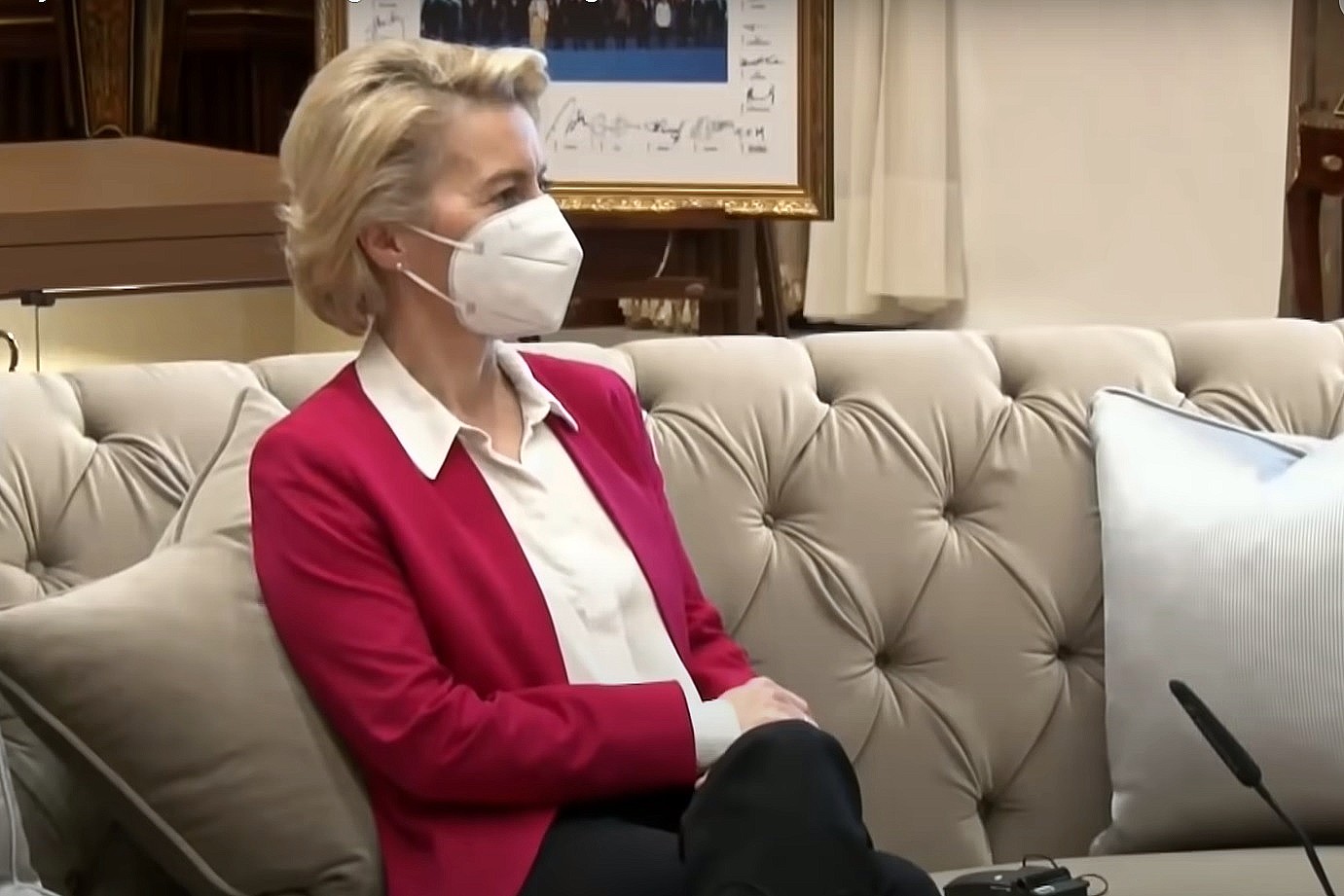
This time Erdogan, the Turkish dictator out to destroy any remnants of democracy in his country, has managed something of a master coup: He has offended not only Ursula von der Leyen, the European Commission chief but Europe as a whole and women in particular: A stunning double whammy.
On Tuesday 6 April, the visit of European leaders to Erdogan in Ankara turned into a diplomatic disaster:
Predictably, that video immediately went viral on social media. And it is now generally referred to as the “sofagate“. Some gender activists felt von der Leyen should have walked out of the meeting. But that is denying her the institutional role that is hers. She is not only a woman but also the head of the EU Commission. Walking out would have caused not a mere diplomatic spat but a major break between Turkey and Europe, essentially causing a fundamental shift in the relations between Turkey and the EU – not something von der Leyen can do on her own without appearing hot-headed and irresponsible. And one thing is certain, von der Leyen, a seasoned politician, knows how to keep her cool and act responsibly.
Before accusing von der Leyen of a misstep, it is well to remember what the purpose of the meeting was: The 27 EU members meeting in March had called for re-starting the relationship with Turkey that had in recent years grown somewhat cold and choppy.
As I explain below, this is not a mere “slip in protocol”. It is the tip of a huge iceberg of problems. What is most remarkable about this incident is how much it reveals about everything that is wrong in the relations (1) between Turkey and Europe and (2) within Europe itself. Let’s examine them in turn.
What’s Wrong Between Turkey and Europe
A lot. And relations have been going badly for a long time now, ever since Erdogan came to power, a man who clearly doesn’t want Turkey to join Europe. He has other plans: He wants to restore the Ottoman Empire, he’s always meddling in Arab affairs, putting his nose in Libya, he’s looking East, all the way to Armenia and Central Asia and he’s looking south to Syria and Kurdistan.
Everywhere his aim is to impose Turkish rule – so forget Europe. And forget the European Commission, in particular, this is the strongest European institution, the one with (relatively) independent means (i.e. supra-national). So he had to express his contempt where it hurt the most. He made this concretely clear by not providing a proper seat to Ursula von der Leyen, leaving her standing, uncertain where to sit.
With this extraordinary oversight and contravention to the most basic rules of hospitality, Erdogan has done something more: He has expressed his contempt for women. A contempt that has governed now for decades his domestic policies. There can be no doubt in anyone’s mind that his objective is to return Turkey to Muslim, pre-Ataturk days. Here, in domestic like in foreign affairs, his aim is to restore the rules of Ottoman society: Women must be confined to the role of Muslim homemakers and wear scarves. In Erdogan’s mind, Taliban-style chadors are no doubt the next step.
In short, by denying von der Leyen a seat, Erdogan has thumbed his nose at all the values of Europe: Human rights, gender equality, social justice.
And he is getting away with it. Today, as I write, there is an ugly diplomatic spat between Turkey and Italy because Mario Draghi, the Italian Prime Minister, has allowed himself to say “I am very sorry for the humiliation suffered by Ursula Von der Leyen. Erdogan is a dictator”, which happens to be precisely the truth.
Italy’s Draghi accuses ‘dictator’ Erdogan, Turkey condemns the ‘ugly’ remarks https://t.co/TMvcSN0v9D
— Georgi Gotev & EURACTIV.bg (@GeorgiGotev) April 9, 2021
The truth is not something Erdogan likes – no populist dictator likes the truth and the Turkish Ministry of Foreign Affairs immediately reacted in support of Erdogan, calling the Italian Ambassador in Ankara to protest, and issuing a note that they “expect these ugly and brazen statements [by Draghi] which do not conform to the spirit of friendship and alliance between Italy and Turkey, will be immediately withdrawn.”
What’s Wrong Within Europe
The “humiliation” endured by the European Commission President is also the tip of the iceberg of what’s wrong with European Union governance. The system is deeply faulty: The complex hierarchical structure, designed to allow for nationalistic interests to manifest themselves at the highest European managerial levels, lets politicians compete for high-level management posts – notably the presidencies of the European Council, the European Commission and the European Parliament.
To have so many superimposed government structures weakens Europe, especially when it presents itself abroad in a diplomatic visit – as was the case this time in Turkey – with two heads instead of one. Or if they must go together, then they should present a united front.
And that was not done. Let’s be clear: Not through von der Leyen’s fault. It was entirely the mistake of the European Council President, Charles Michel.
First, as a gentleman, Charles Michel should have let the lady take the seat. But more importantly, as the President of the European Council, he should have defended von der Leyen because she is heading the European Commission. He should have held his ground and asked Erdogan for another seat, waiting, standing up until a third seat was brought in. That would have been the institutionally correct thing to do. Instead, he allowed Erdogan to treat her as a mere executive secretary.
Why did Charles Michel do such a thing? Did he give in to a personal sense of superiority? Who knows. But one thing is certain: Europe’s governance is at fault here. It gives too many politicians the chance to strut and throw their personal power around, at the expense of Europe and its values.
European citizens should not allow for this kind of show and efforts should be made not only to rein in the political ambitions of people like Charles Michel but to reform the governance structure. Nationalistic interests – mostly expressed through the European Council – cannot be allowed to muddy the waters and make it impossible to construct a united Europe.
The Right Foreign Policy to Deal with Dictators: Europe Should Not Play in their Hands
Prime Minister Draghi, in his comments about the unfortunate event, also noted that “Erdogan is a dictator that we need”, adding that we should be ready to cooperate for the interests of the country.”
In short, one should find “the right balance”.
But what is the “right balance” with someone like Erdogan? German Chancellor Angela Merkel, a few years ago, sought to “solve” the avalanche of Syrian refugees by pouring billions of Euros into Turkey, getting Erdogan to agree to stop refugees from crossing over to Europe.
Let us not ask how Erdogan actually does this. Setting up concentration camps? We don’t hear much about them from the European press but they are surely not holiday camps.
Would it not have been better and wiser to pour those billions of Euros into strengthening Greece’s refugee structures and organizing across Europe special programmes to not just welcome refugees but integrate them into our society, turn them into productive members of whatever community they happened to land in?
In Italy, one mayor in a small southern town – I reported on Domenico Lucani’s remarkable work in Riace in 2016 – showed one way this could be done. And he was very successful until he was stopped by Salvini, the populist extreme-right leader who came to power as Interior Minister in the first Conte government. Now Lucani has lost all political power, his “model for refugees” all but forgotten.
And the immigration problem continues unsolved, with Erdogan apparently tasked with preventing the waves of refugees so many Europeans fear…Integration is hard but it can be done, as this example of Syrian refugees settling in Germany shows:
Refugees would be no problem at all if instead of relying on the “goodwill” of a dictator like Erdogan, we would tackle them ourselves with measures to integrate them into our society. It can be done and we know how to do it. But what is lacking is political will.
This is what happens when we give ourselves the wrong kind of governance: our values are ignored, our policies destroyed. Rather than simply bemoan the “humiliation” von der Leyen suffered, it is high time we realized that this cannot go on and that a reform of European Union structures is urgently required.
Editor’s Note: The opinions expressed here by Impakter.com columnists are their own, not those of Impakter.com. In the Featured Image: Ursula von der Leyen at the meeting with Erdogan in Ankara, 6 April 2021 – sitting on the couch. (screengrab from video)