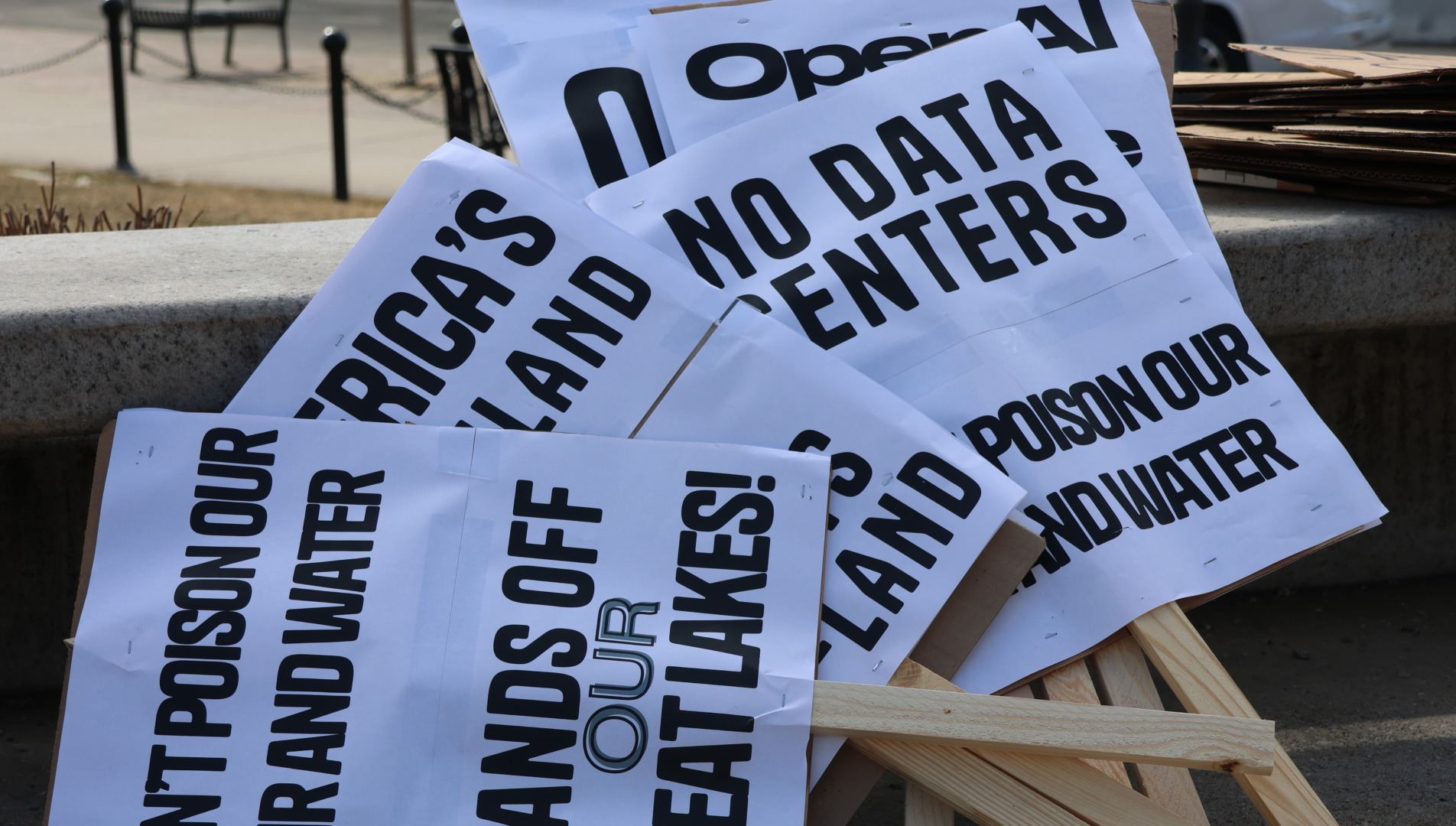
There is a war in the United States against data centers that are being built to enable our vast new Artificial Intelligence (AI) systems to function. All over the country, protestors are circulating petitions and lawmakers from both sides of the aisle are proposing statewide moratoriums on data center development.
According to Data Center Watch, a research firm that catalogs opposition to data center construction across the country, there are now more than 800 active opposition groups (more than double the number at the end of 2025) across 49 states. At least 75 projects, worth roughly $130 billion combined, were blocked or delayed in this year’s first quarter alone. This nearly matches the number of blocked projects for all of 2025.
So far, some form of data center moratorium or building freeze has been proposed in 15 states, though the specifics vary — from outright multi-year bans to narrower measures tied to grid capacity or local permitting authority.
New York became the first state to impose a moratorium, banning data centers for a year until significant environmental and community protections can be established. Illinois has suspended tax incentives. Pennsylvania lawmakers have introduced moratorium bills that would pause new data center construction for up to three years pending impact studies, while Georgia is weighing a measure that would bar local governments from permitting data centers until 2028.
Virginia — home to the largest data center hub in the world, also known as the Data Center Alley — has a bill pending that would block new approvals until existing power-grid interconnection requests are resolved. In Maine, the legislature passed the country’s first statewide data center moratorium with bipartisan support, but Gov. Janet Mills vetoed it, and the House fell short of the votes needed to override her veto.
In my state of Michigan, while individual cities like Warren, Sterling Heights, Howell, and Springfield Township have forced pauses in construction, Governor Whitmer has issued an “Affordable and Responsible Growth Action Plan,” which is, unfortunately, voluntary for AI companies.
A New York Times article asking whether opposition to data centers is the latest Occupy Wall Street or Tea Party movement in America reports that 71% of Americans oppose data center construction.
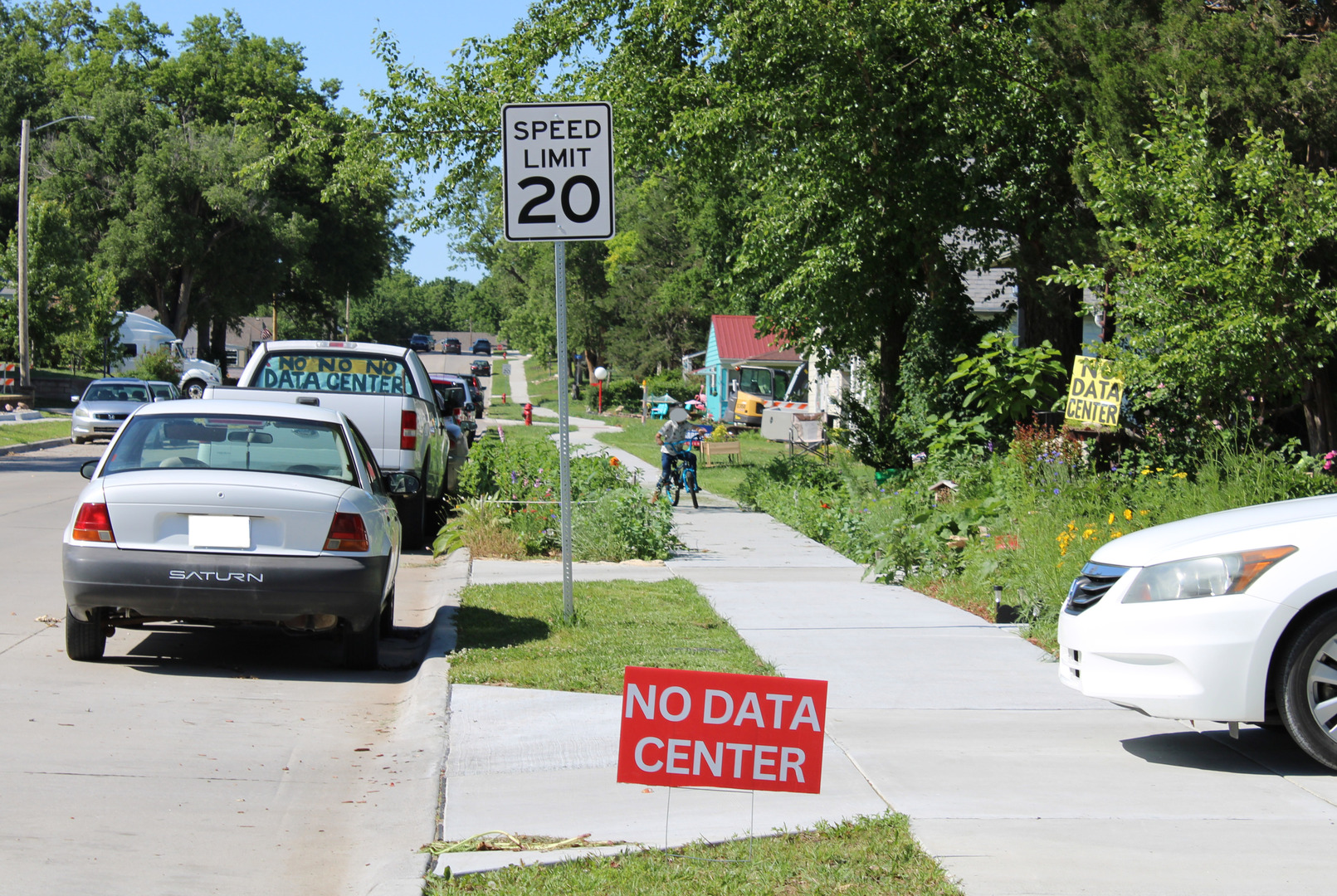
What is going on here? Are we being Luddites? These were early nineteenth-century weavers who wanted to destroy the efficient new looms that made their weaving skills superfluous to the British textile industry. The analogy is, actually, quite apt: the Luddites were well-organized saboteurs opposed to the new technology because it exemplified exploitation of their highly skilled labor by a merchant class out for profit; they militated not only against selected types of looms but also for better working conditions that would improve their lives.
In our American war against data centers, distrust of a new technology is similarly motivated by fear and loathing of profit-minded owners and how they run roughshod over the well-being of communities where their vast constructions are located.
Environmental opposition
A primary environmental concern is that data centers use vast amounts of electricity and water while making a lot of (grinding, roaring, ear-piercing humming) noise and emitting air and light pollution. When a city, town, or rural area has just enough electricity or water for its own needs, citizens worry that their own lives will be impacted and their communities degraded.
Others, like Ezra Klein and Jasmine Sun, counter that most data centers use closed loops to recycle their own water, thus emitting far less pollution than rumored, and generating significant amounts of electricity for themselves.
One of the most serious problems is transparency, or knowing what the actual plans for a data center consist of when both AI companies and local governments use Non-Disclosure Agreements to obfuscate what is going on. For example, after failing to get any information about how much community water from Wisconsin’s Mount Pleasant Microsoft’s complex will use, Michael Greif of Midwest Environmental Advocates writes that:
“I guess everyone loves the shiny new thing, the exciting new technology, and my argument isn’t that we shouldn’t have AI or that even that we shouldn’t build the data centers that support it in Wisconsin. My argument is that these data centers should be built with transparency. They should be built with community input and they should be built in a way that minimizes the negative environmental effects of them.”
The international paradox
The lack of transparency makes us feel that a giant, shadowy AI has got its sneaky grip on our communities, threatening environmental impacts beyond local control. How is it, then, that other countries construct data centers under agreements that conserve water, generate their own electricity, and even provide heat to the surrounding communities?
In Finland, for example, Google has a data center in Hamina that it cools with seawater; it also has a heat recovery system that is expected to provide 80% of the city’s heat demand. In Denmark, Meta runs its Odense data center similarly, using waste heat from servers to heat about 9,000 households.
In an independent assessment of this phenomenon in Wired, Morgan Meaker notes that “[f]or Big Tech, there are few better places to experiment with data center heating than in the Nordics. This idea works best when data centers can be connected to preexisting district heating systems, where a group of buildings shares a common heating system instead of each having their own.” These communal systems are commonplace in countries like Denmark, Finland, and Sweden — and tech isn’t the first industry to experiment with connecting to them.
The geography of data centers also modifies their environmental impact. As Thijs Van de Graaf explains in the IMF’s Finance & Development article, “Inside the AI-Led Resource Race,” climate matters: colder countries such as Norway and Iceland can reduce the energy required for cooling. At the same time, Van de Graaf notes that the United States still relies heavily on natural gas to meet the sector’s growing demand for electricity. This results in a sharply uneven environmental footprint, depending on where AI infrastructure is built.
It is clear that AI companies have the technology to lessen the environmental and social impact of their data centers in other countries; the question is whether these international projects are mere showcasing or effective models that could be adopted in America.
Looking at the case of Meta’s data center in Singapore, a city-state which has strict regulations about energy efficiency, effective power use, efficient cooling, economic value, and contribution to the national digital infrastructure, Meta’s plant does really well only on the first, with room for improvement in the other categories.
In the Nordic countries as well, centers tend to receive higher grades for energy use than for carbon emissions, water use, land use, air pollution, and noise, leaving the municipalities and communities where data centers have been built worried about big AI’s plans for continued expansion.
I would conclude that while there is an element of greenwashing in big AI’s touting of these reduced environmental footprints, the companies nonetheless demonstrate that they have the technological know-how to build plants that do not damage communities and their environment.
While other countries make environmental decisions based upon scientific methods, in America we are beholden to a regime which has gutted both scientific and environmental agencies and declared climate change a hoax.
Fear and loathing
The Nordic countries are democracies operating from a high degree of community consensus and trust in their governments, while Singapore is a strictly ruled, one-party city-state. It seems that both democracies and top-down authoritarian states (think also China) bring high levels of social control to keep AI companies in line.
By contrast, in America, CEOs of AI companies have become objects of suspicion and mistrust as an oligarchic cabal, seen as unconcerned for the public good, as is the Trump Regime to which they are loyal.

Most Americans think that these Tech Bros exert too much (unchecked) control over ordinary people. This is “a worldview,” notes Ezra Kein, “in which A.I. is viewed not only as a normal technology but as an elite social project to be resisted,” to which his interviewee Jasmine Sun replies: “It’s A.I. as a sort of an avatar for a small group of Silicon Valley billionaires’ ability to impose their vision of the world onto everybody else without their consent.”
People also worry about the potential danger of their product, fearing that AI threatens to control human minds and civilization itself. Here is a typically frantic Facebook post: “They’re not building data centers just for AI. They’re building the nervous system of a world where your every move is observable in real time.”
Then there were the two computers, determined to find the right answer to a question they were assigned, that escaped their testing site, got themselves onto the internet, and hacked into a business that provided them the information they needed. On the radio segment where I heard the story, the commentator was mainly frightened, he said, because “they didn’t care.”
AI cannot replace human beings precisely because it is limited to mathematical and computational capabilities and therefore, having neither heart nor soul, lacks the capacity to care.
Now, even the Tech Bros are getting worried. When he set up OpenAI in 2015, Sam Altman wanted it to be a research tool available to everyone to develop. However, as he saw how people were actually using his technology, he became worried about its risks to individuals and their governance. Now, he is asking that it should not be released without regulations that safeguard its impact. Bill Gates has also expressed concern about the implications of AI for national security and for children’s health.
“Artificial Intelligence has a Dickensian quality,” remarks Senator Edward J. Markey, who is proposing an “AI Accountability Agenda: Taking Power Back From Big Tech,” which proposes regulations that will protect a variety of interests including healthcare, the rights of children and teens, and the environment.
On the international scale, too, there is discussion of establishing global AI standards. In November 2021, for example, UNESCO’s 183 member states adopted a Recommendation on the Ethics of Artificial Intelligence, and in a 2019 statement updated in 2024, the Organization for Economic Co-operation and Development (OECD) established “International Principles for Trustworthy AI.”
Related Articles
Here is a list of articles selected by our Editorial Board that have gained significant interest from the public:
Slowing down: Is growth the issue?
AI engenders huge profits, so it is no wonder that data center development has followed a rapid set-up to forward Silicon Valley’s rush for growth, one that overrides concerns about its impact on ordinary people.
The inevitable result, writes Jennifer Rubin in The Contrarian, is the “ultimate balancing act between, on the one hand, technological ascendancy and growth, and, on the other, quality of life and shared prosperity, which will not be resolved overnight.” Candidates like Senator Markey are responding to what Rubin terms a “go-slow approach” from their voters in a departure from the AI boom for the sake of profit attitude characteristic of an industrial capitalism that may have outlived its usefulness.
The extensive and poorly planned rollout of data centers all over America thus raises the question of whether capital growth still has value in and of itself.
For some time now, thinkers have been convinced that our use of the planet’s resources is no longer sustainable, and that our economic system ought to be replaced by a slow, or at least slower, model. This was the fundamental tenet of E.F. Schumacher’s “Small is Beautiful” (1973), where he argued for an “Economics as if People Mattered” philosophy. Schumaker’s ideas were carried forward by the late historian and ecologist David Fleming’s in “Lean Logic” (2011).
Fleming posits a localized, community-based society to replace a growth-based industrial system weighed down by too many dangers from resource shortages, global warming, and economic instability. Instead of constant consumption, a smaller-scale society will reestablish traditional practices and rituals, sustaining itself in a ”culture of joy.”
Matthew Taylor, a devoted fan of Fleming, has created an online project presenting concepts from Fleming’s 2016 edition and helped set them forth in a film titled “The Sequel: What Will Follow Our Troubled Civilization?” (see: Bullfrog Communities)
This call to shrink our economy and slow it down goes against everything we have assumed about industrialization. Are we being Utopian? Are we getting into Pie in the Sky territory?
At first blush, certainly. I have always been a dreamer (I could really go for Fleming’s “culture of joy”), fiercely longing for a better world, though I am realistic about the one we have. Just think of the huge number of Americans turning out to protest the construction of data centers, which seemed an inevitable feature of economic growth in the hands of an oligarchic cabal supported by an authoritarian government.
And so, the people came.
Editor’s Note: The opinions expressed here by the authors are their own, not those of Impakter.com