
In 1791, the US Constitution’s Bill of Rights was ratified to include ten amendments. The First Amendment guarantees five freedoms to all American citizens: the freedom of religion, speech, press, peaceful assembly, and the freedom to petition to government for redress of grievances. Within the first section, the freedom of religion includes two clauses on the relationship of government to religion. It states that, “Congress shall make no law respecting an establishment of religion, or prohibiting the free exercise thereof.” Its place as the first section within the First Amendment is not mere coincidence, given the historical formation of the US. Although the Pew Research Center reports that young Americans are increasingly non-religious (22.8% as of 2014), these clauses continue to resonate as religious individuals in the US require protection regardless of their belief, thus introducing a need for religious studies to be incorporated in the basic educational curriculum.
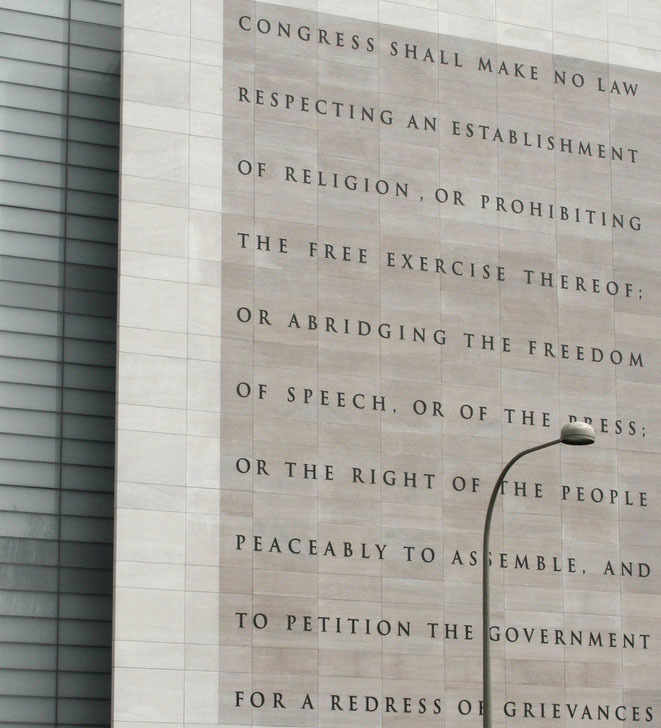 PHOTO CREDIT: Wikimedia Commons
In 2014 and 2016, 1 in 3 Sikh and Hindu students who were interviewed by the Sikh Coalition and the Hindu American Foundation, respectively, reported being bullied for their beliefs, perceived religious identity or actual religious identity. In 2015, 1 in 2 Muslim students interviewed by the Californian branch of the Council of American-Islamic Relations reported being bullied for their religious identity. After the 2016 US Elections, a poll by the Institute for Social Policy and Understanding showed that 42% of Muslim parent respondents and 23% of Jewish parent respondents had school-age children who were bullied, where 25% of bullying among Muslim students stemmed from teachers or school officials. In the same poll, 60% of Muslims (mostly younger Muslims, women, and Arabs), 38% of Jewish people, and 11% of Catholic experienced religious discrimination after the elections.
More recently, since April 2017, San Diego parents have protested against and are suing the San Diego Unified School District over a proposed curriculum to counter bullying towards Muslim students. In May 2017, two men were killed in Portland while protecting two Muslim teenage girls from religious harassment. Just last week, on June 10, 2017, the March against Sharia law occurred across 28 US cities.
In this state of discrimination, fear, misunderstanding, polarization, and disparate voices comes the potential of the educational system.
The big change
On June 12, 2017, the National Council for the Social Studies (NCSS) supplemented their existing curriculum to include religious studies from Kindergarten to the 12th grade. As the NCSS presents curriculum standards at a national level, the new inclusion of religious studies in the College, Career, and Civic Life (C3) Framework shows that the academic study of religion is a core component of global citizenship and domestic civic life in order to develop “informed, critical, and engaged citizens”. In doing so, the C3 Framework adopts the conception of religious literacy used by the American Academy of Religion, where a religious literate person possesses “a basic understanding of the history, central texts (where applicable), beliefs, practices, and contemporary manifestations of several of the world’s religious traditions and religious expressions as they arose out of and continue to shape and to be shaped by particular social, historical, and cultural contexts; and the ability to discern and explore the religious dimensions of political, social and cultural expressions across time and place.” In a news release on this announcement, Dr. Charles Haynes, Founding Director of the Religious Freedom Center in Washington, D.C., lauded the NCSS for recognizing that, “Religious literacy is not an add-on or an afterthought.” Like many other global contexts, religious literacy is now given its own standing in the US school system.
However, skeptics of this supplementary curriculum are leery of this change and rightly so, as various forms of religious studies exist. While the teaching of religion occurs in a confessional setting and promotes the belief of the host institution or community, teaching about religion intends to teach about the beliefs, practices, and behaviours of a group from a non-confessional standpoint. Some global contexts aim to teach from religion in order to highlight the beneficial practices and perspectives of some communities without the promotion of beliefs from any belief group, but the NCSS promotes teaching about religion. In doing so, the separation of Church and State is not only maintained but required. The opening paragraphs of the C3 Framework address this salient imperative.
 PHOTO CREDIT: Flickr
Yet, reports show that some teachers proselytize in class and bully students with beliefs that differ from their own. As such, it is hard to determine the long-term success of this implementation at this time. Questions remain. For example, how will parents and community members respond to this? How will teachers respond? Will Faculties of Education and Teacher Certification programs prepare teachers for this new curriculum? Moreover, how will school administrators respond? My research has shown that the most capable teacher with the best intentions is greatly limited by their administration; if the school principal and district administrator is against the teaching of religious literacy, the teacher’s contribution to their class and school is heavily constrained.
Withstanding these questions and skeptics, perhaps now is a time to steer change for purely practical reasons.
A practical rationale
In some schools and neighbourhoods, students are bullied for their religious beliefs, or their actual or perceived religious or non-religious affiliation. This religious bullying is often misrecognized or overlooked by teachers, and occurs among adults in the workplace and community as well. This is of great concern as all forms of bullying pose short-term and long-term effects into late adulthood for all those who are bullied, bully, or witness bullying. While prejudice, bias, and hate may be the basis of bullying, discrimination, hate crimes, and murders, misinformation and a lack of knowledge about different belief groups are other elementary reasons for these acts. As such, society needs a source of knowledge and skills to counter these inaccuracies.
Evidently, the NCSS sees this need and is trying to address it based on its given resources. To support this cause, research cannot show that religious literacy courses can directly offset the occurrence of religious bullying, discrimination, and hate crimes; however, studies have shown that religious literacy courses have transformed the attitudes of students towards people of differing beliefs, including attitudes towards their least-liked group. Thus, educational institutions, fellows at the Religious Freedom Center, and researchers are finding means to address this relevant need today. How do you, as a member of the global society, intend to protect the rights, well-being, and safety of others around you, regardless of their belief? What part will you play?
To learn more about religious bullying and ways to recognize it, click here. To increase your own religious literacy, consider Harvard University’s MOOC on religious literacy or review videos from Religion for Breakfast.
Bio
- Y. Alice Chan is a PhD Candidate in the Faculty of Education at McGill University. She conducts research on religious bullying, religious literacy, and citizenship education in the US and Canada, as well as the role of education in countering violent religious extremism globally. She has been a Lead Author on global reports for UNESCO-MGIEP and the Tony Blair Faith Foundation. Her studies in Sociology and Economics (Queen’s University), Masters of Teaching (OISE/UT), and work in Fortune 500 corporations, NGOs, schools, and leadership in the community equip her with the insight to bridge perspectives across these milieus.