In his farewell address on Jan. 11, 1989, then President Ronald Reagan spoke of the United States “as the shining city on a hill,” an open society, “teeming with people of all kinds living in harmony and peace…if there had to be city walls, the walls had doors… open to anyone with the will and the heart to get here.”
For many people, U.S. citizens and the rest of the world, this “city” has fallen a fair distance.
Relevant U.S. Judicial History
One of three branches of government designed to serve as a check and balance on the other two is the Supreme Court. Established by the Judiciary Act of 1789, it has been a conservative institution over much of its 236-year existence.
There are examples, just to mention a few milestones: The decision in Dred Scott v. Sandford in 1857 determined that African Americans could not be U. S. citizens and, as slaves, were property of their owners; Plessy v. Ferguson (1896), which upheld racial segregation; Lochner v. New York (1905), which struck down a state law limiting working hours; Hammer v. Dagenhart (1918), which struck down a federal law banning interstate shipment of goods made with child labor; Adkins v. Children’s Hospital (1923), which struck down a federal law establishing a minimum wage for women in the District of Columbia; Schechter Poultry Corp. v. United States (1935), which struck down FDR’s National Industrial Recovery Act; Hirabayashi v. United States (1943), which upheld a curfew on Americans of Japanese origin who had done nothing wrong; and Korematsu v. United States (1944), which upheld the forced internment of Americans of Japanese ancestry who had done nothing wrong.
The pattern was interrupted by the appointment of liberal Supreme Court Chief Justice Earl Warren in 1953. He was supported by Associate Justices Hugo Black, William O. Douglas, William J. Brennan, Jr., and Thurgood Marshall. Warren was replaced as Supreme Court Chief Justice by Warren Burger in 1969, who was joined by more conservative colleagues. The Court nonetheless decided landmark decisions such as New York Times Co. v. United States (1971), which upheld press freedom in allowing the publication of the Pentagon Papers (despite the Nixon Administration’s claim of the need for secrecy), and Roe v. Wade (1973) regarding abortion rights.
The Roberts Supreme Court of Today
Although not to the liking of many, the decisions by each of these earlier Courts were made by considering basic legal and constitutional principles. What is different now is that the Supreme Court, with Chief Justice John Roberts, is composed of three longstanding, staunchly conservative members recently joined by three conservative Trump appointees and has not shown a willingness to limit the current President. Some of the current Justices are die-hard, committed to “originalism” and opposed to the Court creating new rights.
In the current term of the Court, the six conservative Justices seem less inclined to spell out legal reasoning in their decisions: many of their significant decisions have been announced with the sparest of explanation, and most often seem to be what President Trump wants, frequently shadowing Project 2025 recommendations.
Do the conservative Justices accurately follow the wishes of the Founding Fathers? Those men were the “originators”; they probably put the First Amendment before the Second Amendment for a reason, which historians can explain in depth. How does that track with the behavior of today’s Supreme Court, one that holds the “right to bear arms” in the highest regard, and often interprets it to mean whatever gun supporters want, while muzzling “free speech” when the President and his supporters consider it “offensive”?
In New York State Rifle & Pistol Ass’n, Inc. v. Bruen (2022), the Supreme Court held that New York’s “proper-cause” requirement for obtaining an unrestricted license to carry a concealed firearm violates the Fourteenth Amendment in that it prevents law-abiding citizens with ordinary self-defense needs from exercising their Second Amendment right to keep and bear arms.
That said, in 2024 the Supreme Court ruled that domestic abusers who are subject to restraining orders do not have a constitutional right to own guns.
Related Articles: How Racist is the American Political System? | The US System Is Not Working | The Post-Roe Era Has Begun: What It Means for the US and the World | Trump Responds to Whether He Will Uphold the Constitution: ‘I Don’t Know’
With respect to “free speech,” in Moody v. NetChoice (2024) the Court held that social media companies are not exempt from First Amendment principles, signaling that their content moderation practices could be subject to scrutiny in future cases. And most recently, the assassination of a political figure, Charlie Kirk, has opened widespread public reaction to what should be allowed as “free speech.”
At the very least, inconsistent treatment at best.
Due Process: “To Be or Not to Be”
After the American Civil War, in 1868, the Fourteenth Amendment was ratified. Section 1 states that it is unlawful to “deprive any person of life, liberty, or property, without due process of law…nor deny to any person within its jurisdiction the equal protection of the laws.” Note that the Amendment uses the word “person,” not the word “citizen.”
This language is now at the center of discord across the country, touching on whether a person who entered the country unlawfully is entitled to some form of “due process.” Detention — essentially arrest and internment — happens now without a claim that such individuals have rights. Indeed, it is not an overstatement to suggest that the Trump Administration writ large and its enforcement entities are conducting a vendetta against those who often do not have the resources, language skills, education, or understanding of their rights granted by this venerable Constitution as amended.
A different due process issue related to U.S. military strikes on alleged Venezuelan drug vessels in international waters. It has raised serious questions as to whether these boats “could have been interdicted rather than destroyed — as has been done in the past — but that the president ordered a lethal strike as a matter of first, not last, resort.”
The strikes were conducted without any apparent effort to determine if all individuals who were on board and killed, were culpable of the allegations, and thus any regard to due process.
The Damage Being Done
What America stood for to the rest of the world for so many years was embodied in the gift of France in 1886, the Statue of Liberty, which is located near Ellis Island. She holds in her right hand a torch, symbolizing enlightenment and the path to freedom. The words (from a sonnet by Emma Lazarus) engraved on a plaque on the statue’s pedestal are:
“Give me your tiredness, your poor,
Your huddled masses, yearning to be free,
The wretched refuse of your teeming shore.
Send these, the homeless, tempest-tossed to me,
I lift my lamp beside the golden door!”
Today, this lamp does not shine as brightly on what was once the “city on a hill.” The words below from Madonna’s “Don’t Cry for Me Argentina” (1996) capture what would be Lady Liberty’s virtual tears:
“It won’t be easy, you’ll think it strange.
When I try to explain how I feel
That I still need your love after all that I’ve done
You won’t believe me, all you will see is a girl you once knew.”
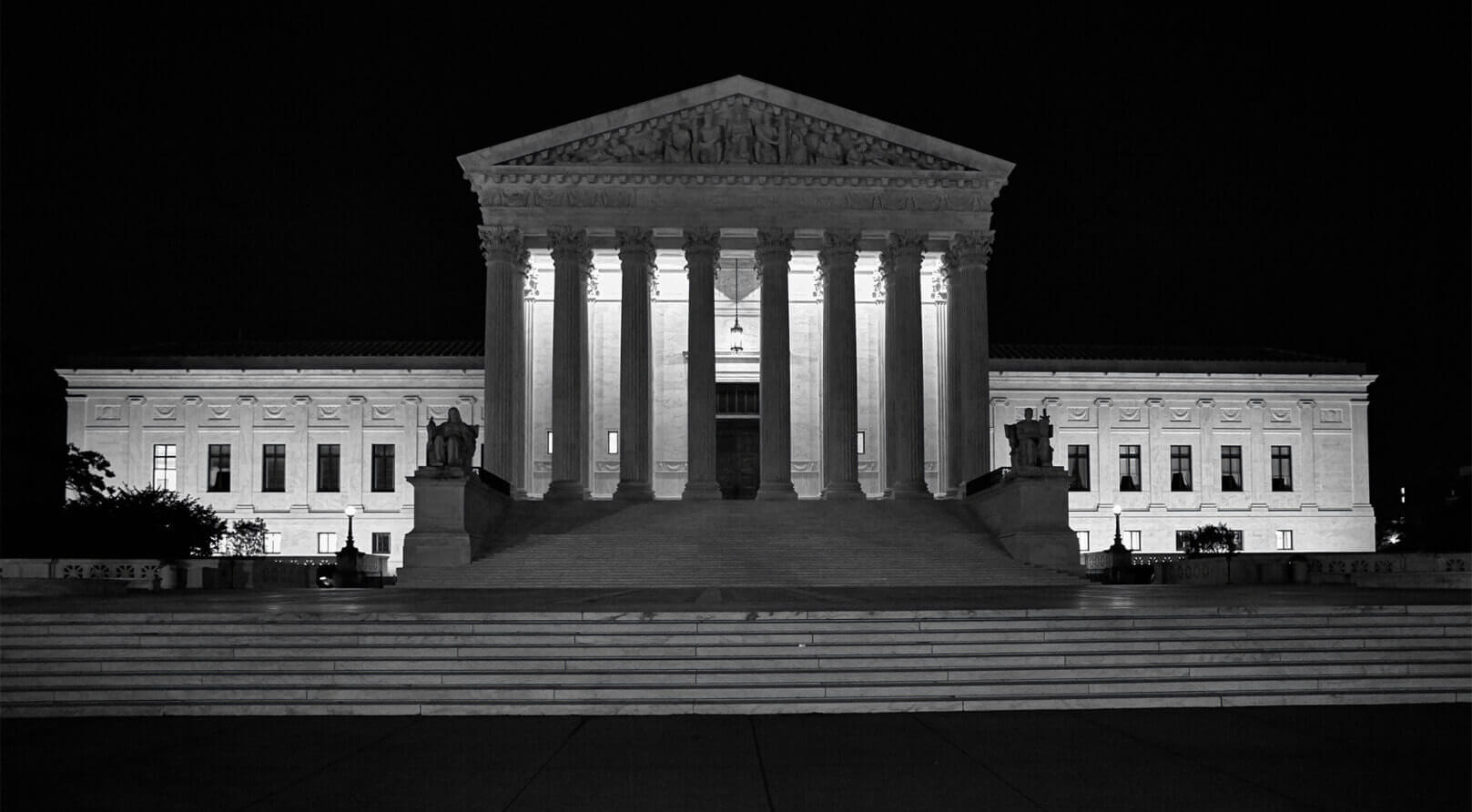
Editor’s Note: The opinions expressed here by the authors are their own, not those of Impakter.com — In the Cover Photo: The Supreme Court of the United States. Cover Photo Credit: Wikimedia Commons.