Every tonne of carbon dioxide emitted carries economic harm inflicted on people around the world, compounding quietly over decades. A new study by researchers at Stanford University, published in Nature on March 25, proposes a first version of a framework to calculate that figure precisely: who caused the damage, how much, and where it landed.
The scale of the findings is shocking. One tonne of CO₂ emitted in 1990 caused approximately $180 in discounted global economic damages by 2020, and will cause a further $1,840 through to 2100 — a tenfold difference. The future debt vastly outweighs the historical one. It would not be enough to see the harm as a debt or a penalty for emission-intensive activity.
The study arrives at a defining moment for the international climate agenda. The Loss and Damage Fund agreed at COP27 remains largely unfulfilled. Climate litigation is unfolding across multiple jurisdictions. In Washington, the federal government’s own estimate of the social cost of carbon — the standard tool for weighing the harm of emissions against the cost of reducing them — has been dramatically cut back under the current administration, which has also withdrawn the United States from the Loss and Damage Fund, the Paris Agreement, UNFCCC, and the IPCC, among many other international bodies and treaties.
Calculating the social cost of carbon
The team behind the study is led by Marshall Burke, a professor of Global Environmental Policy in the Doerr School of Sustainability at Stanford. Researchers treat a unit of CO₂ emissions as a financial asset that generates a flow of costs. These costs accrue to people who had no part in creating it. They compare it to an unpaid garbage collection bill. The difference is that this garbage is in the atmosphere, it’s invisible, and the costs compound for generations.
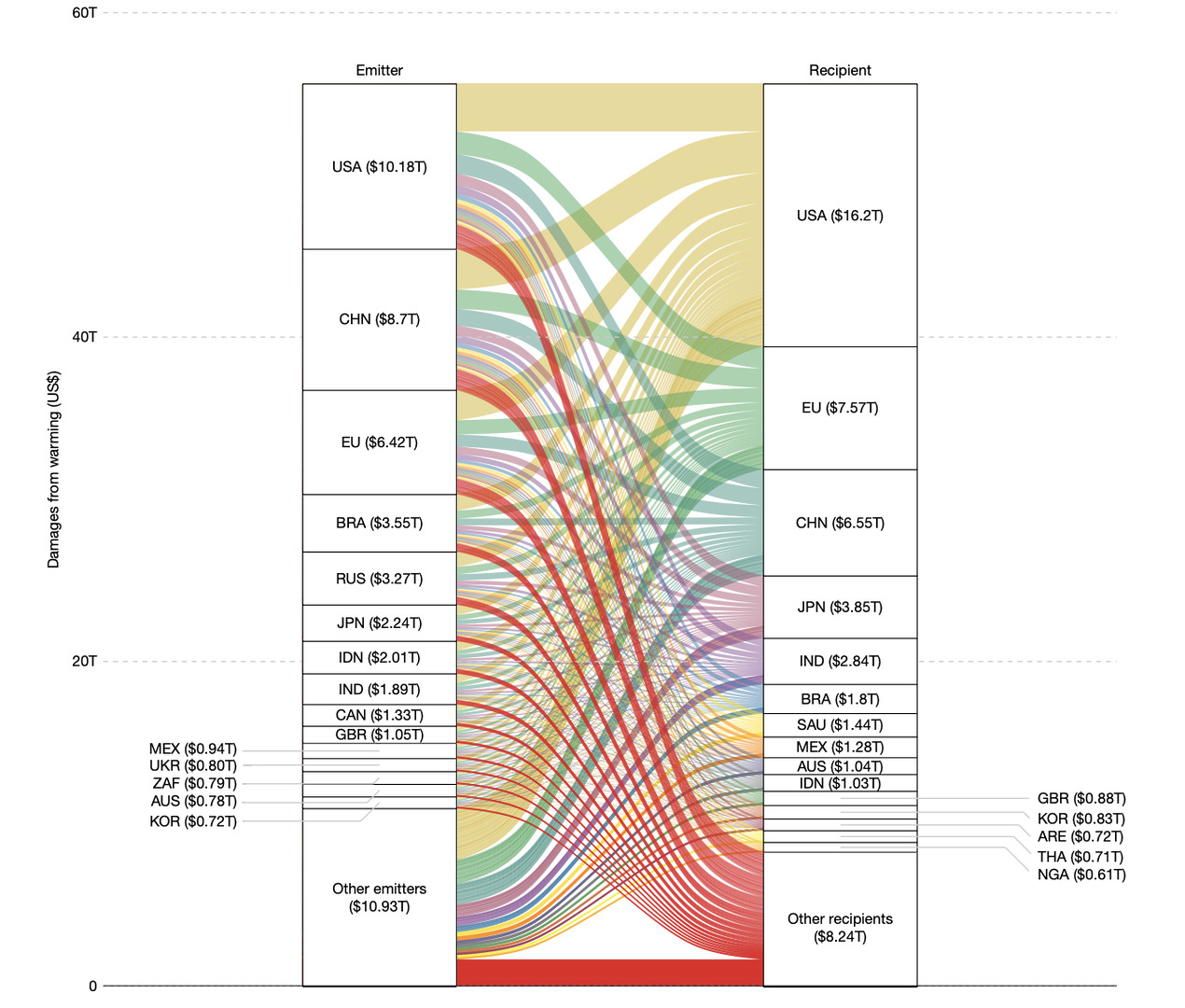
The study calculates cumulative damages attributable to country-level emissions between 1990 and 2020. The United States was the single largest source, generating approximately $10.2 trillion in total global economic harm by 2020 — of which roughly 30%, or $2.97 trillion, fell within the US itself, and a further 14%, or $1.39 trillion, in the European Union. China was the second-largest source at $8.7 trillion, followed by the EU at $6.42 trillion. Taken together, these three emitters account for the majority of all quantified global climate damage over the period.
The picture of who received the damage cuts differently. US emissions since 1990 have caused $500 billion in economic damage in India and $330 billion in Brazil. It’s important to note, however, that the uncertainty ranges are very wide: $180–$1,300 billion for India, $110–$820 billion for Brazil. The numbers are not precise, but precision is not the only goal, even these estimates paint the general picture.
The geographic pattern of relative damage — harm as a share of GDP — is starker still. Damages proportional to GDP are largest in tropical and mid-latitude countries, where warming suppresses economic growth with high statistical confidence, while high-latitude nations experience limited effects or in some cases modest benefits. The countries that contributed least to emissions are paying the highest relative price.
To translate emissions into monetary harm, the researchers combined global climate models with a relationship between temperature and economic activity. The key finding is that warming depresses not just economic levels but growth rates. This means that the damage compounds over time rather than hitting once and fading. It is the mechanism that makes the long-run numbers so much larger than near-term estimates.
The team of researchers combined their approach with the existing social cost of carbon framework — the same tool regulators use for climate policy. Under conservative assumptions (a 2% discount rate, with impacts counted only through 2100), the team calculates a social cost of carbon of $1,013 per tonne. That number is at least five times larger than recent estimates produced by the US federal government.
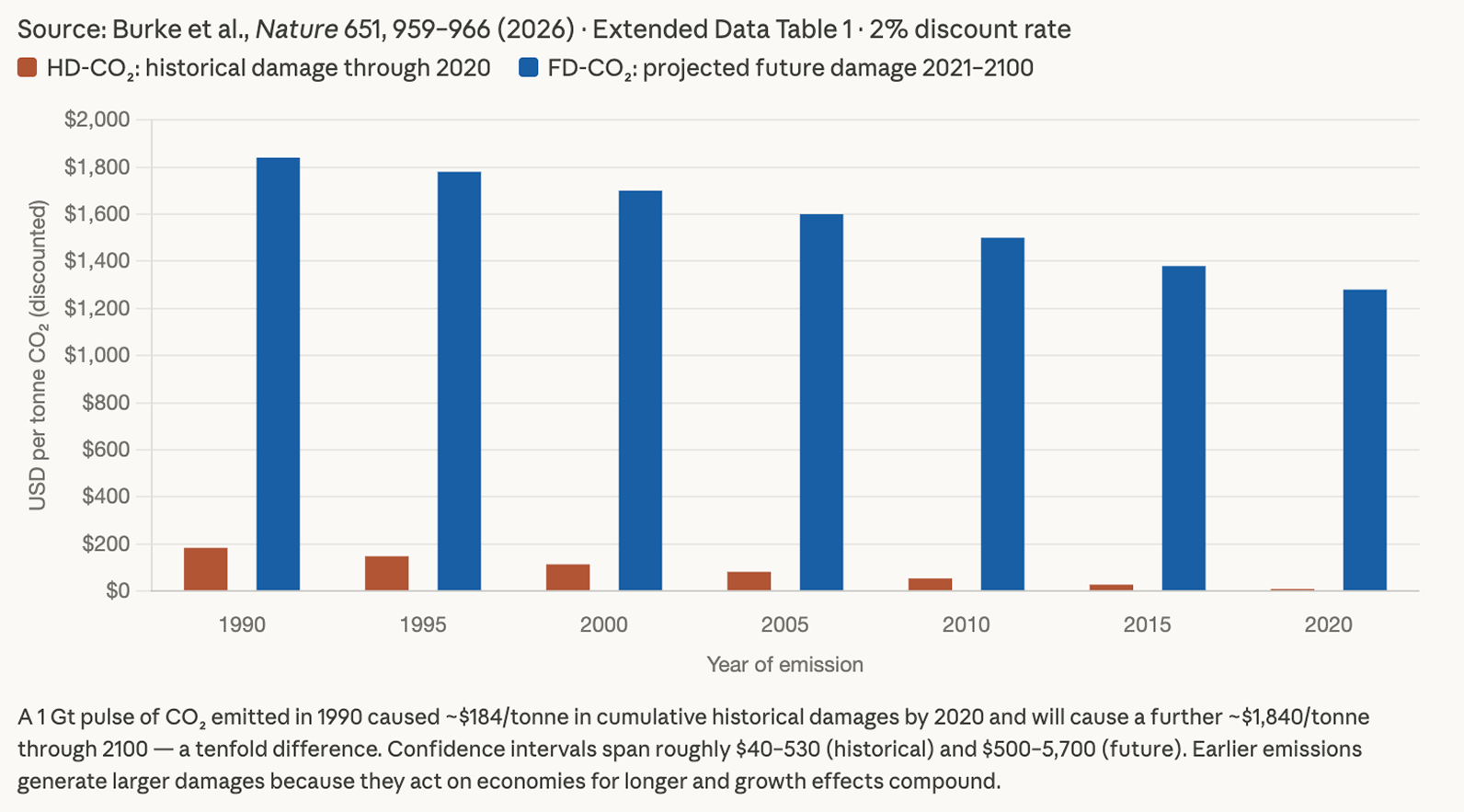
The discount rate deserves emphasis here because it is not a technical footnote — it is an ethical and political choice that reshapes the entire calculation. A higher rate makes future harms look smaller in today’s money, reducing the apparent cost of inaction; a lower rate treats future people’s suffering as roughly equivalent to present suffering. The authors present results across a range from 1% to 5%, precisely because this choice cannot be settled by science alone.
The study arrives at a defining moment for the international climate agenda. The Loss and Damage Fund agreed at COP27 remains largely unfulfilled. The current US administration has pulled out of it and the loss of the largest global economy proves to be critical for the initiative. The same is true for the Paris Agreement, UNFCCC and IPCC. Climate litigation is expanding across multiple jurisdictions.
Related Articles
Here is a list of articles selected by our Editorial Board that have gained significant interest from the public:
The general situation beyond numbers
The study has structural limitations, and the authors state them. The damage function is built on temperature and GDP — powerful but incomplete. Health impacts, sea-level rise, tropical cyclones, the loss of cultural homelands, and damage to ecosystems are not captured in the current estimates. The figures understate total harm, potentially by a lot.
There is also the question of adaptation. As the study authors explain:
“An accelerated adaptation scenario under which GDP is assumed to become successively less sensitive to temperature over time — a trend inconsistent with the observed stability in the temperature–GDP relationship over the past 60 years and the general lack of observed change in sensitivity at the sectoral level — could reduce future damages substantially, with the magnitude of reduction dependent on the assumed adaptation rate.”
There is limited evidence that societies have succeeded in reducing their sensitivity to warming. The authors tested a scenario in which adaptation progressively reduces sensitivity over time — consistent with the optimistic view that human ingenuity will outpace climate impacts — and found it would substantially reduce future damage estimates. But they note this trend is not visible in the historical data, and the burden of proof for assuming that it will materialise lies with those who invoke it.
A further complication is incentive design. The framework defines loss and damage as harm net of any adaptation taken, which creates a perverse incentive if compensation is tied to this figure: countries might rationally under-invest in protection to maximise their claims. Any implementation would require careful system design to avoid this trap.
Finally, the framework explicitly does not determine legal liability. Consistent with Article 8 of the Paris Agreement, the authors stress that their damage estimates do not necessarily equal what is owed by one entity to another. They describe such as a moral and legal question beyond the scope of the analysis.
Editor’s Note: The opinions expressed here by the authors are their own, not those of impakter.com — Cover Photo Credit: Zhang qc