We are now witnessing a major military policy shift with Trump and his Administration’s efforts to compel loyalty from generals, admirals, and senior enlisted advisors. President Trump and US Secretary of War Pete Hegseth are methodically pushing the boundaries on, and expanding the use of, troop deployments for perceived domestic problems within the United States.
On September 30, Secretary Hegseth called together 800 senior leaders from all over the world to Quantico for an unprecedented meeting, which President Trump joined, to assert their control over the military. It is becoming evident that the President and the Secretary are attempting to consolidate their powers over our military leadership, and are increasingly using the National Guard, and even the active-duty military, domestically as policing instruments.
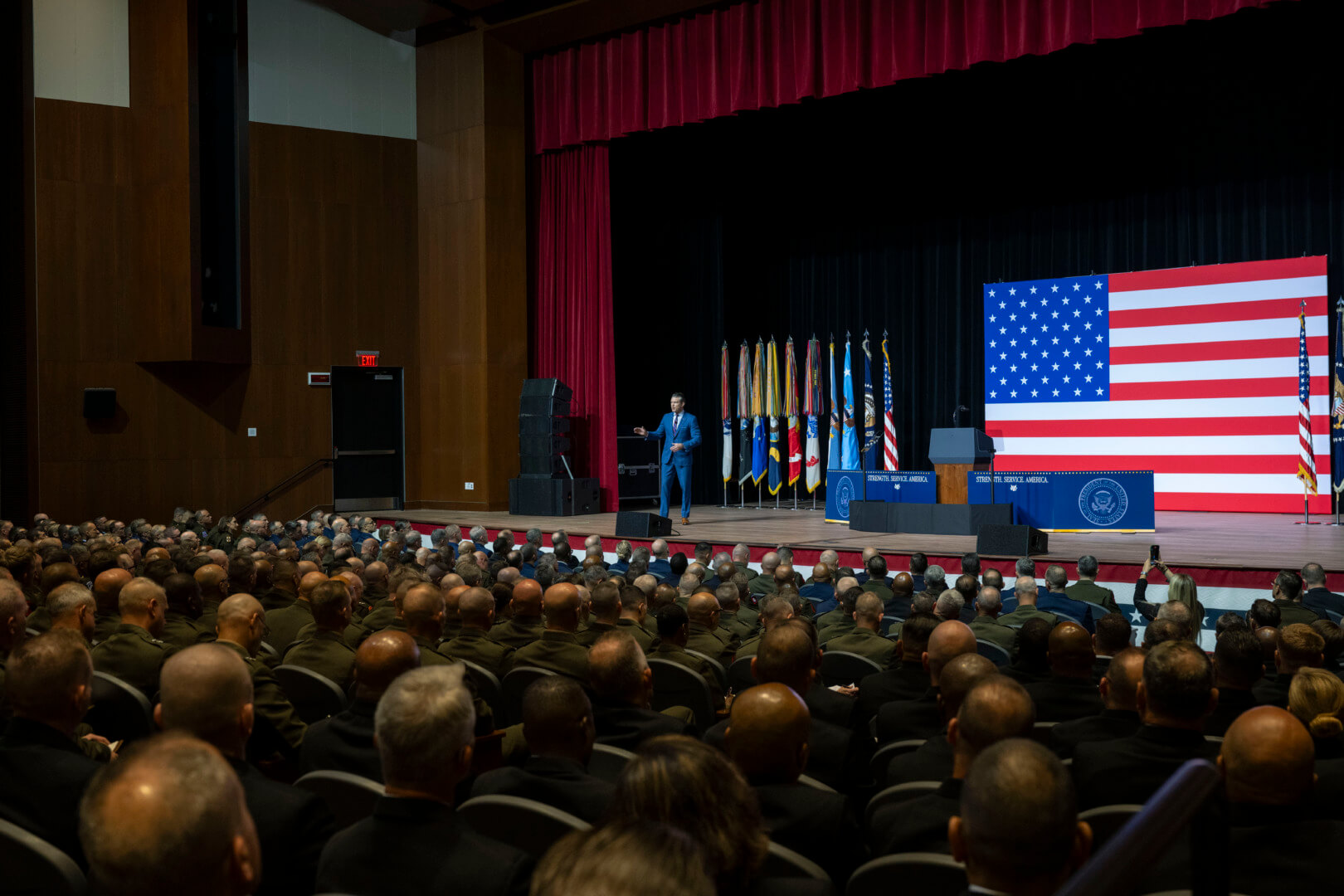
Secretary Hegseth, who grew up in Minnesota and attended Princeton University where he was editor-in-chief of The Princeton Tory, was a cadet in the Army Reserve Officers’ Training Corps (AROTC). He graduated in 2003, was commissioned as an Army infantry officer, and worked at Bear Stearns as an equity-markets analyst. Hegseth served combat tours in Iraq and Afghanistan and was awarded the Bronze Star Medal twice. In 2014, Hegseth became a commentator on the Fox News Channel and worked for various conservative causes until President Trump nominated him to be Secretary. In January 2025, Hegseth was confirmed by the Senate in a 51–50 vote; this was only the second political confirmation in US history to be decided by a vice president.
While the Quantico in-person meeting could easily have been held over secure video link, Hegseth wanted to speak personally to “his” senior military leaders, even at great public expense and disruption to the worldwide command structure. It was painful and embarrassing to watch Secretary Hegseth lecture the nation’s most senior military leaders about his priorities and personal grudges, including turning back the clock to 1990, railing about resetting physical standards, inspectors general, rules of engagement, and concentrating on defending the U.S. and the western hemisphere.
“No more identity months, DEI offices, dudes in dresses. No more climate-change worship. No more division, distraction, or gender delusions. No more debris,” Hegseth said, and included the threat: “If the words I’m speaking today are making your hearts sink, then you should do the honorable thing and resign.”
Hegseth was joined by President Trump, who gave a bizarre 72-minute political speech as he rambled on about leftist threats and “training for a quick reaction force that can help quell civil disturbances. And this is going to be a big thing for the people in this room, because it’s the enemy from within,” and suggested “we should use some of these dangerous cities as training grounds for our military.”
Trump’s speech at Quantico was met by silence from the senior military leaders, who were probably wondering what will come next. They all work by a code of ethics and have a shared trust and loyalty to support and defend the Constitution — not to the President or any individual. At their commissioning, every new U.S. military officer solemnly swears: “I will support and defend the Constitution of the United States against all enemies, foreign and domestic; that I will bear true faith and allegiance to the same” (Title 5 U.S. Code 3331).
The Quantico meeting was a pivotal event for this Administration. The President and Hegseth are attempting to consolidate their powers over the military and appear to be preparing senior military leaders for expanded additional domestic duties which push the limits of and violate the 1807 Insurrection Act and the Posse Comitatus Act of 1878 (amended 2021).
In response to the 2020 George Floyd protests, President Trump considered invoking the 1807 Insurrection Act, but was thwarted by Attorney General Barr, Defense Secretary Esper, and JCS Chief General Milley. Trump threatened to use the Act again this year during the southern border crisis and in Los Angeles against immigration protesters. Trump and Hegseth are increasingly pushing against, and bending the traditional rules to assert their control over the active-duty military to enable deployment within our nation.
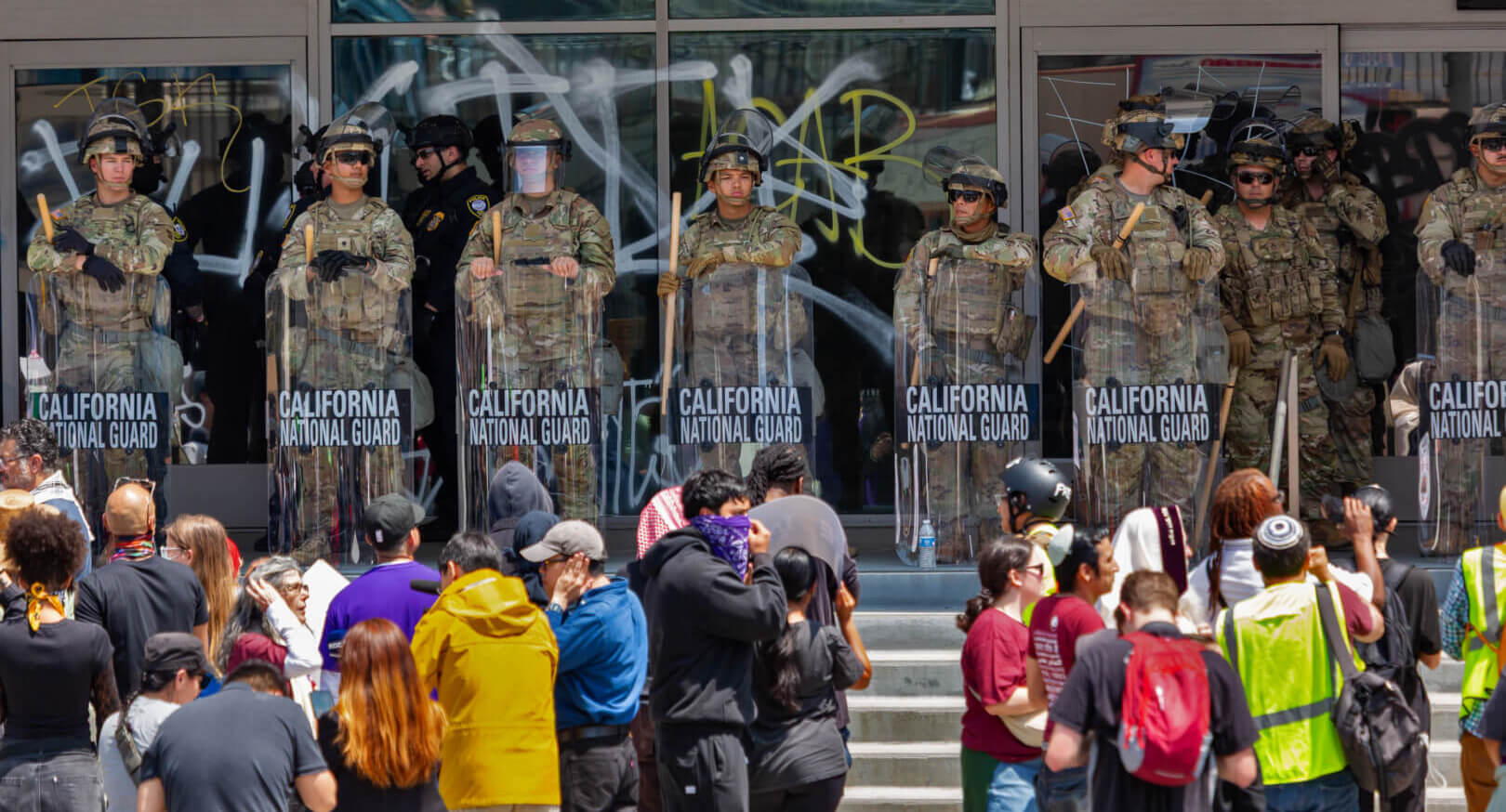
The President has deployed the National Guard to many cities that have Democratic Party leadership or are in “Blue states,” citing crime and protesters’ potential threats to federal buildings and personnel. Under the Posse Comitatus Act of 1878 (amended 2021), troops under federal authorities are generally prohibited from conducting law enforcement actions against civilians within the U.S. The Act’s purpose is to reinforce the traditional separation of military and civilian law enforcement.
In June, the Administration deployed over 700 active-duty Marines to Los Angeles to protect federal buildings and personnel without invoking the Insurrection Act. In August, Trump claimed that crime had increased and sent more than 2,000 National Guard troops to Washington, DC, “despite data from the Department of Justice showing it had drastically decreased and is at a 30-year low.”

Some cities have filed lawsuits asserting that the deployment of the National Guard was illegal. In September, a federal judge ruled that Trump’s use of the National Guard in Los Angeles was unlawful since the Secretary of Defense had expanded National Guard duties to include crowd control, security patrols, traffic and riot control. The Administration has appealed this decision.
The increasing trend for the Administration to use military personnel for domestic operations — often without the approval of the cities and states targeted — is clear. Having earlier deployed troops to Los Angeles and the District of Columbia, Secretary Hegseth ordered 200 Oregon National Guard soldiers into Portland on September 27 after President Trump declared the city “war-ravaged.”
Related Articles: What Is Trump up to and Can It Be Prevented? | What the 3.5% Rule Tells Us About Protest Success | American Democracy at Risk: Three Retired Army Generals Sound the Alarm
On September 29, the Illinois National Guard was notified for activation when “The Pentagon said it had received a request to help protect federal personnel, property and functions.” Governor Pritzker said that Trump’s increased immigration enforcement in Chicago was a “pretext to deploy military troops against” the Chicago area.
On October 1, Secretary Hegseth, Attorney General Bondi, and White House Deputy Chief of Staff Miller flew to Memphis to survey the “Safety Task Force” which includes “219 National Guard members who had been deputized as ‘special U.S. Marshals,” according to Bondi. Representative Cohen, who represents Memphis pushed-back, said:
“Memphians are not enemies; they are Americans. They are entitled to constitutional rights, not their government working to ‘intimidate, demoralize, hunt and kill’ them. We are not a training ground or target practice.”
States have filed several lawsuits and in a significant October 4 ruling, Trump-appointed U.S. District Judge Immergut temporarily blocked the President from deploying Oregon National Guard troops to Portland. She stated that “there was no evidence that recent protests rose to the level of a rebellion or seriously interfered with law enforcement.” According to the lawsuit, Oregon argued that the deployment of National Guard troops violates federal laws and the state’s right to police its own citizens, and that the decision to send troops only to “disfavored” Democratic cities violates the state’s rights under the 10th Amendment of the U.S. Constitution.
Judge Immergut wrote that allowing Trump’s legal arguments would mean that he could “send military troops virtually anywhere at any time” and “risk blurring the line between civil and military federal power — to the detriment of this nation.”
The next day, on October 5, President Trump evaded Judge Immergut’s ruling and reasserted his relentless and pretentious overuse of federal executive branch powers by sending 300 already federalized soldiers of the California National Guard to Oregon against the wishes of the state of California (America’s biggest state with a population of 40 million, and very Democratic in politics). California Governor Newsom hit back, saying:
“This isn’t about public safety, it’s about power. The commander in chief is using the U.S. military as a political weapon against American citizens. We will take this fight to court, but the public cannot stay silent in the face of such reckless and authoritarian conduct by the president of the United States.”
We are in very dangerous times now with President Trump, Secretary Hegseth, and the administration throwing their weight around and using the military so often. The President has signed hundreds of Executive orders, initiatives and demands — aided by a supine Congress and a compliant Supreme Court — and has made the most radical changes to our government and federal workforce in the past century. President Trump has weaponized the Department of Justice to seek vengeance by intimidating “and then seeking pledges” from law firms, universities, the press, and individuals. He has set up mystery immigration prisons and used masked agents to arrest persons on the basis of their appearance. This administration has ended USAID, withdrawn from multinational organizations, imposed tariffs throughout the world, and threatened our neighbors Canada and Mexico.
Since the end of WWII through the Cold War and until this administration, the United States has forward-deployed its forces around the world to bolster our allies and to counter our enemies. There is a great need now in complex foreign relations to maintain close contacts with allies around the world — not just in the Western Hemisphere. How must our allies and competitors now view us? Many have already revised their views of the United States as a trusted ally. As the Trump administration pulls back from international agreements and alliances, China and Russia may feel more empowered to test our resolve and to threaten our allies, and fill in the gaps left by our departure.
At Quantico, the President seemed surprised, if not irritated, by the silence of his audience, admonishing them that it was OK to clap. For professional senior military leaders, sworn to an oath to “support and defend the Constitution of the United States,” this tag team attempt to demand their support for a political agenda was appalling. We the people, whom our military must ultimately defend, could clearly hear the message transmitted by the senior military leaders’ silence. Likely, so can our allies across the globe.
** **
Richard Seifman contributed to this article.
Editor’s Note: The opinions expressed here by the authors are their own, not those of Impakter.com — In the Cover Photo: California National Guard in front of protestors, June 9, 2025. Cover Photo Credit: Wikimedia Commons.