

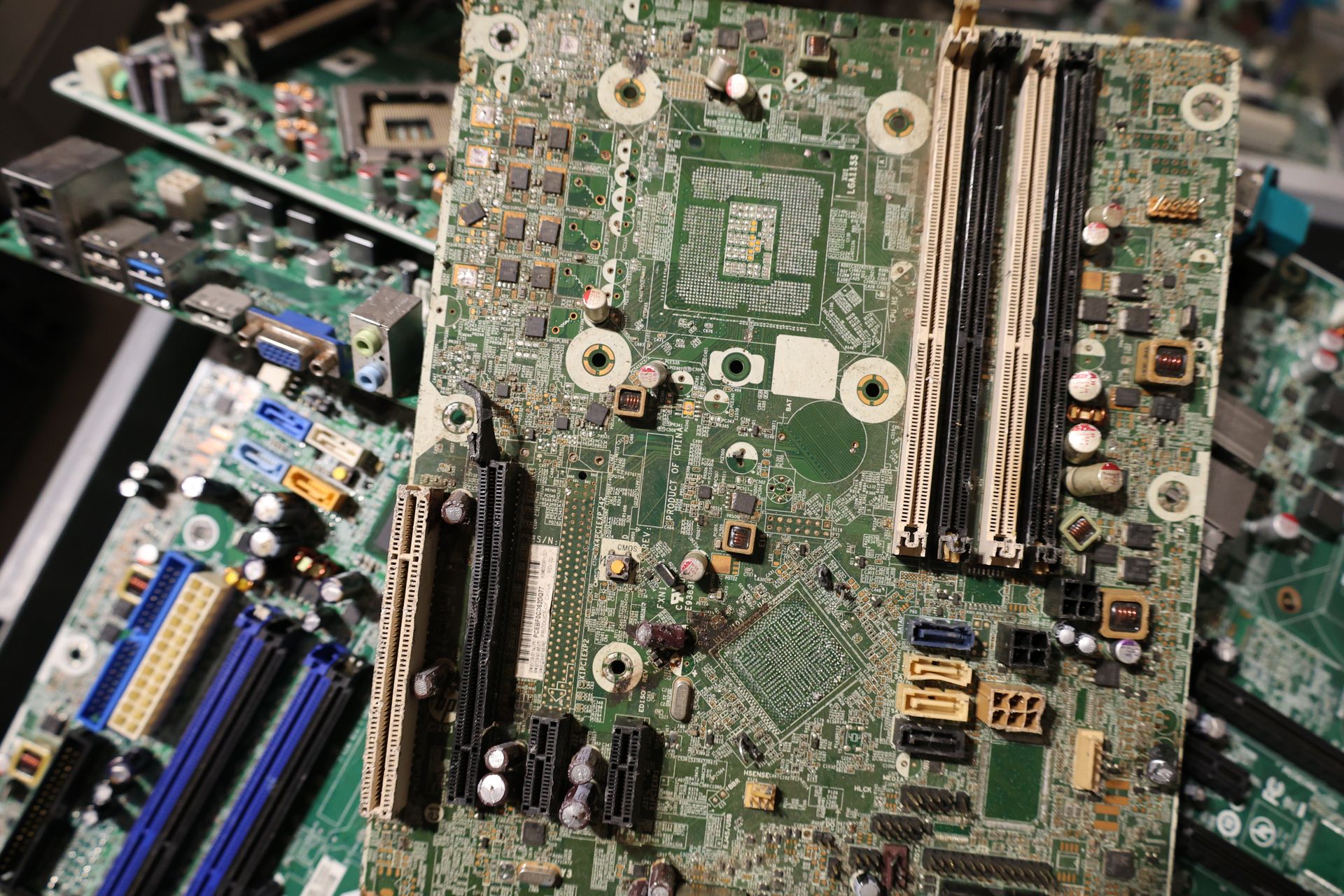
Artificial intelligence (AI) is often described through models, applications, and computing capacity. Behind all of them is a physical infrastructure that has to be manufactured, installed, powered, maintained, and eventually replaced. The data center hardware lifecycle therefore extends well beyond the period when a server is processing workloads.
Physical components do not necessarily become unusable when they leave active service. They may be replaced because newer systems provide more performance in the same rack footprint, support different workloads, improve efficiency, or simplify fleet management.
That creates a less visible sustainability question. When a new generation of AI hardware enters the data center, what happens to the generation it replaces? The answer can determine whether the materials and manufacturing effort already invested in that equipment remain productive or become part of the growing stream of electronic waste.
Retirement does not always mean end of life
A server can be retired for several reasons without being physically exhausted.
- Performance: Newer processors and accelerators can deliver substantially more computing power within the same physical footprint.
- Energy efficiency: If newer equipment can perform the same workload with significantly less electricity, replacing older systems can make operational and economic sense.
- Workload requirements: AI infrastructure changes quickly. Hardware designed around one generation of training or inference workloads may not provide the required memory capacity, interconnect performance, or acceleration for newer systems.
- Fleet standardization: Operators may replace multiple generations of equipment to simplify maintenance, software compatibility, and spare-parts management.
- Economics: Support contracts, repairs, power consumption, and other operating costs can make older systems less attractive even when the components continue to function.
This distinction between technical life and economic life is becoming particularly relevant for AI accelerators. Reuters reported in October 2026 that NVIDIA has argued its advanced GPUs can have useful lives of up to 10 years, while financial institutions often use depreciation periods of three to four years when valuing such assets. The figures do not establish a universal replacement cycle, but they highlight the gap that can exist between physical usefulness and financial treatment.
For sustainability, that gap matters. A piece of hardware that is no longer competitive in one AI cluster may still have useful capacity in another environment.
What actually happens when a server leaves the rack?
The first stage is controlled decommissioning. Equipment must be removed without compromising customer data, asset records, security controls, or the operation of the remaining infrastructure.
After removal, each system or component can be assessed for its next destination.
| Stage | Typical action | Sustainability implication |
| Decommissioning | Remove equipment from active service, record asset status, and separate it from production infrastructure | Creates a controlled transition instead of sending equipment directly to disposal |
| Data sanitization | Sanitize or destroy data-bearing storage media | Allows eligible hardware to move into reuse or resale without exposing sensitive information |
| Testing and grading | Check servers and individual components for function, condition, and compatibility | Separates recoverable assets from equipment that has reached true end of life |
| Refurbishment | Repair or replace failed components | Extends service life without manufacturing an entirely new system |
| Redeployment | Move usable systems to another workload or facility | Keeps existing hardware productive and delays new equipment purchases |
| Parts recovery | Harvest functioning processors, memory, storage, power, and networking components | Preserves value that would otherwise be lost with whole-system disposal |
| Material recycling | Recovers metals and other materials from non-reusable components | Returns resources to manufacturing streams |
| Final disposal | Handles residual material that cannot reasonably be reused or recovered | Limits the environmental burden of equipment with no viable recovery path |
The important point is that “retired” does not describe a single outcome. It begins a decision process. Two identical servers can leave the same data center and end up on entirely different paths depending on their condition and potential secondary use.
Data security can decide whether hardware gets a second life
Reuse cannot begin until information security has been addressed. Storage devices may contain sensitive information. An organization therefore needs a documented method for ensuring that information is no longer recoverable before a device is transferred to another user, another facility, or a secondary market.
The National Institute of Standards and Technology’s SP 800-88 Revision 2, published in September 2025, focuses on establishing media-sanitization programs and selecting appropriate controls based on the sensitivity of information. The revision also updates guidance around modern sanitization practices, including cryptographic erase.
The practical sequence is straightforward:
- Identify: Determine which media contain information and what security requirements apply.
- Sanitize: Apply an appropriate method to make access to the target data infeasible.
- Validate: Confirm that the selected process achieved the required level of assurance.
- Destroy when necessary: Physical destruction remains an option where secure sanitization is not appropriate or cannot be reliably verified.
This is more than an information-security requirement. It is also a condition for circularity. Equipment that cannot be securely cleared may be difficult to reuse even when its hardware remains functional.
Reuse can preserve more than a server
Once the equipment is secure, the next question is how much useful value remains. The highest-value outcome may be continued use of the complete system. Another server may support internal development, testing, education, or less demanding workloads even when it is no longer suitable for the newest AI cluster.
In other cases, the system itself may no longer make sense as a complete unit, but individual components can still be useful.
- Internal reuse: A server can move to another workload with lower performance requirements.
- Refurbishment: Targeted repairs can return equipment to service without replacing the whole system.
- Parts harvesting: Working memory, power supplies, processors, storage devices or networking components can become spare parts.
- Secondary use: Functional equipment can be sold or transferred to organizations with different performance requirements.
- Material recovery: Equipment that no longer has practical technical value can be dismantled and recycled.
The environmental case for extending hardware life is linked to what happened before the equipment reached the data center. A 2026 life-cycle assessment of rack servers published in Procedia CIRP found that manufacturing server components accounted for 40% to 50% of the total carbon footprint in the study’s modeled context. It also found that a circular end-of-life approach reduced modeled greenhouse gas emissions by 36% compared with business-as-usual end-of-life management.
That does not mean every older server should remain in service regardless of efficiency. A newer accelerator can deliver substantially more useful compute per watt. The more useful question is whether an existing asset has a viable second application before it is reduced to parts or raw materials.
Microsoft treats retirement as a recovery process
Microsoft provides one of the clearest examples of how the post-service stage can be managed at hyperscale.
In a September 2026 update, Microsoft said it had achieved a 92% reuse and recycling rate for decommissioned servers and components in the previous year. Its Circular Centers evaluate equipment after secure decommissioning and determine whether complete systems, individual components, or materials should receive another use.
The company describes several pathways for the hardware:
| Hardware condition | Potential destination |
| Complete system remains suitable for use | Internal labs, training environments, or qualified buyers |
| System is unsuitable, but components work | Spare-parts inventory or other systems |
| Equipment has secondary educational value | Schools and technical training programs |
| Components no longer support useful operation | Material recovery and recycling |
| Data-bearing equipment | Secure decommissioning before any further disposition |
The significance is not the recycling rate alone. Microsoft has built dedicated infrastructure around the question of what each asset can become after production use. The company says its Circular Centers now span North America, Europe and Asia-Pacific, with recent additions in Wales and Australia. It also reported that more than 3.2 million components were reused through internal and external channels in 2024, with the program generating more value recovery from existing equipment.
That model changes the role of decommissioning. It becomes an extension of asset management rather than a final waste-handling step.
Google is recovering components, not just whole servers
Google’s data center circularity program shows why the individual component can matter as much as the complete machine. The company says millions of assets and components enter its reverse supply chain each year. Decommissioned hardware is evaluated and disassembled, with recoverable parts directed toward reuse, resale, or recycling. Google reported that it harvested approximately 8.8 million components from decommissioned hardware for reuse or resale in 2024.
This matters because a server does not reach the end of its useful life all at once.
A chassis can become unsuitable for a particular deployment while memory modules, storage devices, networking components, or power equipment remain serviceable.
Google’s approach therefore focuses on extracting value before the hardware enters the final recycling stage. When functional reuse or resale is no longer viable, the company says materials are sent for recycling to recover critical raw materials, including rare-earth elements and precious metals. Circularity does not require the same server to continue performing the same job. It can also mean keeping individual components in productive circulation.
The environmental footprint starts before a server reaches the rack
The end-of-life question becomes more significant when the full physical lifecycle is considered. A server begins with raw materials and semiconductor manufacturing. It then moves through component production, assembly, transportation, deployment, and years of operation before retiring.
Each stage consumes materials and energy. That is why hardware replacement creates a different sustainability question from operational efficiency alone.
A new AI system may be significantly more efficient than the hardware it replaces. At the same time, producing the new equipment requires another round of semiconductor fabrication, component manufacturing, logistics, and installation.
The Global E-waste Monitor 2024 reported 62 million tonnes of e-waste in 2022 and projected that annual e-waste generation would reach 82 million tonnes by 2030. Only 22.3% of the 2022 total was documented as formally collected and recycled. The report identifies shorter product lifecycles, technological development, and limited repair options as factors contributing to the growing waste stream.
Those figures describe electronic waste across the economy and should not be interpreted as data center waste alone. The relevance to AI infrastructure is more specific, particularly within the broader debate around data centers and their growing physical footprint. More frequent equipment upgrades can therefore increase the number of servers, accelerators, and components that need a clear recovery pathway.
Lifecycle support is becoming part of data center operations
Hardware retirement also creates an operational requirement that is easy to separate from conventional maintenance but increasingly difficult to ignore.
Operators need to know which equipment is still serviceable, which components should be retained as spares, when a replacement is justified, how assets should be handled after removal, and what compliance requirements apply at each stage.
The sector is estimated to grow from $320 million in 2025 to $820 million by 2032, representing a 14.39% compound annual growth rate (CAGR). The significance of that growth is not limited to routine maintenance. It points to a wider service environment in which data center operators have to manage infrastructure across its useful life, including parts, support, compliance, and replacement decisions.
That links maintenance and sustainability more practically than it may first appear.
As AI infrastructure becomes more hardware-intensive, these processes become part of the operational framework surrounding the computing equipment itself.
Recycling is important, but it should not be the first question
Recycling is essential when equipment has reached the end of its functional life, yet it should not be the only definition of responsible disposal. A working server that is shredded immediately loses potential service value. A failed server containing functioning components may still contain useful parts. A circuit board that is no longer repairable can still contain recoverable materials.
The more useful hierarchy is:
- Extend: Continue using equipment where its efficiency and performance remain appropriate.
- Refurbish: Repair systems where targeted work can restore useful service.
- Harvest: Recover functioning components for spares or another deployment.
- Redeploy: Move usable hardware to another workload or organization.
- Recycle: Recover materials from equipment that no longer has a practical technical application.
- Dispose: Handle residual material that cannot reasonably be recovered.
This approach also makes the idea of a circular AI infrastructure more concrete. Circularity is not simply about keeping every machine in service for as long as possible. It is about deciding what form of useful value remains at each stage.
The next AI upgrade should not be the end of the hardware lifecycle
The next generation of AI hardware will continue to replace older systems as performance requirements, energy efficiency, and workload demands change. The sustainability question is therefore not whether data centers should upgrade. It is what happens to the equipment being replaced. Decisions made before decommissioning, from asset assessment and repair planning to secure data sanitization, can determine whether a server continues into another application, supplies usable components for other systems, or moves directly into recycling.
That makes hardware lifecycle management part of the wider sustainability equation for AI infrastructure. A server contains materials, components, and manufacturing effort that exist before the first workload runs on it. Extending its useful life where technically and economically appropriate can preserve some of that embedded value, while component recovery can keep individual parts in circulation even after the original system is no longer suitable. Recycling remains essential when reuse is no longer practical, but it should come after the available options for continued use and recovery have been assessed.
AI’s physical footprint therefore does not end when a server leaves the rack. Each hardware refresh creates another lifecycle decision, and the outcome depends on how systematically that transition is managed. The more computing infrastructure expands, the more important it becomes to account not only for the performance of the newest systems, but also for the useful life, recoverable value, and final destination of the hardware they replace.
Editor’s Note: The opinions expressed here by the authors are their own, not those of impakter.com — Cover Photo Credit: RETURN E-Waste.