

Today’s Regulatory Analysis
- EU Green-Lights €9.45bn Safety Net for Dutch Offshore Wind: Brussels has approved up to €9.45 billion in Dutch aid for two North Sea wind farms, shifting price risk from developers back to the state.
- Britain Announces Clean Power Auction: Britain has opened its next renewables auction with a notional £1 budget, leaving ministers to set the real figure only after they have seen developers’ bids.
EU greenlights €9.45bn safety net for Dutch offshore wind
The European Commission approved the Dutch TOWOZ scheme on November 17, 2026, covering the IJmuiden Ver Gamma-A and Gamma-B wind farms. Together they offer 2 GW of capacity and up to 7,441 GWh of electricity a year and are expected to start operations in 2032.
In each of the two tenders, bidders can either offer the state a concession payment to build without aid, or request a premium. Premium bids are considered only if no concession bid comes in; the lowest requested premium wins, with one winner per site. The premium tops up market revenue when prices are too low to cover production costs. A bid cap and a claw-back limit overcompensation: part of the aid must be repaid when prices exceed the strike price.
Klimado – Navigating climate complexity just got easier. Klimado offers a user-friendly platform for tracking local and global environmental shifts, making it an essential tool for climate-aware individuals and organizations.
The Commission found the scheme necessary “given the market and investment risks affecting such projects,” and said the investments would not happen to the same extent without public support. This marks a long shift from the non-subsidy era, when a Dutch tender closed in 2025 with no applicants. Price risk that developers once accepted is moving back to the public balance sheet.
The scale of that transfer is visible in the ceiling. Premium bids are capped at €117 per megawatt-hour for Gamma-A and €116 for Gamma-B. Spread across 15 years of maximum output, the €9.45 billion budget works out at roughly €85 per megawatt-hour, nearly three-quarters of the capped price. On those terms, the market would need to supply little more than €30. The budget only makes sense if the state is prepared for prices to stay very low for a very long time.
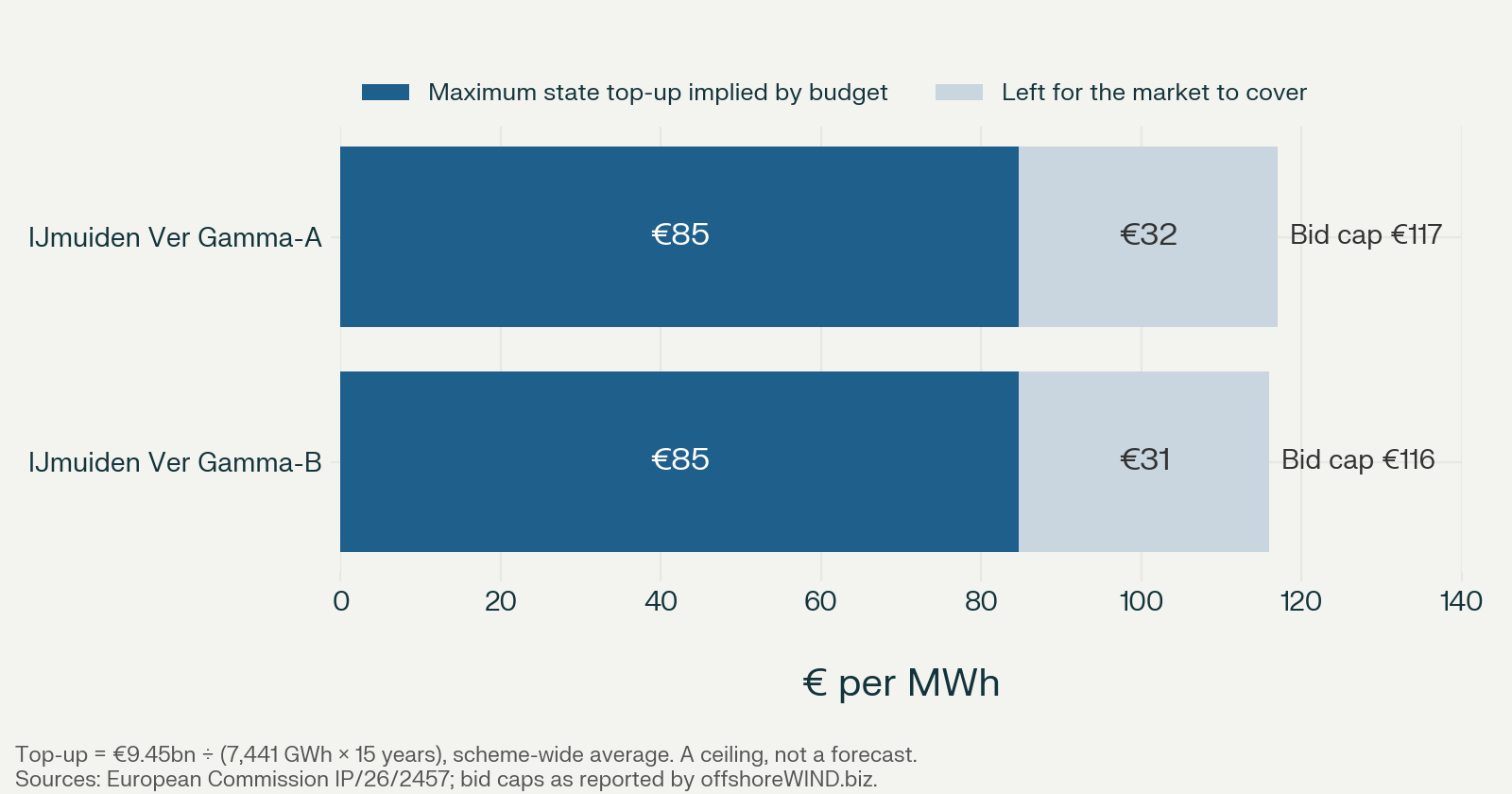
New wind capacity depresses prices during the windiest hours, when these farms earn most of their revenue. The more offshore wind the Netherlands builds without matching demand, the more the premium costs. Because a successful concession bid shuts out every premium bid, each tender rewards the most optimistic view of future prices. An aggressive bidder could win a site without support and then struggle to finance it.
To prequalify, bidders must diversify turbine and component supply chains to reduce dependence on imports from outside Europe. Whatever that adds to costs will surface in premium bids, so an energy scheme ends up funding supply-chain resilience.
The timing is no accident, as EU electricity rules allow feed-in premiums instead of two-way contracts for difference only until July 2027, and both tenders must be held before then. The successor model will inherit a market that has already seen what the state will pay, with payments running into the late 2040s.
Executive Vice-President for Clean, Just and Competitive Transition Teresa Ribera said every euro invested in homegrown clean energy “makes Europe more energy-independent and our industry more competitive.” The Netherlands estimates the projects will avoid 147 million tonnes of CO₂ equivalent over their lifetime. Whether they need the money is another matter, and the answer will show how much merchant offshore wind is left in the North Sea.
Related Articles
Here is a list of feature articles selected by our Editorial Board exploring renewables auctions, state support schemes, and the electricity pricing that shapes clean-power investment:
- Two Routes, One Destination: How Italy and Chile Navigate Their Way to Carbon Neutrality by Cristiano Spillati and Martin Libra of Limes Renewable Energy
- UK Lays Groundwork to Widen Boiler Upgrade Scheme Beyond Heat Pumps by Ariq Haidar
- UK Opens Power Subsidy Scheme to Re-Industrialise Britain by Ariq Haidar
Britain announces clean power auction

The UK government announced the budget for Allocation Round (AR) 8 of its Contracts for Difference scheme on November 19, 2026. Initial budgets are set at a notional £1, and a final budget will be set only after bids have been submitted. Prices across all wind and solar technologies will be visible to ministers before they confirm which projects to procure.
The government calls this an evolution, as the approach was used for offshore wind in the previous round, which the release says secured a record amount at a price 40% cheaper than new gas plants. In that round, the fixed-bottom offshore wind budget started at £900 million and was raised to £1,790 million after bids were reviewed.
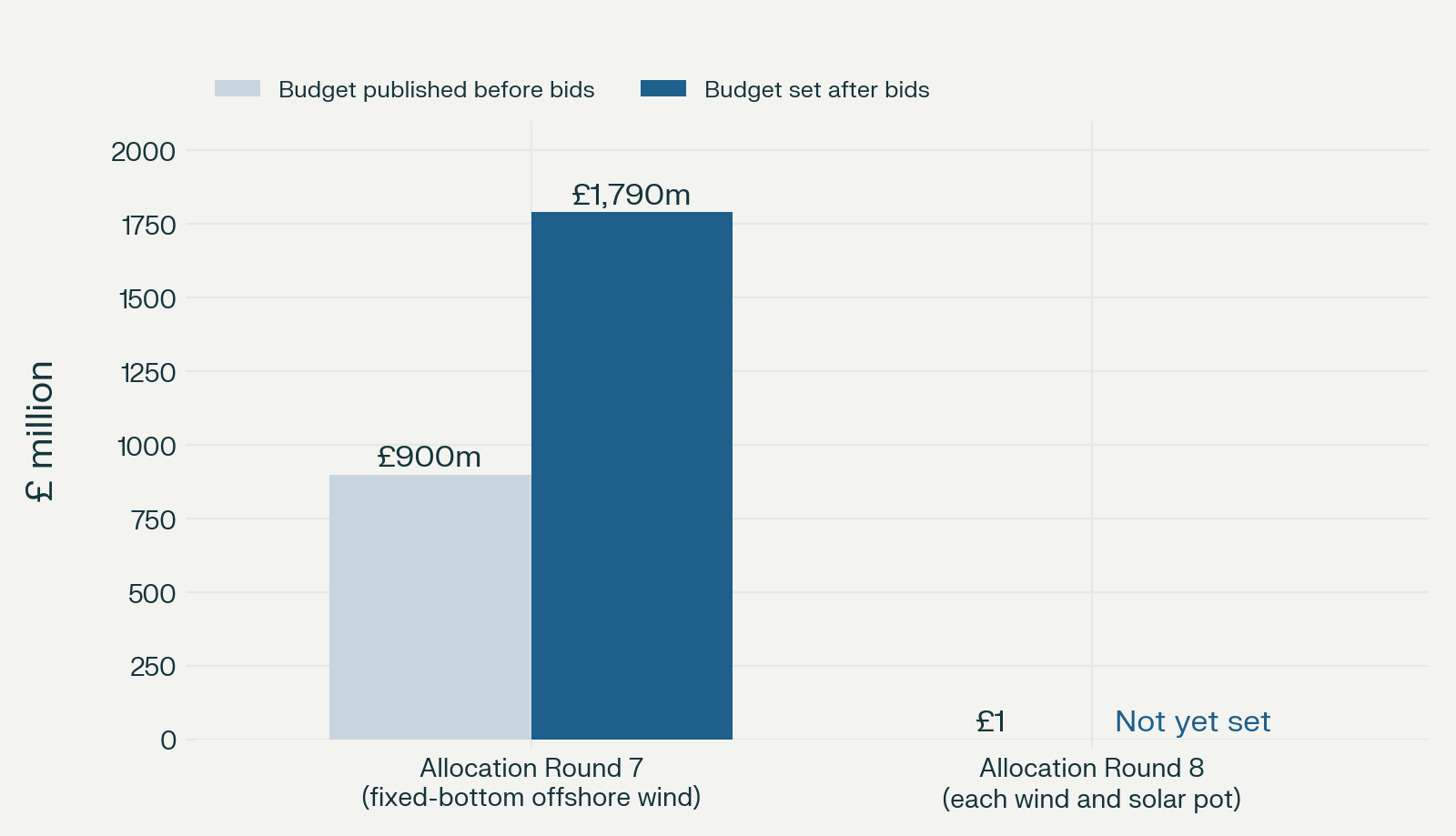
A budget published before the auction told developers roughly how much the state wanted to buy. Now the budget is an output of the auction, set wherever ministers decide to stop buying. The release says budgets “can be increased where we are confident bidding projects offer value for money.” It does not define value for money.
Ministers see every bid, while developers no longer see the size of the prize. A bidder who cannot guess where the line will fall has reason to bid close to cost, which is good for billpayers. It also raises the chance that winning projects are priced too thinly to be built.

The release is issued jointly with Exchequer Secretary Dan Tomlinson, who said the approach “maximises transparency and control over what we buy.” It also promises clean power “in the right place and at the right price.” With four technology groups starting from the same £1, solar, onshore wind and offshore wind are in effect competing for one fiscal judgment made after the fact. Location now sits alongside price, yet the release sets no rule for weighing it.
The release describes the greater control as coming “ahead of more substantial reforms for AR9.” Developers with marginal projects must choose between a round with no volume signal and a successor whose rules are not yet written. Supply-chain investors face the same blank, because factories are sized on expected volumes.
The government says auctions over the past two years secured enough clean electricity for more than 20 million homes. How much this round adds is no longer set in advance. It will be a ministerial decision, taken after the bids are in.
Editor’s Note: The views expressed in this article are those of the author and do not necessarily represent those of Impakter. This content is provided for informational purposes only and does not constitute legal or compliance advice. — Cover Photo Credit: Nicholas Doherty on Unsplash