“July 6 wasn’t the first day I learned this kind of sentiment existed. It wasn’t the first day I learned that the United States does not really like us,” said Ziva Xu, a Chinese international student at the University of Washington. That was the day Trump administration clamped down on foreign students, introducing what is commonly referred to as the ICE student ban.
The U.S. Immigration and Customs Enforcement provoked global anxiety, fear, and anger when they introduced a policy that would have prohibited international students from staying in the U.S. if their college or university went fully online. Colleges across the country rallied support for their international students – comprising more than one million students – and many schools backed MIT and Harvard’s lawsuit against the ICE student ban.
“Since the beginning of the administration there have been numerous efforts to restrict [access] and create an unwelcoming atmosphere for international students and scholars and other populations,” said Presidents’ Alliance Executive Director Miriam Feldblum.
Though the ICE student ban was rescinded on July 14, the sentiment of the Trump administration is poignantly clear: International students and visa seekers could be subjected to another arbitrary regulation at a moment’s notice.
“The administration’s past policies are a cumulative series of efforts that say in direct and implicit ways to international students ‘you’re not welcome here’,” Feldblum said. “It is a disregard for them.”
In Trump’s April 22 proclamation and June 22 proclamation about restricting immigrant and nonimmigrant visas, he rationalized that COVID-19 was causing massive unemployment and that the subsequent visa ban would increase American job opportunities.
As COVID-19 reaches record highs in the U.S., the Trump Administration continues to actively ignore the concerns of public health officials, refusing to mitigate the spread of the virus and grossly mishandling the country’s growing cases. More recently the administration has declared that all COVID-19 patient information be directly sent to a central database in Washington, raising the issue of possible data fact distortion and concerns with data transparency.
“The administration has certainly taken a very opportunistic approach to the pandemic in trying to push through policies that have been on their agenda before the pandemic,” Feldblum said. “They are trying to revise, restrict, and eliminate pathways for immigrants and international students and workers in this country.”
Trump is seemingly only concerned with the gravity of COVID-19 when he can relate it to his damaging immigration policies, but not when advocating for schools to reopen or international students to travel back home. This contradiction with how Trump supposedly manages and controls COVID-19 through visa bans and temporary suspensions has significant and lasting repercussions.
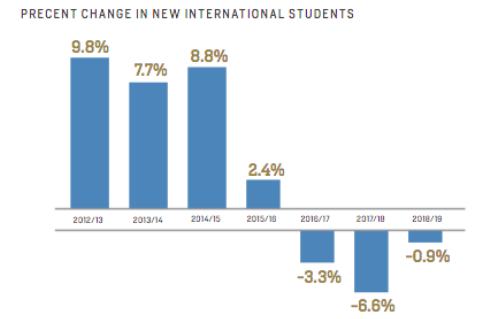
The percentage of new international students has generally decreased throughout the past years with some variable differences. With fewer international students coming to the U.S. to seek higher education, American universities are losing human capital and economic stability.
According to a 2017 policy brief by the National Foundation for American Policy, there were “12,539 full-time U.S. graduate students compared to 45,790 international graduate students at U.S. universities” in the computer science major. Similar statistics are true for other science and engineering graduate programs.
International students positively contribute to the technological advances made by their academic communities. A decrease in enrollment could substantially hinder the quality of American higher education, which Trump’s current suspension of H-1B visas could only exacerbate.
“H-1B visas came at a time when there was a labor shortage for high skilled areas in the U.S. and the country wanted to bridge the gap by bringing in more technical labor from other countries,” Director of International Student Concerns at the National Association of Graduate-Professional Students Madhan Arulanandam said. “A visa that was created to attract talent and fill in the gap is now being portrayed to be eating the American job market, which is not true at all.”
Arulanandam predicts that the Trump administration may ban Optional Practical Training (OPT) in the coming weeks as it was originally listed on the same executive order that banned H-1B, but was later removed.
“The purpose of OPT is to train people after their classical education, which cannot teach field or industrial skills. Most OPT candidates are looking for a STEM job and there is already a high ratio of STEM job openings per eligible candidate,” Arulanandam said. “Not every OPT student is going to apply for an H-1B visa and not every student will apply for a green card, as many come here, get trained, and then go back to their home countries to start their own business.”
With the current visa suspensions in place and chance of imminent immigration policy changes, international students struggle to know what their future in the U.S. will afford them, grappling with American societal norms that misconstrue their experiences.
“I often feel guilty about attending college in the U.S. because I want to help Mexico from Mexico. I really want to better my country and diminish inequalities,” Mexican international student at the University of Washington Sara Muste-del Río said. “The U.S. is a country really focused on capitalism and I don’t know if I can achieve what I want if I’m learning here, with an education from the American point of view.”
Double majoring in sociology and law, societies, and justice, Río hopes to eventually return to Mexico, where she can have the strongest impact on her community. She recently found herself along with many others in a group that was denied a work visa, though all the necessary permit requirements with a company were met and that company was willing to sponsor them. Many work visas may be impacted by the recent administration’s efforts as international students could be forced to leave the country due to different variables, leaving permanent citizens with an advantage.
Ziva Xu spoke of her own experiences with American students that carry many biased beliefs about the intent and positionality of international students.
“Many people have the same assumption about international students – that we are coming here to pursue the American dream, but there is no real American dream to pursue if the country is treating us like this,” Xu said. “I don’t believe that people are coming here because they think America is better, they could be coming here just because they think America is different.”
Related Articles: Trump’s Anti-Immigration Policies | America’s Withdrawal from WHO
Amidst a time when the U.S. federal government can so quickly and permanently alter the fate of international students, colleges and universities must address the culture within their campuses. International students should not feel discriminated against or study in an environment that is working against their favor.
“We did not come here because we absolutely hate our home countries or to assimilate to American culture or to be the model Asian American citizen that people still expect in society,” Xu said. “We came here to learn and contribute to a community where people can learn from one another. This part of the experience is what people seem to be missing.”
“We did not come here because we absolutely hate our home countries or to assimilate to American culture or to be the model Asian American citizen that people still expect in society,”
— Ziva Xu
With only 11% of colleges and universities — excluding minority-serving institutions — headed by people of color, systemic racism against non-American students will require a more representative and equal administrative body.
“Presidents and chancellors need to be responsive at the institutional level,” Feldblum said. “They need to not only [think] about how they are advocating for change in national policy, but [also what they] are doing about their institutional policy.”
For international students, the decision to come to the U.S. is not a simple addition to their education experience, but a permanent identity transformation.
“What I’ve noticed is that when [American] students study abroad, it is a fun exploration for a couple of months and then they know they get to go home – and America is home for them,” Russian international student at the University of Washington Masha Moshchevitina said. “But for international students, it is more complicated. [When I came here] I tried my hardest to integrate myself into American culture and slowly, over the years, America became my home,” she added. “I don’t fully belong here, but I also don’t fully belong in Russia anymore – there is this conflict between the cultures.”
“I don’t fully belong here, but I also don’t fully belong in Russia anymore – there is this conflict between the cultures.”
— Masha Moshchevitina
Maintained immigration policies targeting international students, whether through visas or physical presence, will curtail the positive desirability of higher education in the U.S and eventually diminish the choice to come here.
“There are many shortcomings aimed at international students,” Arulanandam said. “This is just a political game and international students who are coming here to gain knowledge are being used as pawns, which is really unacceptable.”
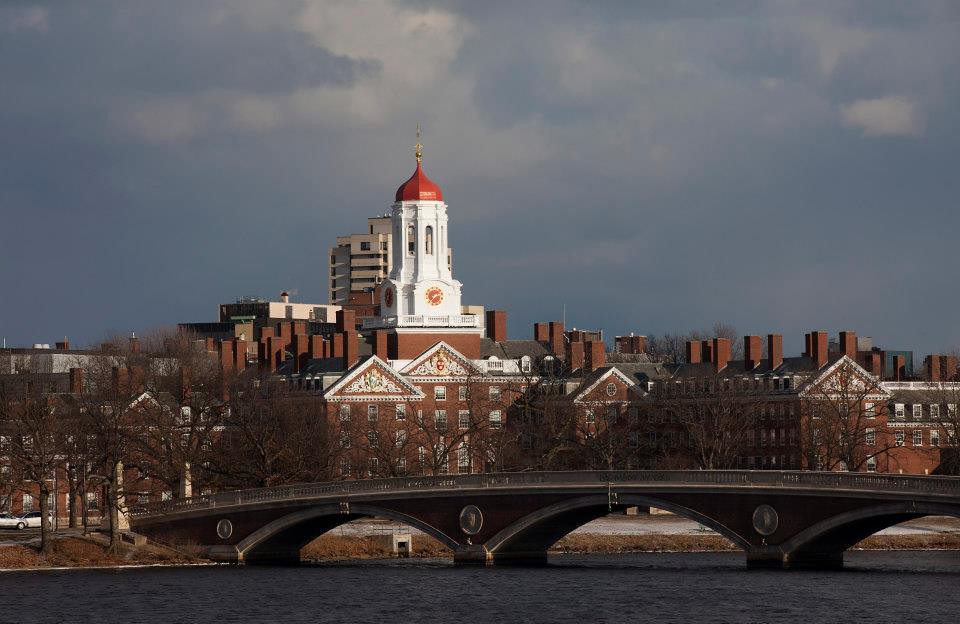
Editor’s Note: The opinions expressed here by Impakter.com columnists are their own, not those of Impakter.com In the Featured Photo: Harvard University Campus. Featured Photo Credit: Harvard University Official