Fighting in Sudan erupted on April 15, 2023, in the Darfur region and for the first time in a long history of violence, it reached the capital city of Khartoum.
The war has since caused 550 casualties and approximately 4,926 injuries, forcing 100,000 people to flee over its borders. The fighting is now creating a humanitarian crisis that the international community cannot easily respond to before the warring parties come to some sort of agreement allowing for the opening of humanitarian corridors to distribute aid.
Intense fighting shaped the course of the following 12 days, with the first 72-hour cease-fire failing to maintain peace. After another three-day ceasefire, followed by a three-day extension failed, a new agreement has been reached under the mediation of South Sudan. Three weeks after the beginning of the conflict, the warring sides apparently agreed to another seven-day ceasefire from May 4 to May 11 and promised to name envoys for peace talks during that time.
However sporadic fighting continues and the warring parties are meant to hold talks this Saturday in Saudi Arabia.
As we wait and hope for the situation to de-escalate so that humanitarian aid can start, here is an overview of the causes behind the conflict.
Sudan’s long history of violence
This is not the first time that the resource-rich African country has experienced violence and bloodshed within its borders.
Since gaining its independence in 1956, Sudan has suffered through six successful coups, along with 11 attempted ones, two civil wars, and a genocidal conflict in Darfur.
The present war has erupted from a power struggle between Sudan’s two military leaders: General Abdel Fattah al-Burhan and General Mohamed Hamdan Dagalo, known best as Hemeti or Hemedti.
Burhan is the leader of the Sudanese Armed Forces (SAF), the country’s official military, which arguably makes him the de facto leader.
Hemeti is the head of the paramilitary Rapid Support Forces (RSF), a group accused of multiple atrocities and 300,000 civilian deaths since 2003 during the bloody genocidal war in Darfur that still persists today.
Both of the leaders rose under the longtime dictator Omar al-Bashir.
Bashir’s dictatorship lasted 30 years, safeguarded by the violent military, whose allegiance was ensured by rewards of political and economic power.
Both Burhan and Hemeti played key roles in Bashir’s regime as well as his downfall in 2019.
https://twitter.com/ikushkush/status/1114613825016356865
The coup that overthrew Bashir brought false hopes of a transition to democracy in the country.
The civilians that prompted the coup – by participating in a peaceful sit-in in front of the army headquarters for months – continued their protest. Al-Bashir’s ouster was only the first step for them, as the transitional military council did not adequately represent civilians. Instead of the military council, the protestors called for civilian rule.
Unfortunately, the peaceful protestors were met with harsh violence. What happened two years ago, on June 3, 2019, scarred Sudan and set the tone for any future democratic transition. RSF soldiers under Hemeti’s command opened fire on unarmed protestors, killing hundreds.
https://twitter.com/ENNNNN1996/status/1532677737244241922
Unimaginable violence was unleashed on the citizens, subjecting them to abuse, humiliation, beatings and sexual violence. The military was in charge of running the country, all the while promising a democratic government.
Sara Abdelgalil, then a spokesperson for the Sudanese Professional Association that helped organise the protests, told Foreign Policy in 2019:
“We still have not achieved what we are fighting for, Omar al-Bashir is not there, but the regime itself is still there. Objective one has not been achieved. Objective two has not been achieved, which is a civilian government. It’s like having a diversion in the middle of your journey.”
A deal was struck in August between the military and the civilians, forming a power-sharing government between the military and the Forces of Freedom and Change, a group representing the ones opposed to the military, including civilians, politicians, and armed groups.
Still, the government was supposed to hold elections in late 2023 for a truly democratic government. However, the government was short-lived when in October 2021, the army organised a coup, seized power, and dismissed the prime minister along with most of the civilian cabinet.
The coup isolated Sudan, brought back weekly protests, deepened economic instability, and catalysed international tensions.
Since October 2021, the West has been trying to guide Sudan towards democracy and even believed that they were on the verge of a breakthrough barely a few weeks before the recent fighting erupted.
Clearly, neither of the leaders were “Jefferson democrats,” so why did the West try to portray them as such and believe in their ability to form a democratic government?
The spread of democracy in Sudan
Sudan’s infamous dictator Bashir had a close relationship with Russia, having acquired $1 billion worth of weapons from Moscow.
This evolving relationship has been of concern for the US. As such, they decided to send a battleship to the Red Sea along with military and diplomatic envoys to negotiate with SAF officers.
Another source of pressure for the US was China’s Belt and Road Initiative, which would reinforce China’s ties with Sudan.
Driven by insecurity, Biden’s foreign policy was dictated by his fear of losing influence in Africa’s third-largest country. To maintain America’s weakening hold over the continent, Biden tried to shape Sudan as a bulwark against China and Russia’s control of Africa.
Sudan’s military leaders continuously balanced between the global powers to get the Biden administration to acknowledge and accept a military rule, despite America’s democracy-focused foreign policy.
Related Articles: Droughts in East Africa: Stronger and ‘100 Times More Likely’ Due to Climate Change | How 12 Years of War Destroyed Syria’s Forests | Bloody Politics: One Year of War in Ukraine
Biden’s administration has adamantly called Sudan’s transition “civilian-led,” despite the 2019 constitution clearly stating that the military would hold all the power for the first 21 months of the transition, and civilians would then take over for 18 months. Yet, the 21-month deadline seemed to move further and further away.
It would seem that Washington was a little naive, hoping that by calling Sudan a democracy, it would suddenly transform into one. The result, critics argued, was that rather than empowering citizens, as a citizen-led transition would require, America prioritised working with military generals.
Amgad Fareid Eltayeb, an advisor to Sudan’s deposed prime minister, addressed this issue, saying that senior American diplomats “made the mistake of coddling the generals, accepting their irrational demands and treating them as natural political actors. This fed their lust for power and their illusion of legitimacy.”
https://twitter.com/Amjedfarid/status/1648434731338579968
Jeffrey Feltman, the first US special envoy for the Horn of Africa, was quick to note that trusting the two leaders was a mistake made by the international community as well, saying:
“We avoided exacting consequences for repeated acts of impunity that might have otherwise forced a change in calculus. Instead, we reflexively appeased and accommodated the two warlords. We considered ourselves pragmatic. Hindsight suggests wishful thinking to be a more accurate description.”
Looking into the history of the country and of the individual leaders, building a civilian-led government through negotiations seems improbable.
Khartoum the Federal Capital of #Sudan has Fallen.💔 #SudanWar #LabourDay
Viewers Discretion is advised pic.twitter.com/Sy5tC4abRD
— UNCLE DEJI™️ (@DejiAdesogan) May 1, 2023
Former CIA analyst, Cameron Hudson, now an African specialist at the Center for Strategic and International Studies, told CNN that the foreign powers involved made a “serious miscalculation” believing that both of the generals would come to an agreement. He insisted that the level of violence displayed by the military should come “as no surprise to anyone.”
What to expect
The new seven-day cease-fire has supposedly been in place for two days now, but troops on both sides have violated it. The Sudanese Army, in a post on Facebook, announced that its delegation had left for Jeddah on Friday evening to discuss “specific details of the armistice,” which is aimed at “securing and creating appropriate conditions for dealing with the humanitarian situation of our citizens.”
But at the time of writing, the outcome of the talks in Saudi Arabia is still unknown.
If the violence in Sudan does not come to a halt, the UN warned that over 800,000 people could be forced to flee the country.
As the situation progresses, we can only hope that Sudan’s past is not going to dictate its future.
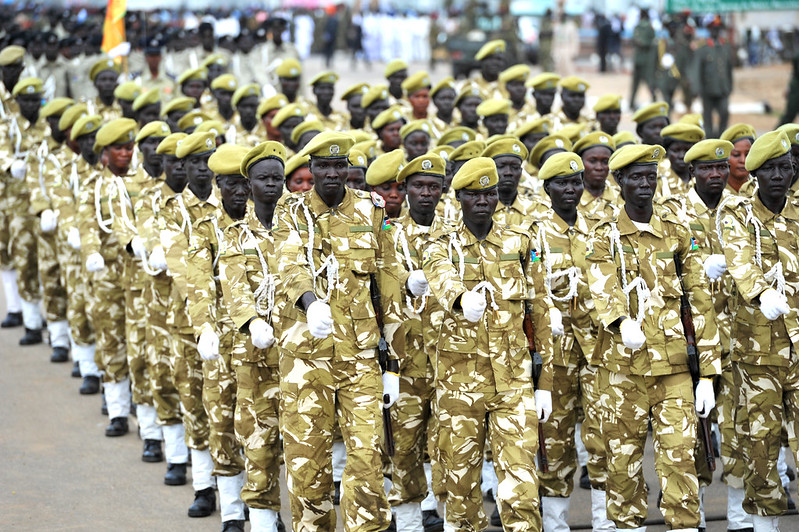
Editor’s Note: The opinions expressed here by the authors are their own, not those of Impakter.com — In the Featured Photo: South Sudan National Army Featured Photo Credit: Paul Kagame