
In recent news, many organizations are citing the silent crisis of retail. Malls and shops are shuttering at unprecedented levels, but not for the reasons that you may think. With the explosion of e-commerce powerhouses such as Amazon, traditional brick and mortar stores can’t compete with the reliability, ease, and risk-free return policies. Although the availability of products globally through e-commerce has boosted many local economies, the connections between shopper and producer have now decreased.
Seeking to revitalize the connection between consumers, products, and the people behind them, Germán Briones set out to create a community where local artisans are at the center of retail space. Evoking a sense of connection and human presence in each product, and placing an artisan’s story at the center has allowed Rupestre to influence a social consciousness in its consumers.
With a mission to diminish as much inequality in Chile as possible, Rupestre employs those from all walks of life to generate social inclusion and job opportunities for those that may face discrimination in other industries. Along with tackling social inequality, Rupestre is passionate about environmental sustainability and ensures all of their products are handmade and has a fully traceable supply chain for their products. We had the opportunity to connect with Briones about the importance of empowering artisans, an environmental impact, and expansion of their brand.
Impakter Magazine: Tell us a bit about yourself. How does your background lead you to start Rupestre?
Germán Briones: At university I studied a degree called “Commercial Engineering”, where I learned about entrepreneurship and business management. After finishing my degree I worked a year and a half in the financial sector providing services for mining, an experience that taught me how to work under pressure. However when working there I realized that even though I was earning well, I wasn’t contributing to society. This was when I decided to quit my job and start my own business, within an industry that I was interested in and where I could make a positive impact on Chile.
From the beginning I sought to form a connection between nature and people. When thinking about what to do, I realized that there was a gap in the market, because most of the products that were being offered were made in a series, without a social overtone. That is how I began to search for artisans, who could offer a product with added value.
I met “Don Lolo”, who later became the first artisan of the Rupestre community. First I bought one pair of shoes from him, then ten, then forty, and so on.
After meeting “Don Lolo”, I thought: each artisan has their own story. So, why not go and find those stories as I did “Don Lolo’s” and tell them to the rest of the people?
I went traveling in southern Chile, where I found many artisans and products with a lot of potential. I started working with them, supporting in areas such as logistics and design. Since this happened, I still travel around Chile looking for more craft producers and forming this big Rupestre community.


What current problems in Chile are you challenging?
G.B.: Rupestre, as it is a B Corporation, tries to solve two types of problems: social and environmental issues.
Regarding social problems, Chile has the lowest Gini Index of the OECD countries, which also positions us as one of the most unequal countries of the world. Rupestre tries to face this problem, by generating work for our artisans. Also we try to generate a connection between the artisan and the customer, by letting the client know who created the product he/she has bought. That is how they realize that there is not a machine behind the process, but a common person like them. This connection also generates social consciousness amongst our clients.
On the other hand, in our team we have some disabled people, allowing us to generate social inclusion by providing job opportunities.
With all these practices we try to contribute to diminishing the inequality in our country.
On the environmental side, our goal is to create consciousness in people, so they can practice a more responsible way of consumption. Nowadays, most of the products offered in the market are of industrial origin, which have a big environmental impact. Our value proposition consists of offering our costumers handmade products almost without this impact and to encourage them in creating new consumption habits. Also, we use resources to verify that our raw materials are sourced from reliable and sustainable sources.
Related article: “UNVEILING THE RICH HISTORY OF AFGHANISTAN’S FINEST CRAFTSMANSHIP”
Rupestre works with local craftmen willing to use materials that are respectful of the environment. How do you control the supply chain for each product sold in your boutique?
G.B.: To be sure that our raw materials come from reliable sources, most of the time we are the ones that buy them.
For example, we buy the sheep leather from small producers in southern Chile whom we have done a previous verification on in order to assure their products comply with Rupestre quality and sustainability requirements. Also we buy our leathers from a tannery that meets these conditions. For the cutting boards, most of the wood is certified by CONAF (in English, National Forest Corporation) and SAG (in English, Agriculture and Livestock Service), which are governmental organizations that verify the wood meets health and sustainability standards required in Chile.

IN THE PHOTO: DON LOLO, THE LEATHER MASTER PHOTO CREDIT: RUPESTRE
What are the other criteria you use for vetting your artisans?
G.B.: We are implementing a standard process to control them. It consists of a Sustainable Form that has to be filled in with information about the process, the waste destination, raw materials origin, and so on. Also we will start doing periodic reviews to supervise the fulfillment of these practices.
What benefits do they get from being involved in your community?
G.B.: We offer different kinds of benefits for the artisans and their families, which are:
- Financing:
Access to microcredits for their production and support on financing workshop machineries needed for some specific processes.
- Training:
New product development with attractive designs which keep traditions alive. Also we give marketing, finance and logistics training.
- Health:
In Chile we have a deficient public health system, so we provide our artisans with access to good medical services (private system) and contact them with specialists.
- Family Holidays:
The artisans and their families can have a one week free stay in the “Zapallar Inn”, situated in Zapallar, Chile.
- Employment:
Work networking available in Rupestre and other projects, for artisan´s families.


In your own vision, what motivates consumers today to value sustainable attributes?
G.B.: I believe that new generations are becoming more conscious about social and environmental problems that the world is facing. This is gradually generating a cultural change and consumers want to be a part of it. When clients buy sustainable products, such as Rupestre’s, they are incorporating a more responsible behavior into their lives, which creates a good feeling for them.
In countries such as Germany, this sustainable movement has been gaining strength in the last few years and I think the whole world has to take this same course. In Chile we are feeling this cultural change, and I am sure that this is just the beginning.
I was surprised by the diversity of products we can buy in your shop. Not only are there toys made of wood, but leather belts, handmade placemats and more. You probably have a “best seller” product right?
G.B.: Yes, as you mentioned we have a large mix of products. Nevertheless, the most popular product is the wood cutting board, which is made from native wood from southern Chile, and of course from fallen trees, not felled. We have cutting boards from 30 to 100 cms in length.
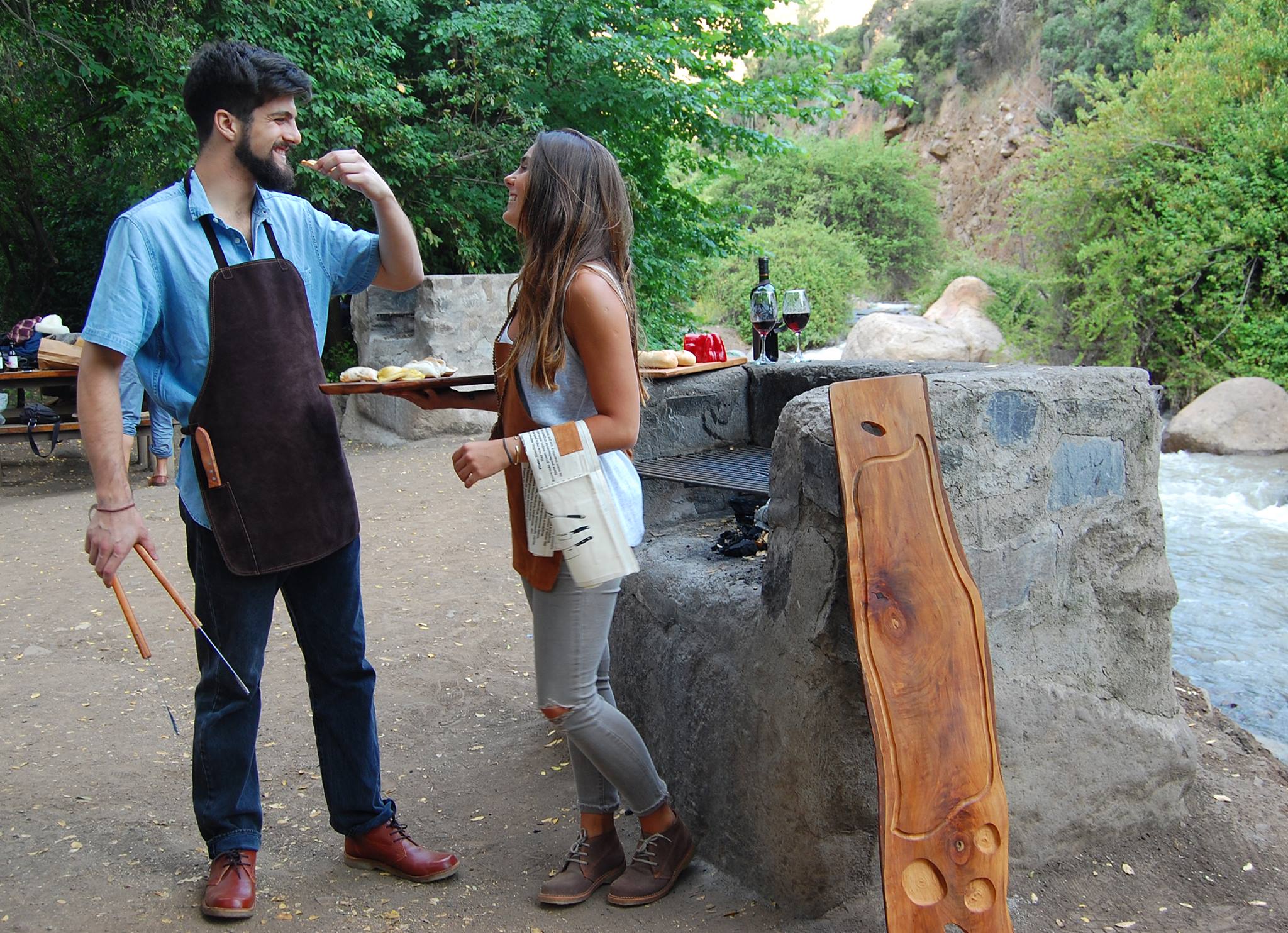
Other products that are highly requested by our clients are our leather aprons and the slippers, made from sheep skin and suede leather.

In the Photo: Germán (in the middle) with part of the team. Photo Credit: Rupestre
So far you have 3 local shops in Santiago. Is it in your plan to expand your community in other countries?
G.B.: Actually, we are in a growth stage, with one of our main goals for this year being to start selling abroad. We believe that our business model can be replicated in other countries, so we can let the world know about our stories and products of the Rupestre artisans. We have been working on this project for a while and our main target markets are some Western European countries and some states in the USA. We have already traveled to Germany looking for possible distributors and we are about to travel to Colorado, USA. Also we are in conversations with a buyer in Spain.
The products for export are the wood cutting boards, leather aprons, leather slippers, mitts and shoes. For the readers that are interested in distributing Rupestre products please contact us at exports@rupestre.com. Also I invite you to review our international catalog on our page, Issuu.
We can also buy your product online. How far can you deliver?
G.B.: We can deliver worldwide, with the shipping cost assumed by the client.
Recommended reading: “DO YOU KNOW HOW YOUR CLOTHES WERE MADE? PROJECT JUST DOES”