Daan Roosegaarde is an innovative environmentalist. He is the founder and owner of Studio Roosegaarde, where he has worked on several groundbreaking creative projects with his team of designers and engineers.
One of the recent projects to come out of the Studio is the Smog Free Tower. This machine-meets-sculpture works like an monumental vacuum cleaner, cleaning the surrounding air. Polluted air is pulled in to the structure, the pollution is filtered out, and then clean air is released.
Studio Roosegaarde has worked on many projects. They have just launched energy-harvesting kites, that can produce 20-100 kilowatts per hour by being pushed and pulled by the wind. They have also launched light emitting bicycle paths which glow all night after charging under sunlight.
In this interview, Daan Roosegaarde shares his ideas, his projects and his thoughts about our collective future.
Q. How would you define yourself?
Daan Roosegaarde: I’m a mathematician, artist, architect and engineer. A lot of people told me that what I was doing could never be done. My job is to prove them wrong. I like making things to improve the world around me. It’s about connecting very practical and very poetic elements together to show what our future can look like.
Q. What kind of impact you hope to see from your work?
DR: I think we live in a world with money and technology available but we lack imagination. For example, if you read the book Drawdown by Paul Hawken, you can find 150 inventions to reverse climate change. Everything is already there but we are not doing it, why?
I hope that with the things that we make, we show that something could be done. We also show the beauty of this new world. There is a Dutch word that we use in the studio a lot: “Schoonheid”. It means clarity, cleanness – like clean air, clean water, clean energy – but also beauty and creativity.
I think all our projects show the beauty of this world and they’re a prototype for the landscape of the cities of tomorrow. This is what creates an impact: they are here today, you can go and touch them.
Q. Do you think your work could help people think in a different way, and understand the issues our planet is facing?
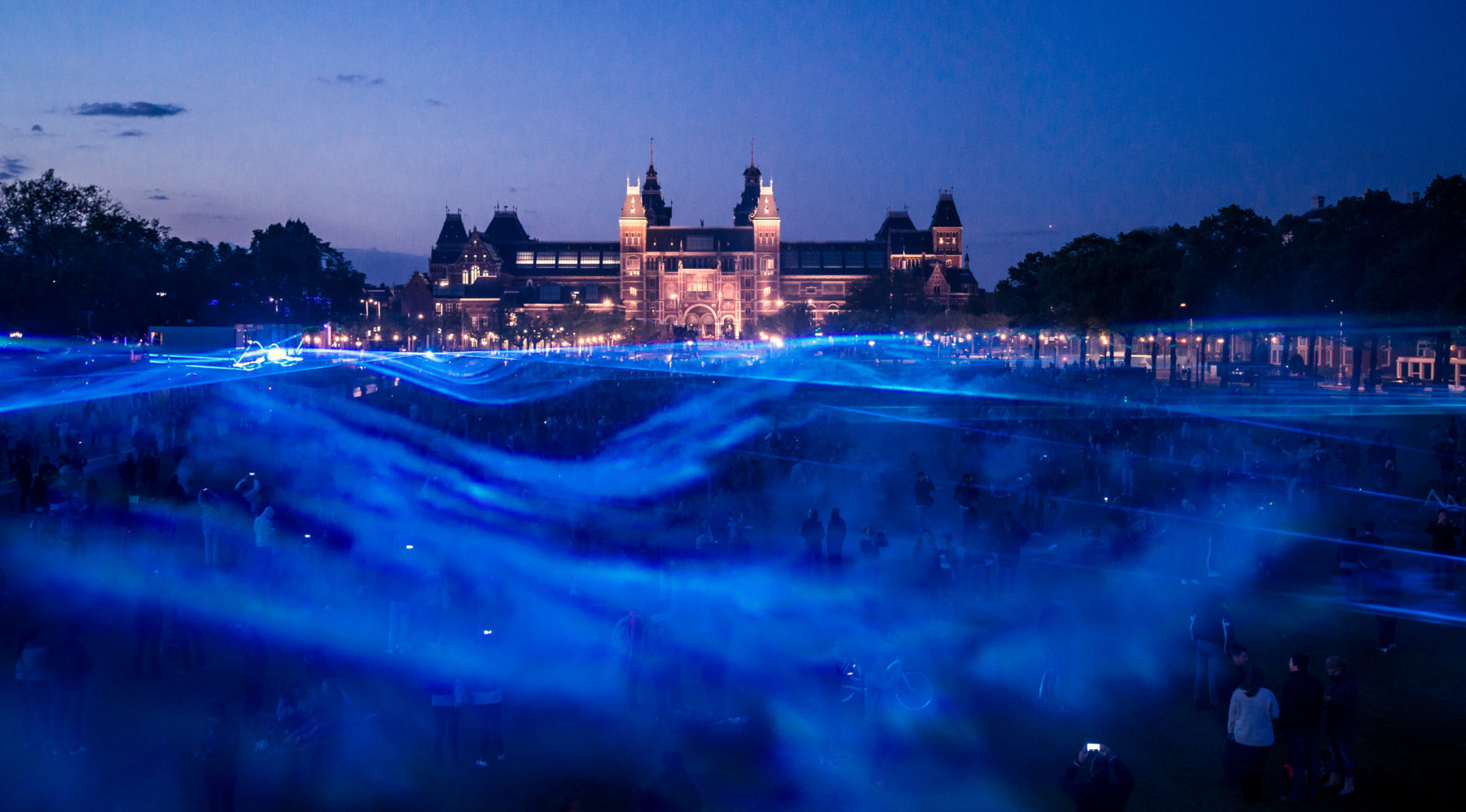
DR: Yeah, I believe so. For instance, when we were working on the “Waterlicht” , we placed blue LEDs and lenses to raise awareness of rising sea levels. With our work we showed how high the water rose during hurricane Sandy, and how the sea level will be in the nearby future. This was incredibly impactful because it was shown at the United Nations in New York, and all the community of people coming from different countries could see that. I think imagination and creativity are the common language. I’m not a politician, I cannot do a long-term city program, but I can make things that could hopefully have a positive impact.
For our Smog Free Tower, it’s the same: we can make clean air parks which are 20 to 70 % cleaner compared to the rest of the city. Of course our project should be connected to a long-term government investment on sustainable energy sources and reducing carbon emissions, but I’m not going to wait for it. I’d rather show people that things can be done. I believe in this sort of bottom-up approach.
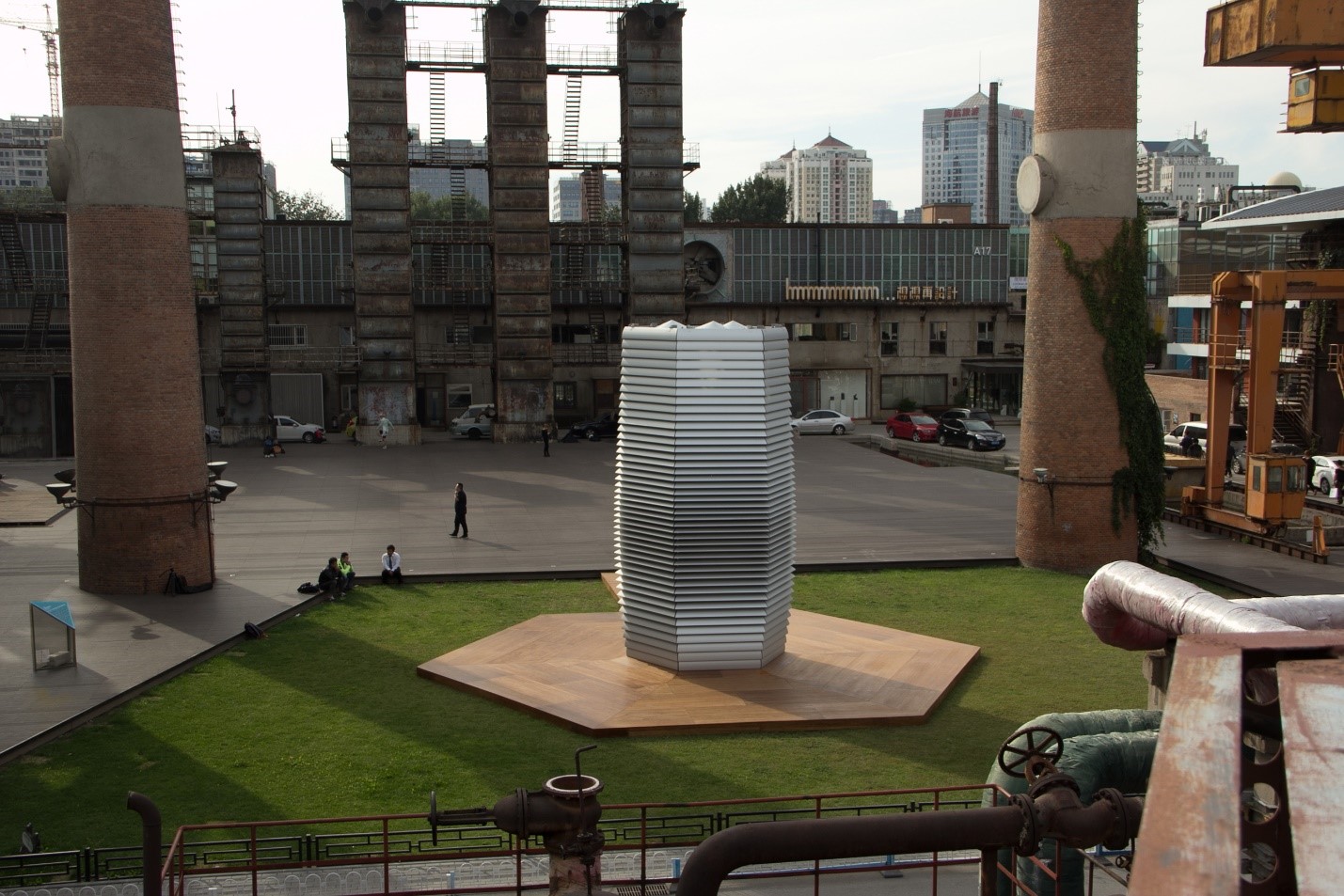 In the Photo: Smog Free Tower – Beijing. Photo Credit: Studio Roosegaarde
Q. Could you tell us more about the way you believe technology should be used?
DR: I like to use technology to make things more interactive. I don’t like objects with a sign “please do not touch.” I believe you have to touch it, you have to interact with, you are part of the identity of the work in the same way as we all are. I also love using lights because it’s a very beautiful way to intuitively speak to people.
Marshall McLuhan once said: “On spacecraft Earth there are no passengers. We are all crew.” This means we all have an impact on the world around us. It could be positive by sharing, by building, by creating, but also negative – the pollution we create, or our inability to create harmony.
Q. You merge the fields of environmentalism, design, architecture, sculpture, and urban planning. Is there any of those that feels more special for you?
DR: No, not any of those specifically. I prefer hybrids. I think the key is about making new connections between them and making them contemporary again. Often sustainability has been defined as doing less: less cars, less showering, less flying. I prefer to do more, I don’t want to do less.
In a very direct way it is all about redefining beauty: why can’t we define true beauty as clean air, clean water, and clean energy? I think if I can bring the notion of beauty and lifestyle back into the sustainable topic, that’s when you create real change and people will care about it more and more. That’s the power of design.
Q. Many important environmental and social ideas are clearly reflected in your work. Do you also bring your own inner personality into it?
DR: I make these projects to make the world more understandable for myself. I look outside the window and I don’t understand the world: the air pollution, the CO2, the rising sea level, traffic jams, street lights burning the whole night with nobody there. All these don’t make sense to me.
With a problem like this, you can react in two different ways: you can sit in a room crying and blaming somebody else or you can try to design or engineer a way to at least improve, if not to solve, the issue.
There is definitely a personal motivation in my projects. They are a way for me to understand what is happening in the world and to better connect with what is around me.
Q. How did growing up in the Netherlands shaped your style and your approach to your work?
DR: If you look at our history, in the Netherlands, we live below sea level. Without technology, or creative thinking, we would all drown. If we look at the landscape as a marriage of arts, design and technology, the work that I do is truly part of that landscape tradition. The Dutch masters in the XVII and XVIII century were obsessed with landscape. I think I’m the same, but they used paint and canvas and I have my smart materials and a good team of people.
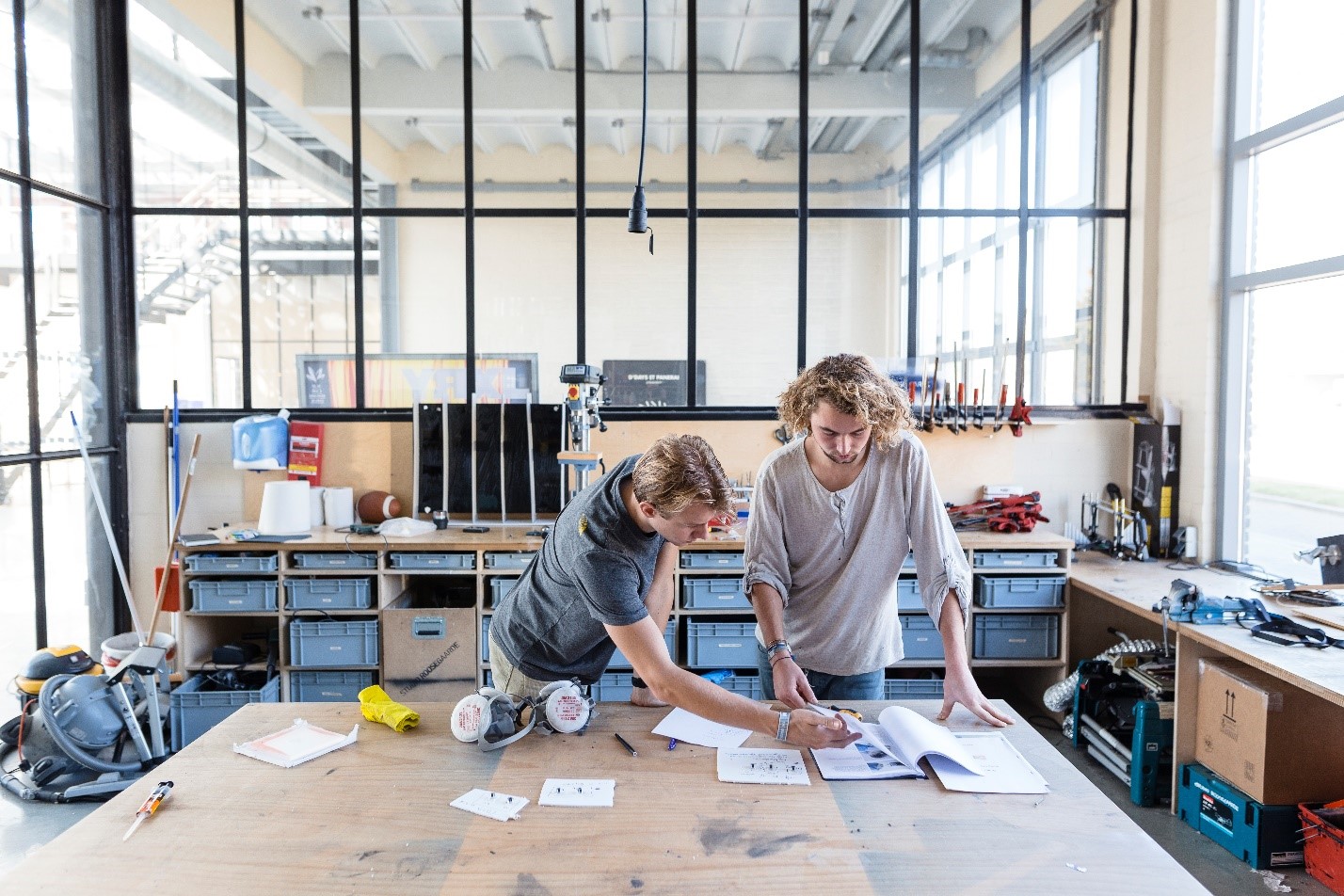 In the Photo: A room in Studio Roosegaarde. Photo Credit: Studio Roosegaarde
Q. Are you working on any new interesting projects at the moment?
DR: Right now we’re working on space waste and space debris. There are twenty-nine thousand particles larger than 10 centimeters, that are real threats to the existing satellites and nobody knows how to clean it. Somehow we’re not satisfied as human beings to “just” pollute our planet but we have decided to do the same with space. I think this is crazy and therefore we are launching in October a big project to address this issue.
Q. You talked about having a vision for global change. Can you you share with us your ideas about this?
DR: I think we all agree that we need a change. But how do we get there? My Studio has a good relationship with the United Nations, and I’m a part of the World Economic Forum for young Global Leaders. These are great institutions which push an agenda in their own way but, personally, I just want to make the change.
We have placed a Smog Free Tower in Beijing and it is proven scientifically, it can clean the air. These kind of actions change the perception of people: let’s throw more rocks in the river and let’s create some ripples; let’s not ask for permission but ask for forgiveness.
I think these large institutions should trigger our makers mentality, more than our consumer mentality. In today’s world we are very much treated as consumers, “buy this, buy that,” instead of makers. If we can do that shift towards becoming makers again, we would really benefit from that all together. There will be green energy, clean air, etc.
I think it should start with a shift in our attitude: We should always think about “how we want to interact with the world around us?” It’s a simple question with a very simple answer, but too often we are just concentrated on solving the problems rather than changing what is causing them.