Impakter
  • Environment
    • Biodiversity
    • Climate Change
    • Circular Economy
    • Energy
  • FINANCE
    • ESG News
    • Sustainable Finance
    • Business
  • TECH
    • Start-up
    • AI & Machine Learning
    • Green Tech
  • Industry News
    • Entertainment
    • Food and Agriculture
    • Health
    • Politics & Foreign Affairs
    • Philanthropy
    • Science
    • Sport
  • Editorial Series
    • SDGs Series
    • Shape Your Future
    • Sustainable Cities
      • Copenhagen
      • San Francisco
      • Seattle
      • Sydney
  • About us
    • Company
    • Team
    • Partners
    • Write for Impakter
    • Contact Us
    • Privacy Policy
No Result
View All Result
Impakter logo
No Result
View All Result
Reviewing the Climate-Smart Cocoa practices to help farmers adapt to climate change

Reviewing the Climate-Smart Cocoa practices to help farmers adapt to climate change

CGIARbyCGIAR
March 17, 2020
in Impact, Philanthropy
0

IITA (International Institute of Tropical Agriculture) has developed Climate-Smart Cocoa practices to impact farmers positively at different levels.



Climate change among other factors has adversely affected cocoa production at varying degrees in Ghana. The phenomenon affects cocoa farming areas differently, thus they have been categorized into three zones: Transform, Cope and Adjust Zones. According to Bunn et al. (2019), in the Cope Zone, climatic conditions are predicted to be relatively favorable for cocoa production with less significant changes to cocoa suitability. In the Adjust Zone, higher annual average temperature, shorter and weaker dry season with higher rainfall in the driest quarter—and higher annual rainfall are expected. In the Transform Zone, higher temperatures, reduced rainfall, prolonged dry season and drought are expected.


Related topics: De-risking agricultural value chains – Adaptation and mitigation around the world – Nyando Climate-Smart Village
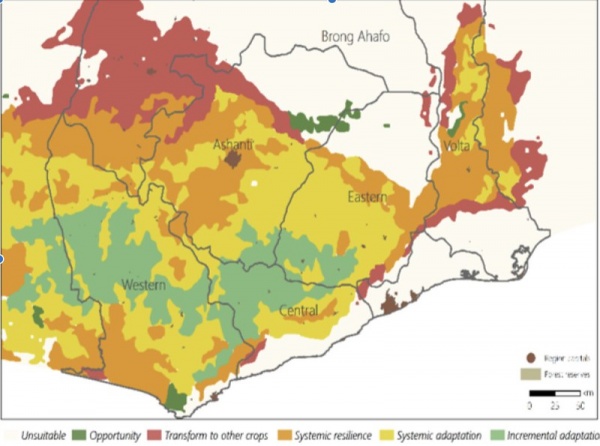
 

Climate change impact zones for cocoa.

Farmers’ application of the business as usual practices in the face of climate change has not yielded the desired improvement in productivity and farm resilience. IITA experts brought together lead farmers and technical officers from both private and public companies with the aim of validating site-specific Climate-Smart Cocoa (CSC) practices which were developed for the three zones. Information on the CSC practices, along with experts’ knowledge were developed through analyzing data on farmers’ adaptation strategies at the plant, household, farm and landscape levels to address the impact of climate change.

Two approaches for a better adoption by farmers

As part of this work, the International Institute of Tropical Agriculture (IITA) and the CGIAR Research Program on Climate Change, Agriculture and Food Security (CCAFS) CSC consortium, including the International Centre for Tropical Agriculture (CIAT), Rainforest Alliance (RA), Sustainable Food Lab (SFL), and Root Capital (RC) developed two complementary approaches to help cocoa farmers adopt CSC practices:

  1. Cocoa farmer segmentation
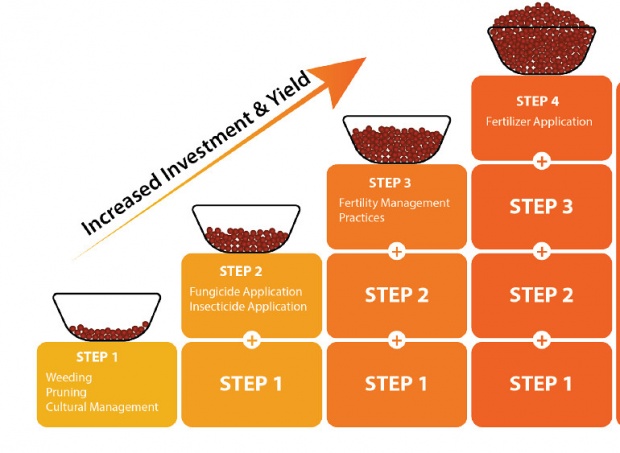
  2. Stepwise Investments Approach (SIA) for cocoa

The first approach categorizes cocoa farmers according to their resource endowments in the climatic impact zones. The second suggests Good Agricultural Practices/CSC which follow an incremental investment pathway, realize the optimal potential of their investment through exponential increase of yield and income from their cocoa farms.

A return on investment (ROI) study conducted by IITA analyzed the cost/benefit of the SIA for cocoa farming in the three climatic impact zones of Ghana under three scenarios: young farms (less than 15 years old), mature farms (16–30 years old) and old farms (older than 30 years). Results showed that cocoa farmers in the Transform Zone obtain the highest ROI when cocoa is in the old stage whilst farmers in the Cope Zone obtain the highest ROI when cocoa is in the young stage. Lastly, farmers in the Adjust Zone obtain the highest return on investment when cocoa is in the mature stage.

Currently, IITA and its partners through CCAFS Cocoa are piloting CSC stepwise trials in the Cope and Adjust Zones. This aims to collect data on performance indicators (pod count) and cost of the CSC practices on plots representing the various steps under the SIA. Also, private sector companies are being engaged to run similar pilots across the three climatic impact zones to generate more data to build a strong business case for climate smart agriculture investment in cocoa systems. Two companies; Produce Buying Company (PBC) a subsidiary of Ghana Cocoa Board (Cocobod) and Cargill Cocoa Ghana Limited are particularly keen on piloting CSC in the coming year.

As part of making the results applicable for our target companies, a CSC implementer free mobile application has been developed and will soon be available on Google Play Store. This App combines farmers segmentation and suggests a stepwise investment pathway to Climate-Smart Cocoa cultivation.

The project team is currently working with a financial consultant on conducting an analysis on agricultural financing within the cocoa sector in Ghana. The results of this work will be the basis for the development of a business model for CSC investment.


About the author: Mustapha Alasan Dalaa is a Research Assistant. Richard Asare is a Cocoa Scientist and Coordinator for the CocoaSoils project. Both work at the International Institute of Tropical Agriculture (IITA).


EDITOR’S NOTE: The opinions expressed here by Impakter.com columnists are their own, not those of Impakter.com.  Photo Credit: IITA

Tags: adaptationclimate-smartcocoa
Previous Post

Innovators Creating Sustainable Coastal Solutions

Next Post

The Most Successful Air Pollution Treaty You’ve Never Heard Of

Related Posts

EU deforestation ban
Business

Why the EU Delayed the Deforestation Ban

European Union lawmakers announced last week that companies will have an additional year to adapt to a ban on selling...

byAlessandro Camillo
December 11, 2024
Sustainable Chocolate
Science

Scientists Invent a Healthier and More Sustainable Chocolate

The chocolate-making process has long been criticized for being wasteful, with only the cocoa beans used while the rest of...

byJacob Lee
September 6, 2024
Sustainable Chocolate Is Impossible Without Higher Prices, Report Says
Environment

Sustainable Chocolate Is Impossible Without Higher Prices, Report Says

Chocolate is bittersweet: it’s warm, savory taste melts in the mouth, is a great topper to any dessert and can...

byElizabeth Partsch
December 8, 2022
Hydronic Shell Technologies: Retrofitting buildings to net-zero emissions
Architecture

Hydronic Shell Technologies: Retrofitting buildings to net-zero emissions

Many discussions and political acts to reduce global GHG emissions demand radical and rapid behavior changes, but what will really...

byValerie Schwane Torres
June 3, 2021
armer harvesting fish in Thanh Hoa Province, Vietnam. Aquaculture production has been found as a profitable and climate-resilient livelihood that farmers can adopt
Foodscape

Towards a Profitable and Climate-Resilient Aquaculture in Vietnam

Vietnamese farmers can improve their profitability and enhance their resilience against climate impacts by growing shrimp, tilapia, and seaweed together....

byCGIAR
December 2, 2020
The Future of Agriculture? Integrating Agroecology and Climate-Smart Agriculture
Food

The Future of Agriculture? Integrating Agroecology and Climate-Smart Agriculture

Re-assessing agroecology's role in sustainable agriculture. Integrating agroecology and climate-smart agriculture in CCAFS activities. The CGIAR Research Program on Climate...

byCGIAR
September 29, 2020
Building Resilient Climate Smart Agricultural Systems For Smallholder Farmers
Green Tech

Building Resilient Climate Smart Agricultural Systems For Smallholder Farmers

Editor's Note: This article was shared with us by One Acre Fund. One Acre Fund provides farm inputs, finance, and...

byAlessandro du Besse' - Tech Editor
September 17, 2020
How the Rainforest Alliance are “Reimagining” Sustainability Certification
Business

How the Rainforest Alliance are “Reimagining” Sustainability Certification

On June 30 2020, The Rainforest Alliance announced their new Sustainability Certification Program with goals to produce better crops, decrease...

byAnna Durbanova
August 5, 2020
Next Post
The Most Successful Air Pollution Treaty You’ve Never Heard Of

The Most Successful Air Pollution Treaty You’ve Never Heard Of

Recent News

World Health Organization

Why America’s Withdrawal From the WHO Is Bad News for Everyone

February 5, 2026
How Climate Change Is Driving Evolution

How Climate Change Is Driving Evolution

February 5, 2026
How to search for an address in the US

How to Research Any Address in the United States

February 5, 2026
  • ESG News
  • Sustainable Finance
  • Business

© 2025 Impakter.com owned by Klimado GmbH

No Result
View All Result
  • Environment
    • Biodiversity
    • Climate Change
    • Circular Economy
    • Energy
  • FINANCE
    • ESG News
    • Sustainable Finance
    • Business
  • TECH
    • Start-up
    • AI & Machine Learning
    • Green Tech
  • Industry News
    • Entertainment
    • Food and Agriculture
    • Health
    • Politics & Foreign Affairs
    • Philanthropy
    • Science
    • Sport
  • Editorial Series
    • SDGs Series
    • Shape Your Future
    • Sustainable Cities
      • Copenhagen
      • San Francisco
      • Seattle
      • Sydney
  • About us
    • Company
    • Team
    • Partners
    • Write for Impakter
    • Contact Us
    • Privacy Policy

© 2025 Impakter.com owned by Klimado GmbH