
PublicRegistry.us is a privately run, paid search platform that licenses U.S. public records from third-party data providers and links them together, so a single search on a name, address or license plate can return contact details, property deeds and tax history, vehicle records, and court files such as arrests, warrants and traffic cases as one connected report. We tested it to see how much of an ordinary person’s life is already searchable, and the answer surprised us. Our overall score is 4.9 out of 5. The search is quick, the reports are organized well enough for OSINT-style research, the rules on misuse are clearer than at most rival sites, and you can take your own listing down yourself.
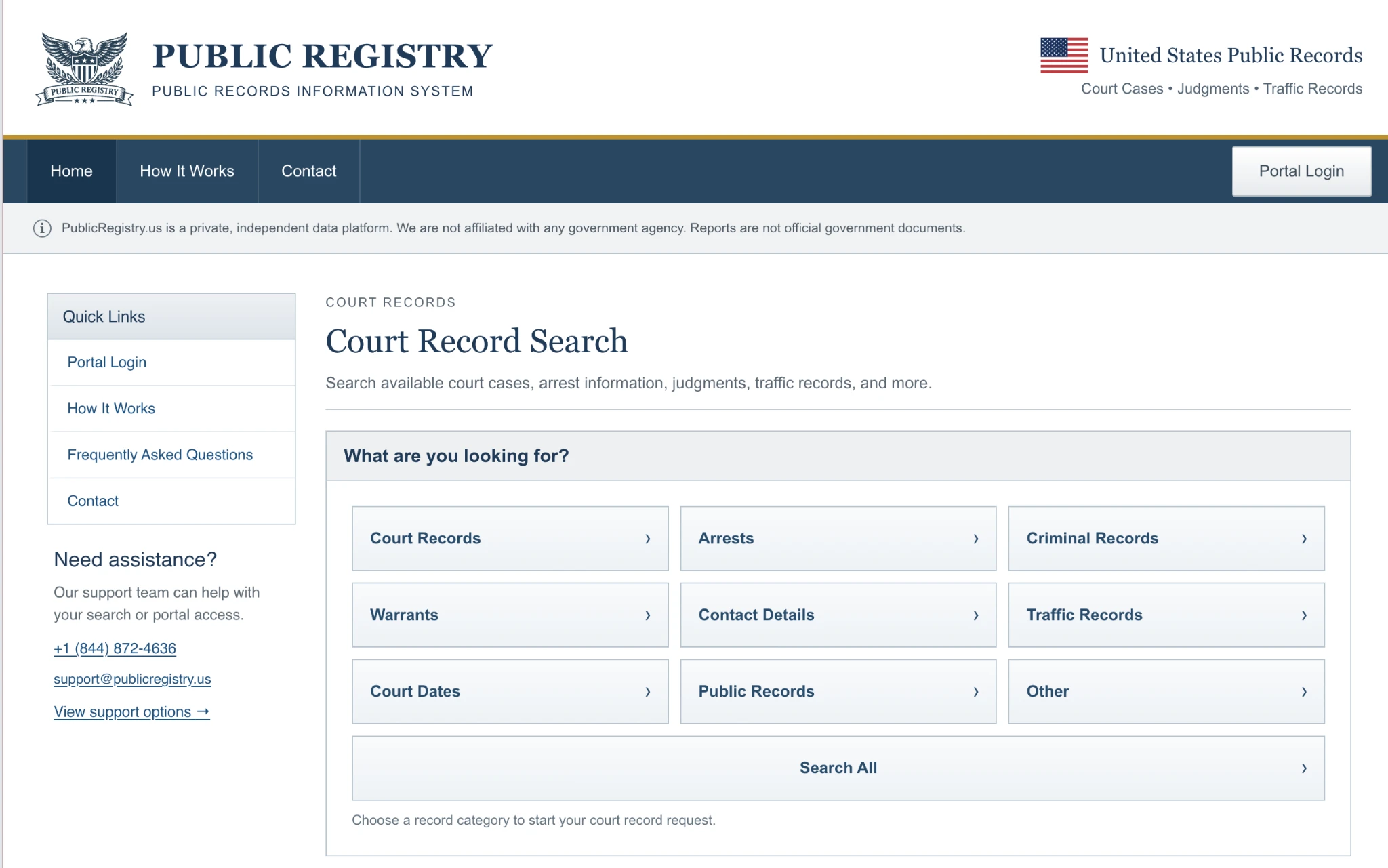
Start by Searching for Yourself
The most useful first search is your own name. You type it into the search bar, or an address or plate number instead, and narrow it by state if you want. Before asking you for anything, the site shows how many matches it found. You only need an account when you decide to open the full report. There is no dashboard to learn and no settings page to get through first.
The homepage has one weak spot. Its category menu lists Court Records, Arrests, Warrants, Contact Details and several more, and it isn’t always clear which of them holds the record you want.
Once a report opens, it is split by record type instead of running as one long list. Matched addresses, associated records and property details each have their own section, with related entries placed together. A property search shows ownership history, tax records, liens and mortgages, along with links to anyone connected to that address where the data supports it. Court and criminal cases are tied back to a person’s profile when the records allow, which saves an analyst from going through county systems one by one.
Reports stay in your account dashboard. If you need to take one with you, add-ons offer a downloadable PDF or a more detailed report with extra record types. In our view, though, the export matters less than the overview itself. Seeing everything listed under your name, and how little effort it took to find, turns a vague privacy concern into a concrete question: what should come down?
Removing Your Listing
That question has a direct answer on PublicRegistry.us. You find your own listing and submit a removal request yourself, without contacting support. The company says it clears the record from its side fairly quickly, although browser caching can delay when you see the result.
The site is also open about the limits. A removal stops PublicRegistry.us from showing your record, and nothing more. The original court filing, the property deed and the third-party source that supplies the data all stay where they are. A full privacy cleanup means repeating the request with every broker that uses the same sources. That is slow work, but it is how the industry operates, not a failing of this particular platform.
Why This Is a Security Issue
The reason to care goes beyond curiosity. Social engineering rarely begins with a technical exploit. It begins with a name, an address and a few personal details that make a phishing email or a pretext call sound as if the sender already knows the target.
The search we just described needs no technical skill and no special access. A name, an address or a plate number is enough. That low barrier was the most important finding of our test, because anything you can find about yourself in a few minutes, someone else can find too.
Where the Records Come From
PublicRegistry.us does not collect records itself, and it is not a government website. Third-party data providers gather public and semi-public records. PublicRegistry.us buys access to that data and links related entries, which is why a search on a person or an address returns connected results instead of scattered fragments.
The source depends on the record type. Property data such as deeds, tax history, liens, mortgages and permits usually comes from county assessor and recorder offices. Court records, including arrests, warrants, criminal history, traffic cases and court dates, come from state and county judicial systems. Vehicle history and plate lookups rely on title and registration records linked to a VIN or plate. People search ties these strands together.
None of this is scraped from questionable places. The data is licensed and aggregated, and it was public to begin with, so a report contains nothing secret. What changes is effort: these records are normally spread across so many county offices that almost no one would assemble them by hand, and here one search replaces five.
Accuracy is the main caveat. The data comes from third parties and public sources and is not checked line by line. The site states that it does not investigate accuracy and cannot correct records at their source. That is true of the whole category, not only this service. If a record matters, confirm it with the court or agency that issued it.
The site also states that it is not a consumer reporting agency under the FCRA. That single line defines what its reports are for. They are not meant for hiring or credit decisions. They suit verification: whether an address checks out, whether a name is linked to a property, or what public records are attached to a phone number.
What the Data May Not Be Used For
The FCRA line carries through to the terms of use, which are more direct than those of most competitors. They rule out using the data for decisions about employment, housing, credit, insurance, education or government benefits, which is essentially any decision that would bring FCRA rules into play. Stalking, harassment and doxing are each named as prohibited, so users are not left to work that out for themselves.
The service is designed for personal lookups and due diligence on information that is already public. It is not a substitute for a compliant background-check provider, and labeling harassment as “research” does not make it allowed. Anyone who needs FCRA-compliant screening for hiring should use a licensed consumer reporting agency. PublicRegistry.us does not present itself as one and does not blur what counts as misuse.
That still leaves a range of legitimate uses: confirming that a court case someone mentioned really exists, checking a property or vehicle before a transaction, verifying that a person is who they claim to be, and searching your own name to see what others can find.
Paying for It
The main option is a report bundle covering up to 720 reports, paid in 24 monthly installments instead of one lump sum, with a small charge at the start. Single reports and add-ons, including the PDF export and the more detailed report, are billed separately from the bundle.
Which option makes sense depends on how often you search. For frequent users, such as people researching family history or running repeated property and vehicle checks, spreading the cost over a large allowance is reasonable. Someone with a single question is probably better off with one report. Either way, the prices are shown before you commit, and future charges can be stopped by phone, email or live chat rather than by digging through account settings.
PublicRegistry.us Versus BeenVerified, Spokeo and Whitepages Premium
PublicRegistry.us has several established competitors, including BeenVerified, Spokeo and Whitepages Premium, each with its own approach to reports and pricing. Here is how PublicRegistry.us compares with them:
| Factor | PublicRegistry.us | Narrower rivals |
|---|---|---|
| Scope | People, property, vehicles and court records in one search | Can give a tighter report in a single area, such as vehicle history or people search |
| Covering all four areas | One service | May require two or three services |
| Removing your own listing | Self-service, with no support queue | Few platforms make this as direct |
Breadth is the main advantage, along with a search that needs little setup and prices shown before you buy. The self-removal tool is the clearest difference: for anyone concerned about their own footprint, it is a real reason to pick this service over others.
Pros and Cons
Pros
- People, property, vehicle and court records are covered in one search.
- Match counts appear before you need an account.
- Reports are grouped by record type, and court cases are linked to profiles.
- The terms name stalking, harassment and doxing as banned and set out FCRA limits.
- You can remove your own listing without contacting support.
- Charges can be stopped by phone, email or live chat.
Cons
- Records are not independently verified and cannot be corrected at the source.
- The data cannot be used for hiring, housing, credit or other FCRA-regulated decisions.
- Removing your listing does not affect the original records or other brokers.
- PDF exports and detailed reports cost extra.
Bottom Line: 4.9 out of 5
We score PublicRegistry.us 4.9 out of 5, and visibility is the main reason. Most people never search for themselves like this, so they don’t know how much of their life can be pieced together from a name and a few minutes of effort. This service shows it. You can then request a takedown, reduce what is public, or simply keep it in mind, but you cannot deal with exposure you don’t know about. That lesson matters more than any single feature.
Editor’s Note: The opinions expressed here by the authors are their own, not those of impakter.com — In the Cover Photo: EA public records search may reveal personal information from multiple sources. — Cover Photo Credit: magnific