
At times, the international community passes by the chance to address major issues, like the drop in labor productivity that resulted from the Covid pandemic and – as it turns out – has deeper roots than just the pandemic. This is what happened at a Summit for a “New Global Financing Pact” held in Paris that ended on June 23, 2023.
With more than 300 high-level participants from governments, international organizations, representatives of civil society, and the private sector, it usefully addressed the colossal financial needs resulting from climate change and debt relief needs of vulnerable developing countries.
Insofar as there were positive indications from many deep-pocket participants to increase funding, whether as part of their development assistance windows or consideration of a possible tax on financial transactions by major corporate polluters. The Summit’s final communiqué indicated that there was now a “good likelihood” of finalising the long-overdue $100-billion pledge in climate finance for developing countries.
Certainly, these are subjects of great macro import. At the same time, there are other matters of great concern that are equally important for our collective future, in particular, to achieve the goals every developing country aspires to, as set out in the UN 17 Sustainable Development Goals, namely SDG 3 (Good Health and Well Being) and SDG 8 (Decent Work and Economic Growth).
It is likely that there was not much if any discussion at the Summit of how to improve labor productivity, in particular taking into account its relationship to major health infectious disease outbreaks – and this despite the fact that, as a result of the massive job disruption caused by the COVID pandemic, labor productivity has increasingly come up as a key issue requiring attention.
Moreover, with respect to the latter, addressing epidemics or pandemic prevention through a One Health approach, demonstrably provides the highest economic returns, in terms of increased benefits and reduced costs.
Global leaders coming out of the Summit, having concentrated on debt relief solutions as well as climate financing, should now turn to related priority topics such as these and look beyond conventional solutions for innovative, out-of-the-box pathways to do common cause.
Such a pathway would be the intersection of two critical concepts: One Health and labor productivity. In this article, we will explore why they need to be considered in tandem.
On one hand, the One Health concept is based on the premise that the health of humans, animals, and the environment are interdependent and therefore, must be treated as a singular unit. This holistic approach recognizes that the health of humans, animals, and the environment is interconnected, and their health is essential for the global health of animals and humans.
On the other hand, labor productivity is a measure of the amount of work that an individual can produce in a specified period. High productivity is desirable in helping to maximize profits, lowers costs of production, and enhance economic competitiveness.
Links Between One Health and Labor Productivity
- Preventing Illness:
One Health approach focuses on preventing the emergence and spread of diseases. By implementing preventive measures, such as vaccination, sanitization, and hygiene practices, the health of animals and humans can be safeguarded.
This, in turn, can reduce the likelihood of downtime due to illness, absenteeism, and hospitalizations. The employees’ health, therefore, has a direct impact on their productivity levels.
- Reducing the Incidence of Zoonotic Diseases:
Zoonotic diseases are those that are transmitted from animals to humans. Some major examples include malaria, influenza, leptospirosis, and salmonellosis. By implementing One Health measures such as monitoring and controlling animal health, vaccination, and improving animal husbandry practices, the risk of transmission of zoonotic diseases can be mitigated.
This, in turn, reduces employees’ exposure to zoonotic diseases and reduces absenteeism, and hospitalization. Thus, the implementation of One Health measures can improve labor productivity.
- Minimizing the Risk of Work-Related Injuries:
One Health measures not only focus on managing and preventing diseases but also on improving working conditions to prevent injuries. The management of environmental and occupational hazards to which animals and humans are exposed reduces the number of work-related injuries.
This, in turn, lowers the likelihood of downtime due to injuries, absenteeism, and hospitalizations, resulting in higher productivity levels.
- Improving Mental Health:
The One Health perspective recognizes the impact of the environment on human and animal health. Employees who work in an environment that is free of environmental pollutants and hazards, such as physical violence, can experience better mental health. This, in turn, enhances their ability to perform effectively, which can lead to increased productivity.
Covid pandemic times have pushed to the fore the issue of the “right work-life balance” for many in the millennial and Gen Z generation, as expressed in the upsurge in “quiet quitting” that hit headlines a year ago, also sometimes described as the next phase of the “Great Resignation”:
This unwillingness of workers to be engaged and productive cannot be addressed without a general review of the approach to work management. And here One Health offers a different, more holistic perspective, recognizing that important aspects of life, including relations with family, friends, and Nature, happen outside working hours.
- Enhancing Food Security:
Adopting One Health measures can also enhance food security by promoting sustainable agriculture practices that are aimed at improving food safety and animal health.
This, in turn, can bolster workers’ health, especially those who work in agriculture. Varied diets and improved nutrition translate to better health, which can result in higher levels of productivity. Both can have positive and synergistic benefits.
Adopting a One Health approach, we could learn from animals and boost our productivity
Take the example of music. We’ve known for over twenty-five years that music boosts milk production in cows. One study, carried out by psychologists at the University of Leicester (UK) found that exposing bovines to slow music increases milk yields by keeping the cows calm and relaxed. The music drowns out background noise from the farm, which helps the cows to feel at peace and relaxed.
Another study, carried out at LCAH Dairies in Lincolnshire and Bishop Burton Agricultural College in Humberside, exposing one thousand Friesian cattle to fast, slow and no music for 12 hours a day over the course of nine weeks found that each cow’s milk yield rose by 3% a day when slow music, rather than fast music, was played³.
And researchers have shown that music affects other animals too, for example, chickens increase their egg production when exposed to music and soothing music destresses dogs in kennels.
So it should come as no surprise that researchers have found that human productivity is also affected by music. One study found that 90% of workers perform better when listening to music, and 88% of employees produce more accurate work. Business owners agree, and 65% of business owners believe that music makes employees more productive.
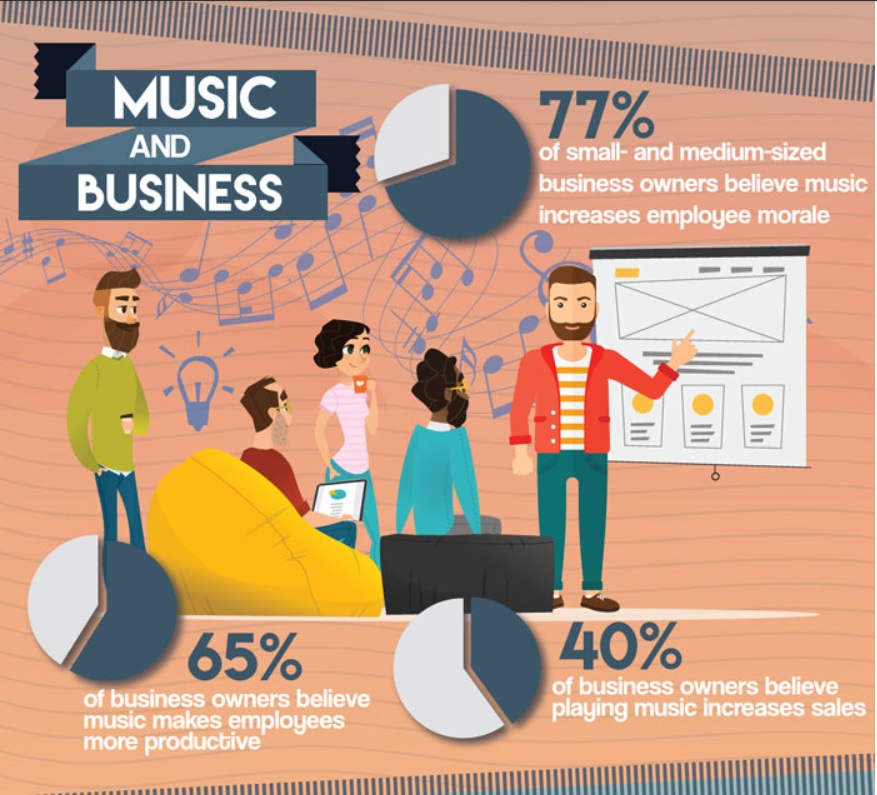
The Harvard Business Review, in a recent article, showed how music can make humans more productive and the “right music” must be chosen in function of one’s skills, the kind of task one is engaged in and one’s psychological profile.
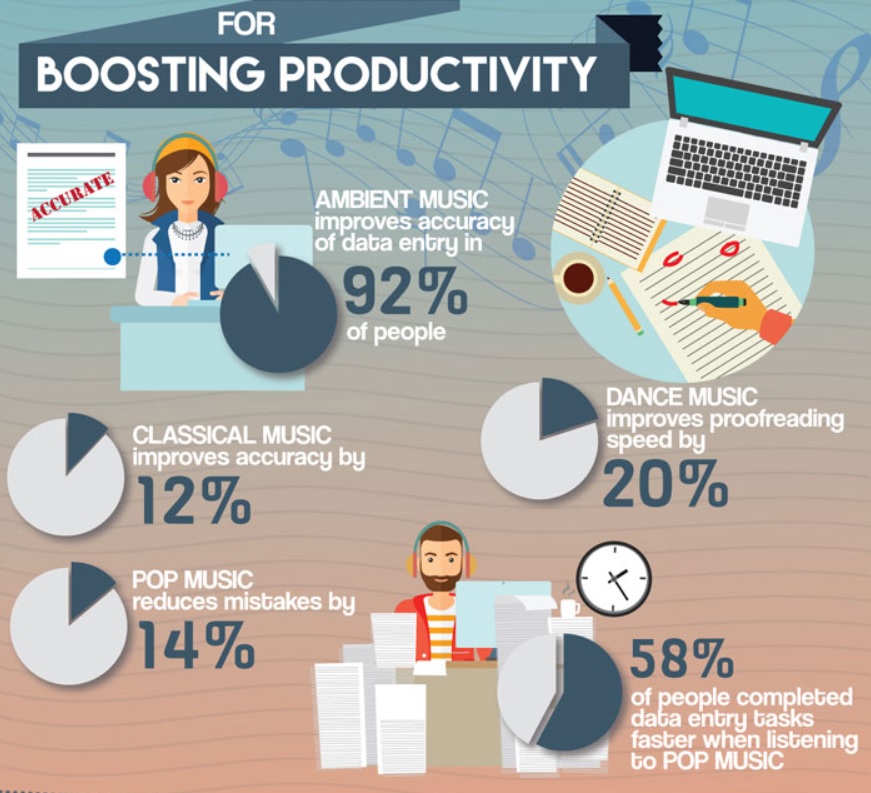
One Health can open new vistas on labor productivity
Applying the magic of music to labor productivity is just one idea and it still needs more research and more evidence in order to adopt it more widely. But as the cliché goes, “what gets measured gets done”. We do not yet have all the right tools and methods to measure data, nor have we done the needed experiments to determine which factors impact labor performance the most and under what circumstances.
However, in-depth measurement methods can be developed. We have seen how climate change, once disregarded and pushed into the backwaters of international interests, has become a high priority as a result of years of advocacy and evidence gathering coupled with improved ways to measure climate impact. Consider how the Greenhouse gas protocol initiative (GHG protocol) launched in 2001 to develop and promote internationally accepted greenhouse gas (GHG) accounting and reporting methods has now become the world’s accepted standard for measuring carbon emissions.
Increasingly big companies are looking for ways to assess and improve their environmental footprint and become socially responsible, as per the ESG framework, i.e. addressing environmental, social, and governance issues. And small and medium enterprises (SMEs) are increasingly drawn in as governments set up more stringent regulations, especially in the EU, calling on businesses, big and small, to become more sustainable.
In short, it is not enough for a business to lower carbon emissions but there is also a need to address all the other issues, the “S” and the “G” in ESG. This means that businesses need to improve, inter alia, the management of human resources and the workplace.
If we can do it for the environment and social issues, with research, money, and heightened public awareness, we can certainly do it for labor productivity and One Health.
Getting a handle on the interactions between worker productivity and One Health, identifying the risks and benefits for economic growth and quality of life, would lead to better functioning and more prosperous societies.
The best time to do so is now.
Editor’s Note: The opinions expressed here by the authors are their own, not those of Impakter.com — In the Featured Photo: screenshot from a video of music designed to help concentration at work Source: Yellow Brick Cinema