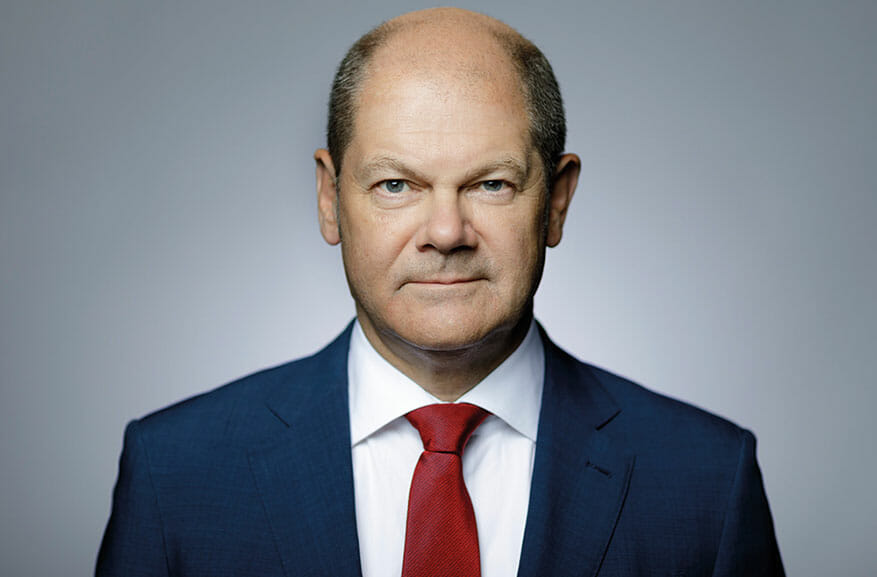
Wednesday marked the beginning of a new era in Germany as Olaf Scholz was sworn in as their ninth post-war chancellor; he is also the first Social Democrat to be in the role in 16 years. He succeeded Angela Merkel who held the office for over 16 years for the Conservatives.
Scholz secured 395 of 736 delegates ballots during a parliamentary vote. He is set to lead the “traffic light” coalition between his Social Democratic Party (SPD), the Greens and the liberal Free Democratic Party (FDP). Their arrangement marks the first power-sharing government of its kind in Germany and the first governing agreement between three parties since 1957.
Scholz’s plans for Germany include a pledge to boost green investment and strengthen European integration. He served as vice-chancellor and finance minister with Angela Merkel in a coalition government for the past four years and it is undoubted that this front-row seat gave him the experience and time to consider the changes he would make should he get the opportunity. Now he has.
A problem Scholz may encounter is how he will emerge from Angela Merkel’s shadow; she leaves behind a strong legacy in Germany and Scholz is already encountering issues from her reign. Among them, the Nord Stream 2 gas pipeline, which is bringing gas directly to Germany from Russia and bypassing the Balkans.
During her administration, Angela Merkel always insisted that it was a commercial entity and not a political tool. Scholz so far is skirting around the issue and no one is clear as to whether he will take the same stance as his predecessor, as members of his party, the Social Democrats have previously backed the pipeline. The concern surrounding the pipeline is whether it should be halted if Putin moved on the Ukraine – he is currently amassing troops on its eastern border – and so far Scholz is not offering a clear answer.
However, it must be remembered that Scholz is now in coalition with the Green Party who has publicly opposed Nord Stream 2. The Green Party controls two key ministries in the Scholz government – energy and foreign policy – so they do have leverage in decisions that are made regarding the pipeline. If the coalition is split on one of the first decisions it has to make it is hard to see how the German people would be able to place the same level of trust in this government as they did in Angela Merkel.
Scholz took an oath at the Bundestag where he promised to use his powers as Chancellor “for the good of the German people.” However, the oath was missing its final line, “So help me God”. Scholz was raised Protestant but left the church and opted to decline the optional final line. The line had always been spoken by Merkel which was expected of her as a leader of the Christian Democratic Union of Germany. This is a symbol in many ways marking the change that has come.
Scholz’s victory also comes at a critical moment in politics for the centre-left in Europe: throughout the last decade, many of the parties that once dominated European politics have become almost obsolete. Observers have noted that a contributing reason for this is that they have been largely abandoned by their historic working-class base.
Scholz’s election may prove that having the working-class vote may be the secret to success. For the first time since 2005, the Social Democrats were the strongest party among the working class. It is reported that over 800,000 voters who had abandoned the party for the far left and far right returned in the last election.
Related Articles: Germany’s Post-Merkel Government Might Be Just What the World Needs | German Elections: a Tight Race, Narrowly Won by the Center-left
On his campaign trail, Scholz put them at the centre saying, “We need to tell people two things, first, that we need respect, we need good pay and proper recognition for work. And second, we have to ensure that there are good jobs in the future.” This message appears to have worked.
Along with a new chancellor comes a new cabinet, Scholz has opted for a gender-equal cabinet and his ministers represent a number of firsts: Green Politician Angela Baerbock is the new foreign minister and Social Democrat Nancy Faeser is in charge of the interior. This is the first time women have held these offices. The new Agricultural Minister Cem Özdemir, of the Green party, will be the federal republic’s first minister with Turkish roots.
Ich werde dem Bundespräsidenten 4 Frauen und 3 Männer als Minister*innen vorschlagen, die gemeinsam für die @spdde mit mir die Geschicke des Landes leiten sollen. Das entspricht der Gesellschaft, in der wir leben – die Hälfte der Macht gehört den Frauen. (1/5) pic.twitter.com/wMPhBeXQzp
— Olaf Scholz (@OlafScholz) December 6, 2021
Scholz did not shy away from appointing some polarizing figures in his cabinet. This begins with the new health minister Karl Lauterbach, a studies epidemiologist and Harvard graduate. He became a regular on television panel debates throughout the pandemic, causing him to become somewhat of a hated figure amongst Germany’s anti-vaxxers and lockdown skeptics. But he was desired by many as the most qualified politician for the job in the health ministry.
Perhaps the most debated figure in the Scholz cabinet is Finance Minister Christian Lindner, the leader of the Free Democrats, a small but vociferous party on the far right of the political spectrum and very fiscally conservative. Not qualities most would look for in the person controlling the purse strings of a country.
He is likely to have a negative impact on European policies and undermine the Greens, a party that decisively supports more European integration. He was picked by Chancellor Scholz, even though many Social Democrats were already warning of the prospect of installing a fiscal hawk in Berlin. So far he is insistent on reeling in national debt while putting a lid on any talk of common borrowing within the eurozone. It is already being suggested that his role in the coalition will mean that the frugal countries of Northern Europe will have an ally in Berlin.
Bundesfinanzminister @c_lindner versteht das Bundesfinanzministerium als Ermöglichungsministerium: Es soll Vorhaben der #Bundesregierung ermöglichen, die Verfassung achten sowie sparsam mit den Mitteln der Steuerzahler*innen umgehen. #Stabilität #Europa pic.twitter.com/par51GF9Zh
— Bundesministerium der Finanzen (@BMF_Bund) December 9, 2021
How Green will the new Germany be?
The Green Party has a significant amount of weight in the cabinet, they secured the vice-chancellorship, economy ministry and foreign affairs. The economy ministry was in fact expanded to include climate policies to pacify the Greens. But will it be enough?
According to the latest reports, Robert Habeck, the new vice-chancellor is aiming for nothing short of a “green economic miracle.” Claudia Kemfert, head of the energy, transportation and environment department at the German Institute of Economic Research in Berlin called the coalition’s proposal “the most ambitious climate protection program Germany ever had.”
Examples include that the new coalition government wants to end the use of coal for power and increase the proportion of clean energy from around half today to 80 percent by 2030. The total amount of electricity needed will also grow to power the 15 million electric cars that are supposed to be on the road by 2030 and to heat homes as fossil fuel systems are phased out.
In this interview from our archive, German Green Party co-leader Robert Habeck shares his vision of a politics that bridges divides. ⤵️https://t.co/5ccMsfWtan
— Green European Journal (@GreenEUJournal) December 8, 2021
Habeck recognises that his “green economic miracle” will not be achieved without encountering many obstacles. He has already stated that behind every corner “lurk anger and quarrel.” He is even likely to face resistance from within the cabinet, most likely from Lindner, as energy transition policies will require funding that Lindner who controls spending will be in a position to refuse or water down.
Mr. Kühnert, general secretary for the Social Democrats stated, “We hope that our election victory in Germany will send a signal for the revival of social democracy internationally.” It certainly appears that hope is the message from the Scholz Government.
Change is on its way in Germany, it is led by democratic movements and forged through coalition talks. With Scholz at the helm, we will have to watch closely as the new Germany tackles everything from climate change, EU relations, the fourth wave of COVID-19. Even how Scholz, who has a reputation for being a good moderator, will negotiate the political obstacles within his own cabinet will matter, especially as one might expect Lindner to come to loggerheads with his Green colleagues. Will the Germans come to miss Merkel or are they in safe hands with Scholz? Only time will tell.
The opinions expressed here by Impakter.com columnists are their own, not those of Impakter.com. — In the Featured Photo: Olaf Scholz. Featured Photo Credit: WikimediaCommons