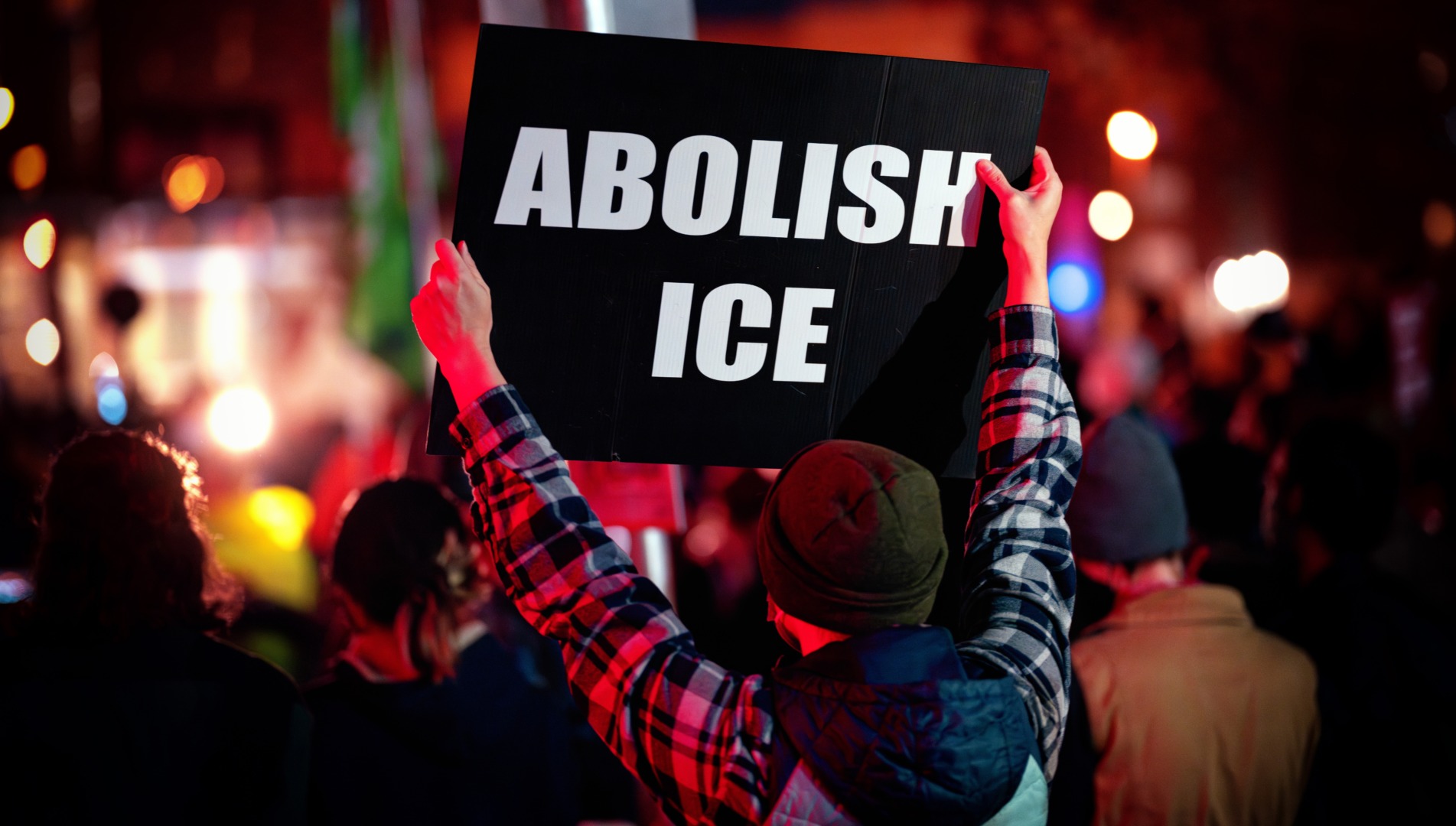
There are more than 200 “detention centers” in America today, where between 68,000 and 73,000 people are incarcerated. Many of the prisoners entered the U.S. as asylum seekers and have carefully followed the rules and procedures for achieving permanent status; quite a few are actually U.S. citizens, with only a small number the purported targets of the operation —immigrants who have perpetrated violent crimes. Their rights have been violated by arrests without judicial warrants, denial of access to lawyers, inhumane conditions with poor (wormy, rotten) food, no medicine, and, in many instances, no space to lie down and go to sleep, even on the granite floors. They are beginning to die.
Anybody who has studied (or lived during) World War II recognizes that these are concentration camps; we are enduring the moral harm of simply knowing that Nazi practices are going on in our own country.
In 1943, in the midst of the darkest days of World War II, theologian Reinhold Niebuhr wrote in his “The Children of Light and the Children of Darkness”:
“‘The children of light’ may thus be defined as those who seek to bring self-interest under the disciple of a more universal law and in harmony with a more universal good. The children of darkness are evil because they know no law beyond the self. They are wise, though evil, because they understand the power of self- interest.”
Of German background, Niebuhr had begun his career at Bethel Evangelical, a German-language Lutheran church in Detroit, where he served as pastor from 1915 to 1928. He experienced World War I’s prejudice against Germans in a city struggling with harsh labor conditions and the virulent racism of a politically powerful unit of the Ku Klux Klan.
It was during these years that he developed his conviction that moral optimism and a belief in reason are not sufficient to deal with the reality of social evil. At a time when it looked like Hitler would triumph in Europe, Niebuhr insisted that for democracy to survive, the “children of light” must look beyond their naïve trust in human good will and reason to take the reality of human evil and cruelty into account.
In 2017, horrified by Trump’s first election, I used Niebuhr’s theory to come to define the evils we were witnessing. Now in 2026, the second year of his second term, the determined lawlessness and deliberate cruelties of his administration can make us fear that the children of darkness may be winning. In Niebuhr’s terms, the good to be found in any social entity depends on our adherence to “more universal law” and “harmony with a more universal good,” rules of conduct that we agree about and formalize in a social compact.
In America, that contract is our Constitution, which all public officials take an oath to uphold. When masked, heavily armed thugs break down doors, search houses, and seize their occupants without judicial warrants, they are disobeying the Fourth Amendment to the Constitution; when they throw them into detention centers without trial they are disobeying the Sixth Amendment, and when they hold captives indefinitely, they suspend their rights under habeas corpus in Article 1, section 9.
These children of darkness obey no law beyond accruing power and money for their own uses, while the children of light uphold legal structures established for the common good. Adam Smith was an early proponent of recognizing society’s inevitable self interest in order to bring it under control. As Jason Furman, Chairman of the White House Council of Economic Advisers from 2013 to 2017, explains, in “The Wealth of Nations”:
“Smith directed his strongest ire against the dominant economic philosophy of his day: mercantilism, which measured success by hoarded gold and trade surpluses, not by human well-being. …At a moment when faith in markets is fraying and faith in governments is strained, Smith’s message is …to discipline power, defend competition and keep the focus where he always insisted it belonged: on improving the lives of ordinary people.”
Trump’s determination to consolidate absolute power in a “unitary executive” (aka dictatorship) enabling him, the Republican Party, and elite oligarchs to pursue his economic goals by over-riding the Rule of Law, fits Adam Smith’s definition of economically self-interested mercantilism.
Moral Harm
Although many have resisted Trump’s lawless cruelty with might and main, his technique of “shock and awe,” which consists of a relentless blitzkrieg of cruelty and illegality every day since his return to office, has left the children of light in a state of moral harm.
This term is most often associated with the mental wounding that soldiers endure from what they do and witness in wartime, but we can be morally wounded when we witness concentration camps being erected in our country (although the detention centers are not strictly analogous to concentration camps in the sense of places people are deliberately sent to die, their unhealthy conditions are indeed deathly and have already taken a number of lives); sadness and empathic horror flood our very souls when we learn that they contain hundreds of children, that ICE (Immigration and Customs Enforcement) has incarcerated a two month old who needs breast milk, denied a deaf six year old access to his hearing aids, and forced a child with stage 4 cancer to discontinue her medical treatment.
Nor is moral harm limited to individuals: degradations of human dignity, normalization of cruelty, and indifference to suffering violate our common conscience and thus the ethical fabric of society. Democracy arises from a living moral conscience shared by the whole nation, which makes moral harm a collective phenomenon.
One of the most disturbing examples is the fact that, though most of us witnessed them move by move on video, the federal government is withholding evidence from the murders in Minneapolis of Renée Good and Alex Pretti by ICE agents, which remain unpunished. Flouting the rules that protect our lives, Trump’s suspension of the rule of law harms us psychologically in a profoundly disheartening way.
Related Articles
Here is a list of articles selected by our Editorial Board that have gained significant interest from the public:
The Repair of Moral Harm
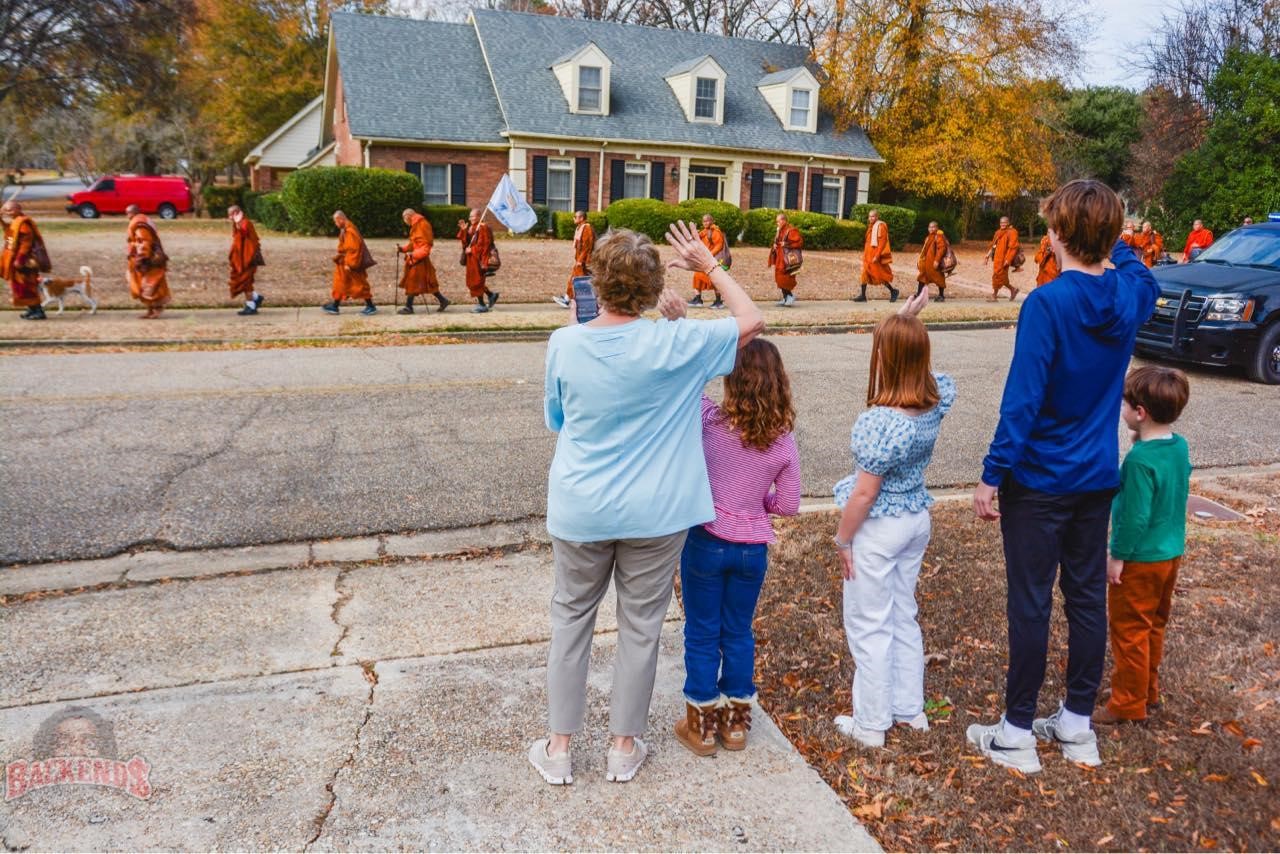
And then, during this winter of our discontent, a line of nineteen Vietnamese Buddhist Monks wound their way into our consciousness, weaving in and out of our social media in their saffron robes and ochre shawls, swaying in contemplative unity as they walked 2,300 miles from their Huong Dao Vipassana Bhavana Center in Fort Worth, Texas to Washington D.C.
There was something inscrutably mysterious about their calm demeanor that drew crowds all along their way who to gaze at them reverently and ask for their blessing. It seemed to me that, having realized how morally wounded Americans were feeling, the monks felt a need to help us heal on a pilgrimage to witness for peace. As they strode silently along for day after day in all kinds of weather, people found them profoundly reparative.
They reminded me of something Rabbi Abraham Joshua Heschel said about accompanying Dr. King in the 1965 March from Selma to Montgomery: when asked whether he had found time for his devotions, Heschel replied, “I felt my legs were praying.” Heschel, like the Zen monks, walked to witness against the moral harm of segregation and on behalf of social good of voting rights.
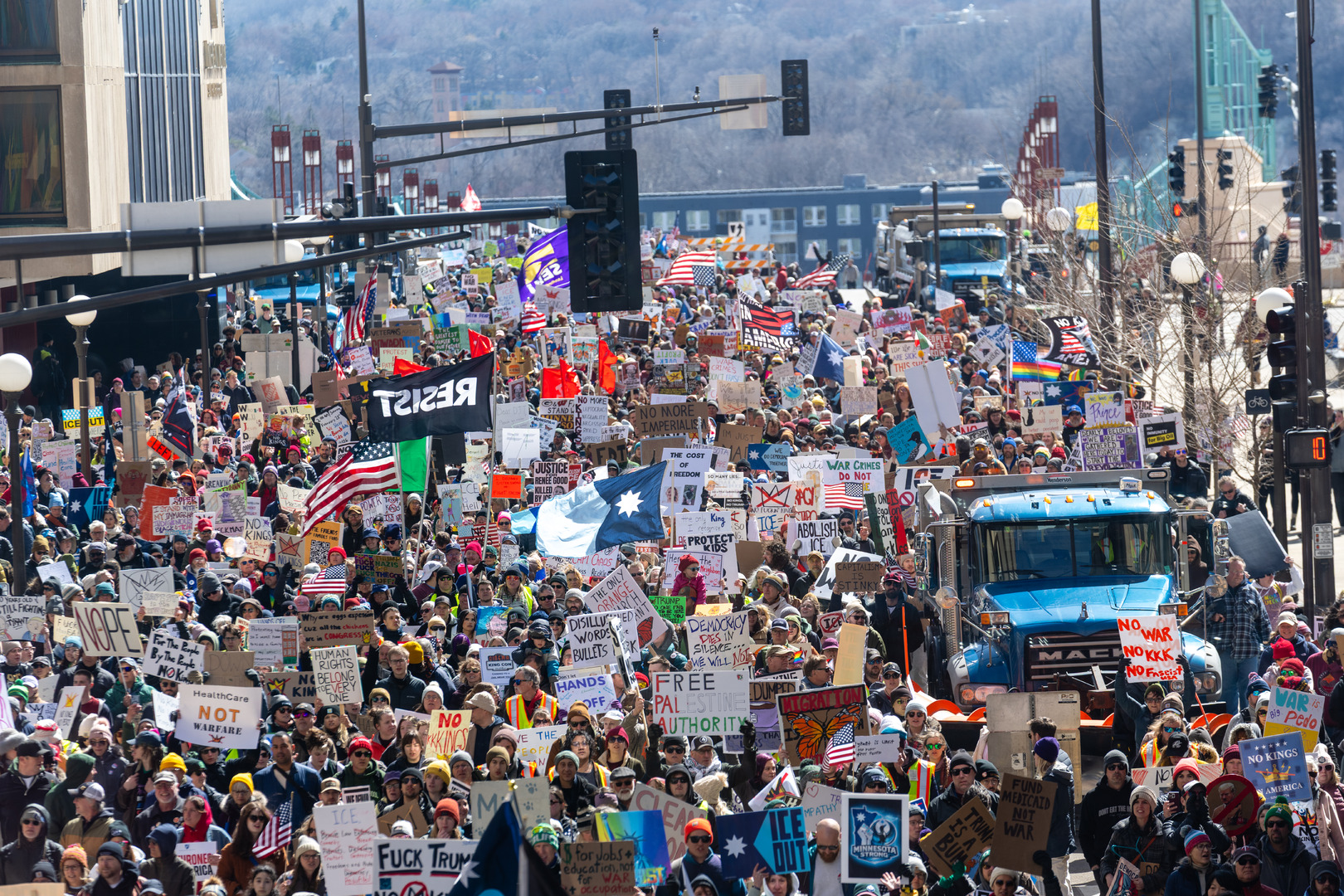
Participation in public protests alleviates moral harm with the kind of joyous solidarity we have witnessed in our three No Kings Marches. On March 28, the “No Kings” protests took place in all 50 states — Red (Trump-supporting) and Blue (Democratic-leaning) states and cities and small towns alike — totaling more than eight million participants. I joined along a local boulevard, where I held up my poster and waved my American flag to cheer every car that honked in concurrence with our values. I did some math and figured that there were 3,600 honks every hour, and that if we add honks from everywhere people demonstrated along roads (and the honkers all voted), our resistance has become powerful enough to restore democracy at the ballot box in this year’s midterm elections.
Although organizers were signing folks up for further resistance activities and get-out-the-vote efforts, moral harm can also be repaired by short-time witnessing like writing letters and making phone calls on behalf of policy reforms that support respect for human dignity, as well as practicing truth-telling in discussion and writing and individual acts of conscience. For one small example, I always wear a No King’s Button and Anti-ICE whistle because I find that this initiates all kinds of political conversations.
Does There Have to Be a Spiritual Dimension to Political Engagement?
We often run into Quakers at demonstrations, a people given to quietly seeking inner light and then taking it out on the streets to illuminate the darkness. Isaac Pennington, an early Quaker, asked to “let things be fairly scanned, that all things may be proved, and that which is good held fast, for truth will not lose ground by being tried, but darkness is afraid of the light, because it has a secret sense that it cannot stand before it.” (1670)
Standing up to unmitigated evil is not an easy thing. When the monks came to the end of their pilgrimage, they were greeted at the door of the Washington Cathedral by Episcopal Bishop Mariann Budde, who had committed a courageous act of moral witness in a prayer service earlier this year when she asked President Trump (to his face) to show mercy to immigrants, and who has been relentlessly pummeled by death threats ever since.
The Zen monks, Rabbi Heschel, Martin Luther King Jr and Bishop Budde are all Niebuhr’s children of light: people willing to stand up and fight against widespread evil on behalf of the public good. Although from different religious traditions, they move the hearts of people who are not necessarily Buddhists, Jews, or Christians. Is belief in a higher power necessary for a moral life? Certainly not for the secular humanists or committedly ethical atheists I know, who, like the American founders who took ethical truths to be rationally “self-evident,” follow a
moral compass based on their firm sense of right and wrong.
Although in mandating the separation of church and state, our Constitution excludes religion from governance, the two seem, nevertheless, intertwined. My own Unitarian minister, Reverend Constance Grant, tackled this issue of “Religion and Democracy” in a sermon where she cited William Ellery Channing’s view that religious values do inform the moral purpose of government:
“We are sometimes told that government has no purpose but an earthly one; that, whilst religion takes care of the soul, government is to watch over our outward and bodily interests. This separation of our interests, into earthly and spiritual, seems to me unfounded. There is a unity in our whole being…I do not deny that government instituted to watch over our present interests. But still, it has a spiritual and moral purpose.” (1830)
Reverend Grant then introduced us to the concept of “Generative Democracy,” which finds a basis for governance not merely in voting but in a continuing and vital interaction among citizens who thus crate new political possibilities. In asking citizens to become “co-creators of democracy,” Generative Democracy expects each of us to develop a living and participatory moral conscience.
The moral harm we are presently experiencing from the Trump regime requires us to harness every bit of moral light that we can find, whether secular or religious. So let’s celebrate the memory of Rabbi Heschel, who liked to describe himself as a “flaming Jewish mystic,” let’s take the compassionate blessing of those Zen monks into our hearts, let’s emulate Bishop Budde’s courage, and be grateful for the sincere moral values of our atheist and humanist friends, always remembering that, as our intrepid New Jersey Senator Cory Booker puts it: “The power of the people is greater than the people in power.”
Editor’s Note: The opinions expressed here by the authors are their own, not those of Impakter.com — In the Cover Photo: Protestor holding “Abolish ICE” banner, Minneapolis, Minnesota, U.S., November 2020. Cover Photo Credit: Tony Webster / CC BY-SA 2.0.