
Today’s ESG Updates
- London Offices Battle to Keep Cool This Summer: Air conditioning has become a non-negotiable tenant demand as the UK heads for its hottest summer on record, exposing a divide between older and newer building stock.
- Trump’s Clean Energy Boom, Despite Himself: US clean energy additions are set to hit a record 45 gigawatts this year, driven by surging AI power demand and expiring tax credits, even as the administration works to curb solar and wind.
- US Cities Push Landscapers Toward Electric Tools, One Leaf Blower at a Time: Noise complaints and emissions concerns are driving a shift to electric gardening equipment, though cost and runtime limits are slowing adoption among professionals.
- London Datacentre Plan Would Emit as Much as 27,000 Flights: Planning documents show the proposed East Havering Data Centre Campus would generate over 1 million tonnes of CO2 annually, the highest disclosed emissions of any UK datacentre proposal.
London offices battle to keep cool this summer
Air-conditioned offices have become one of London’s most fought-over amenities this summer, as the city heads for its hottest on record. In the City of London, 8 in 10 offices: over 3,300 premises, are fully air-conditioned, according to Robert Irving Burns, while only 61% of Westminster properties, many in older converted buildings, have the same. Tenants are increasingly treating it as non-negotiable rather than a bonus.
The strain is showing even among established occupants. Grant Thornton had to relocate strategy sessions three times this summer after meeting rooms overheated, and Hogan Lovells Cadwalader cancelled a summer party over concerns its air conditioning “isn’t keeping up.” Some firms, including Deloitte and KPMG, have capped cooling to limit energy use and emissions, a tension sharpened by the fact that air conditioning itself worsens urban heat and relies on warming refrigerants.
Experts point to Singapore’s integrated approach: shading, ventilation, greenery and efficient cooling as a model, while the UK’s Climate Change Committee has called for a legal maximum workplace temperature, an idea 79% of Britons support in a recent YouGov poll.
Klimado – Navigating climate complexity just got easier. Klimado offers a user-friendly platform for tracking local and global environmental shifts, making it an essential tool for climate-aware individuals and organizations.
Trump’s clean energy boom, despite himself

Photo credit: Markus Spiske
Clean energy additions in the U.S. are set to hit a record 45 gigawatts this year, up roughly 25% on 2024’s record, according to S&P Global Energy — despite the Trump administration’s efforts to curb solar and wind. Surging power demand from AI data centres, rising energy prices tied to the Iran war, and a rush to beat expiring tax credits are driving the boom, with solar and wind capacity set to jump nearly a third and almost 50% respectively in 2026.
U.S. power consumption is expected to grow 39% by 2035, per ICF, and solar and wind remain the fastest, cheapest options to add — breaking even at $37-38 per megawatt hour versus at least $48 for gas, according to Lazard. Courts have also blocked several administration attempts to halt wind projects, while developers say direct engagement with officials has helped smooth permitting despite the political headwinds.
Related Articles
Here is a list of articles selected by our Editorial Board that have gained significant interest from the public:
US cities push landscapers toward electric tools, one leaf blower at a time

U.S. cities are increasingly banning petrol-powered gardening equipment in favour of electric alternatives, driven largely by noise complaints, with added benefits including lower emissions, reduced vibration, and less landscaper exposure to pollution. The shift is drawing new entrants to the market; aerospace startup Whisper Aero adapted its aircraft-grade electric fan technology into a leaf blower after noticing pandemic-era noise sensitivity, offering up to 50 minutes of battery life, though at a premium price and roughly half the blowing force of heavy-duty petrol backpack blowers.
Adoption faces real friction: professional landscapers cite shorter runtimes, lengthy recharge times, and steep upfront costs, with one estimating $10,000 to convert a full equipment fleet as reasons many stick with petrol where local rules allow. Still, major manufacturers are betting on electric alternatives in the long-term. German toolmaker Stihl aims for battery-powered equipment to reach 35% of sales by 2027 and 80% by 2035, backed by a new battery plant in Romania and improved “tabless cell” technology offering 60% more peak power. As one landscaper put it, going electric means “we don’t contaminate the air”, even if petrol tools remain the more powerful, cost-effective option for now.

London datacentre plan would emit as much as 27,000 flights
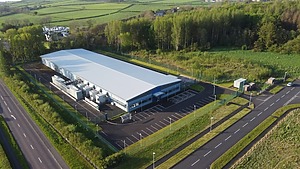
A datacenter in Coleraine
Photo credit: Geoffrey Moffett
A proposed “hyperscale” datacentre in outer London would generate over 1 million tonnes of CO2 annually — equivalent to 27,000 London-New York flights — according to planning documents for the East Havering Data Centre Campus (EHDCC), the highest disclosed emissions of any UK datacentre proposal reviewed by the Guardian. The £14.7bn scheme, spanning 218 hectares of green belt in North Ockendon, would need a 600MVA grid connection and consume 2.65 billion kWh a year at 50% load — more than 1 million UK households’ worth of electricity — with its own planning documents admitting it “does not align with a science-based 1.5C compatible trajectory.”
Critics, including Foxglove’s Donald Campbell and the North Ockendon Residents Association, warn the project threatens both UK decarbonisation goals and green belt land. By 2038, the site’s emissions alone would consume nearly 20 times Havering’s entire carbon budget. The developer has proposed a £77.6m offset payment to cover any shortfall, though campaigners argue datacentre operators should instead be required to build dedicated renewable capacity rather than draw on the shared grid. A revised proposal is expected for public consultation this autumn.
Editor’s Note: The opinions expressed here by the authors are their own, not those of impakter.com — Cover Photo Credit: Tadas Petrokas.