The Israeli-Palestinian relationship is now at its worst in many, many years with the Gaza war threatening to turn longer and involve more countries in the region. The reasons are both historical, fraught with geopolitics in the region, and now involving many countries outside, with the specter of it broadening into a much wider conflict.
At this writing military confrontation is heating up between Israel and Lebanon, and Houthis from Yemen are now engaged, and their missile and drone attacks are having devastating effects on global shipping through the Red Sea and Suez Canal.
With each passing day, the risks grow greater for those directly and indirectly affected. And at this point, while hopefully there is much being discussed behind the scenes, there is little publicly known about big-picture efforts to dampen the situation at some future point when there might be some calming of the belligerents.
Sometimes outsiders can provide seeds of out-of-the-box options to those intensively engaged in seeking solutions to what is on the table at the moment. It is with this in mind that the concepts proposed which follow are put out in public space, without knowing if there are better ones under consideration in private.
Set forth below are multiple elements designed to address core issues, drawing on what has been done in the past, and how external parties can be instrumental in changing the future for those directly affected. As described below it would the the basis for negotiation among all interested parties, and maybe, just maybe, a pathway to avoid a regional war that can easily result in a global one.
The critical elements of this proposal include:
- acceptance of the West Bank as an independent state, not what is typically talked of as the “two-state” solution;
- treating Gaza like Berlin at the end of World War II as a divided city, administered by different external governments, with the North by Israel and accepted partners and the South by Egypt, also with other partners;
- massive Marshall-like Plan financing for both the West Bank and two Gaza entities, financed by interested parties including developed countries, the oil-rich Middle Eastern States, and multilateral institutions, with commitments initially for ten years;
- border and other security measures provided by multilateral actors to all parties, whether under the United Nations or other auspices.
What is very different here is the idea of treating Gaza as an urban and divided entity, not as part of a two-state solution, at least for now.
Assuredly, Gaza is not the same as Berlin, but it is a small strip of land essentially entirely urbanized, and one of the most densely populated areas in the world. It has limited access to resources and infrastructure, with its governance and military organization long in the hands of Hamas, the acronym of the Islamic Resistance Movement.
Regarding the West Bank, in 2004 it was divided into three regional levels with the Palestinian National Authority exercising total or partial civil administration. However imperfectly, the PNA has been functioning as a governing entity that could serve as the political infrastructure for a fully recognized and operational State.
History shows that Israel has in the past been willing to engage in multinational efforts. Such was the case with the signing of the 2004 Oslo Accords by Israel Prime Minister Rabin and Palestinian Liberation Organization Negotiator Arafat, and more recently the Abraham Accords Declaration organized by the United States and signed by multiple Arab countries including, the United Arab Emirates (UAE), Bahrain, ultimately Morrocco, Sudan, and with the expectations others would follow — a process that was interrupted by the Hamas attack of October 7th.
Turning to the reconstruction phase and financial needs, there is the history of the Marshall Plan which showed learning from mistakes following World War II. The Marshall Plan was a major contributing success to recovery and the “economic miracle” of the 1950s and 60s by providing support to European countries devastated in the aftermath of World War II. Ultimately sixteen countries were assisted, including the leader of the Axis, Germany.
Since that time, foreign assistance, whether for political and economic aid, development aid, military aid as well as humanitarian assistance has been provided billions of dollars. It has meant that situations left unaided could have translated into catastrophe.
The Middle East situation is an opportunity to have a global response, for the good of all of us.
Concerning security arrangements, whether for Israel, a divided Gaza, or a West Bank State, it will require better safeguards and guarantees than have been provided in the past by the United Nations,. Here is where countries in the Middle East region have to be willing to put more than their rhetoric and money.
All this will need new thinking and the readiness of external partners to commit to “walk the talk”, so to speak. It may seem far from current reality and aspirational. But what choice do we have?
** **
Professor Dr. Med. Ulrich Laaser DTM&H, MPH, Faculty of Health Sciences, School of Public Health, Bielefeld, Germany, is a Contributor.
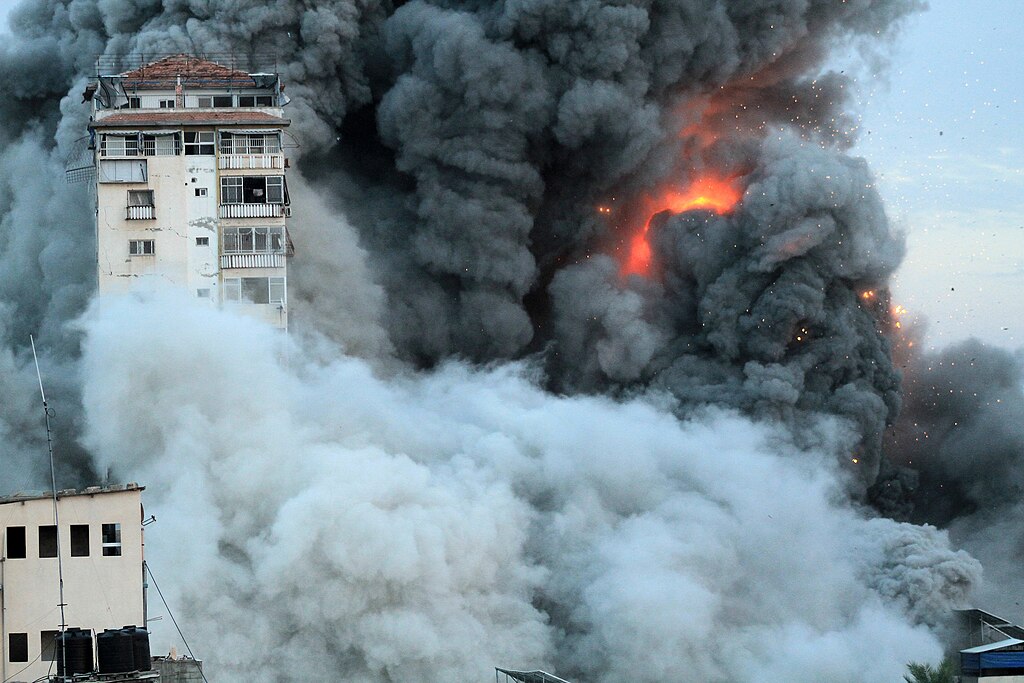
Editor’s Note: The opinions expressed here by the authors are their own, not those of Impakter.com — In the Featured Photo: Smoke and flames billow after Israeli forces struck a high-rise tower in Gaza City, October 7, 2023. Source: Correspondence with Wiki Palestine (Q117834684); author: Ali Hamad of APAimages, for Wafa (Q2915969) (Wikimedia).