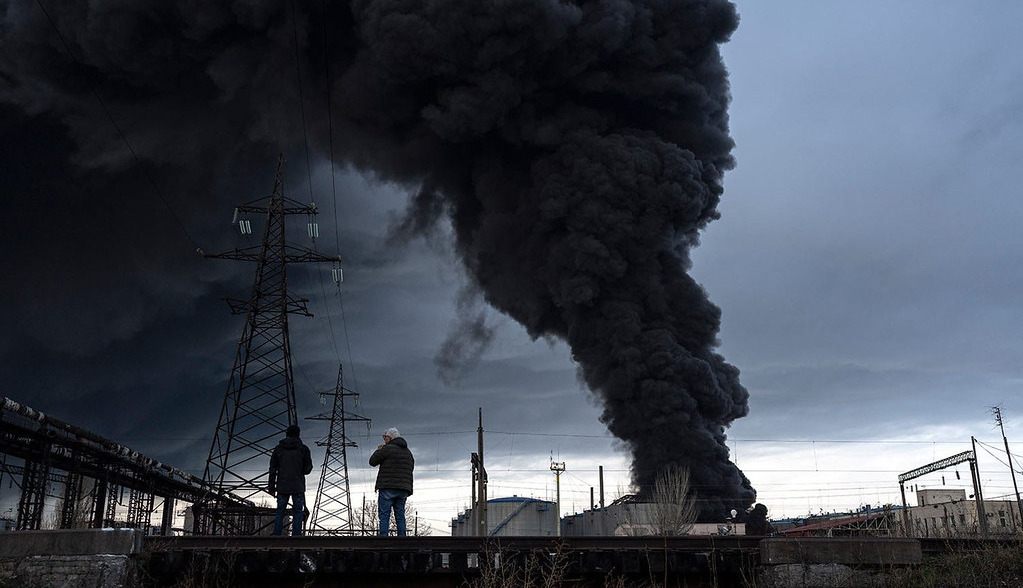
Since Russia’s invasion of Ukraine in February 2022, Ukraine is thought to have suffered $52.2 billion in environmental damage. A joint assessment by the Government of Ukraine, the World Bank Group, the European Commission, and the United Nations expects the total cost of the clean-up to be $411 billion.
In an interview with ArmyInform, an “online media of the Ministry of Defense of Ukraine,” Ukrainian Environmental Protection and Natural Resources Minister Ruslan Strilets said that the cost “includes pollution of land, air, water, burnt forests, and destroyed natural resources.”
“Our main goal is to show these figures to everyone so that they can be seen in Europe and the world; so that everyone understands what the price of this environmental damage is and how to restore this damage to Ukraine,” said Strilets.
According to a report published by Razom, a non-profit Ukrainian-American human rights organisation working to support Ukraine and amplify Ukrainian voices, the ecology on the Russian border has been deteriorating since 2014 with Russian targets including “hydroelectric power plants, water infrastructure, oil refineries, and chemical and pharmaceutical warehouses.”
This, the report explains, has affected all aspects of the Ukrainian environment by contaminating air, soil, surface and underground water.
The environmental cost of war
The report notes that many Russian strikes in Eastern Ukraine, an industry-heavy area “with an abundance of mines, factories, and refineries,” have led to the release of toxic chemicals into the waterways.
Due to the conflict, mines have been closed and abandoned but personnel are still needed “to prevent the reservoirs from being contaminated with heavy metals like mercury, lead, and arsenic,” according to the EU. This lack of supervision had allowed the mines to flood, leading to the outflow of contaminated water.
According to the UN Environmental Programme (UNEP), water infrastructure — such as sewage treatment plants — as well as some facilities storing hazardous materials like solvents, ammonia and plastics have been badly damaged.
As the Razom report details, in Lviv, water samples showed the concentrations of ammonia to be 165 times higher and nitrates to be 50 times higher than the recommended limits.
UNEP also reports that the destruction of agricultural facilities has released large amounts of fertiliser and nitric acid, adding that “there are also reports of the targeting of several large livestock farms, where livestock carcasses pose a further public health risk.”
“The destruction of vital infrastructure, such as oil depots and sewage treatment plants, along the Azov-Black Sea coast can result in devastating consequences, including oil spills and the release of toxic waste to the sea,” Razom states, explaining that this threatens marine life and the protected species living there.
Also noted Razom’s in the report is the “disastrous impact” of Russia’s underwater mines and radar equipment, with environmental organizations estimating the number of dead dolphins and porpoises in the Black Sea at 50,000 in November 2022.
At the same time, the use of underwater sonar has negatively impacted animals like dolphins and whales that use echolocation, explains the report.
Soil is another factor highlighted as threatened by Russia’s invasion of Ukraine.
“More than 200,000 hectares of Ukrainian land are currently contaminated with debris, mines, and shells. The Russian military uses old Soviet equipment that runs on harmful propellants. The chemical compounds in the propellants cause immediate and long-lasting contamination of the soil,” the report says.
Explosions of Russian shells leave behind large amounts of burnt metal, which is “compounded of elements damaging to soil.” Spills of fuels and lubricants are also released from exploding vehicles.
All of this is then absorbed by the soil, threatening food security for decades to come, according to the report.
Biodiversity is also unequivocally threatened by combat in Ukraine. Home to 35% of Europe’s biodiversity, wildlife in Ukraine is threatened by forest fires, loud noises and contamination of soil and water, the report details.
Related articles: Bloody Politics: One Year of War in Ukraine, In War, Women and Girls Pay the Highest Price; the Ukraine War Is No Different, In Wartime, Mental Health and One Health Are Casualties, Ukraine War: How It Impacts Food
Loss of forests is another issue facing Ukraine as a result of the war. Before the war, Ukraine’s land area was 16% forest, according to the Convention of Biological Diversity (CBD). The EU say that these forests will likely be destroyed in the conflict through forest fires, adding that in Luhansk, 20,000 hectares of forest had been destroyed as of 2020.
There have also been over 1,500 reported cases of destruction of the ecosystem since the beginning of the invasion, and “Indigenous species’ habitats like the Irpin wetlands may be irreversibly damaged due to war.”
The path to restoring Ukraine
We are already seeing environmental consequences of war in other places. In Syria, for example, the destruction of forests by the 12-year conflict will impact the country for decades to come. The EU also report that almost 3,000 people died as a result of air pollution in 2018 in Kabul, Afghanistan, where there has been fighting since 1978.
According to the Environmental Performance Index, Ukraine ranked low on environmental indicators like air quality, biodiversity production, and ecosystem health before Russia invaded in 2022. After the war, the environmental situation in Ukraine will be much more serious and desperate than before.
Whilst government bodies and activists in Ukraine are working to measure the ongoing environmental impacts of war, the report states that the question of how to hold Russia accountable remains, and highlights that since the war has diverted Ukrainian resources away from climate action, becoming sustainable in the future will be more difficult for Ukraine.
The International Law Commission, the legal body of the UN, adopted the 27 Draft Principles for environmental protection in times of conflict in May 2022. The report notes that this is “a positive and innovative development” because it will encourage countries and international organisations to ensure that the “damage does not remain unrepaired or uncompensated,” under principle 25.
Did you know that ecocide is not considered an international crime?
The European Parliament voted to criminalise ecocide in the EU, but we need the European Commission and Member States on board. Let's make ecocide illegal.
Sign now! 👉 https://t.co/X9WQQvr1nO#StopEcocide pic.twitter.com/T752sR7HBg
— Avaaz (@Avaaz) March 22, 2023
Furthermore, the report states that “ecocide” has been a crime recognised in Ukraine since 2001, but, despite growing pressures, ecocide is still not internationally recognised. However, methods of warfare intended to harm the natural environment are illegal under international humanitarian law.
According to the report, Ukraine has asserted that it will seek reparations from Russia but there is little precedent for this kind of compensation.
The report argues that whilst the UN has made countries pay reparations in the past, Russia has the power to veto decisions made by the UN Security Council – the body through which all such decisions must pass – so it is unlikely that the UN can force Russia to pay.
Not only has the conflict in Ukraine displaced millions, but the resulting ecological crisis will also affect the country’s recovery for decades to come. The report shows that environmental damage is intrinsically linked to restoring infrastructure and achieving sustainability in the future.
While there still might not be sufficient legal support in gaining reparations from Russia, how Ukraine goes about “seeking accountability for the immediate environmental damage will be crucial in achieving justice and will create an important precedent for the future,” says the report.
Editor’s Note: The opinions expressed here by the authors are their own, not those of Impakter.com — In the Featured Photo: People watch as smoke rises in the air after shelling in Odessa, Ukraine . Featured Photo Credit: Flickr.