
Impakter
  • Environment
    • Biodiversity
    • Climate Change
    • Circular Economy
    • Energy
  • FINANCE
    • ESG News
    • Sustainable Finance
    • Business
  • TECH
    • Start-up
    • AI & Machine Learning
    • Green Tech
  • Industry News
    • Entertainment
    • Food and Agriculture
    • Health
    • Politics & Foreign Affairs
    • Philanthropy
    • Science
    • Sport
  • Editorial Series
    • SDGs Series
    • Shape Your Future
    • Sustainable Cities
      • Copenhagen
      • San Francisco
      • Seattle
      • Sydney
  • About us
    • Company
    • Team
    • Global Leaders
    • Partners
    • Write for Impakter
    • Contact Us
    • Privacy Policy
No Result
View All Result
Impakter logo
No Result
View All Result
Facing Climate Change: A Guide for Local Authorities

Facing Climate Change: A Guide for Local Authorities

Dr. Anastasia NikologiannibyDr. Anastasia Nikologianni
January 4, 2019
in Design, Environment, Style
0

It is apparent that climate change is spreading across the globe and even though we have known about its science for decades now, action and adaptability have been slow. Scientists and environmentalists have made it clear that the extreme environmental phenomena we see are enhanced and appear more often as a result of climate change. However policy is still adapting to the new situation. We need to accept that we are not planning for ‘extremes’, but for a ‘new normal’ and therefore various mechanisms need to change or adapt to secure a sustainable future.

In the photo: A city in the snow. Extreme weather conditions, hot or cold, are more common due to climate change. Photo Credit:Joy Real

A call for action comes from a collective initiative led by the Town and Country Planning Association (TCPA UK) and the Royal and Town Planning Institute (RTPI UK), with contributions and support from several institutions, universities and individuals. A guide for local authorities and policy makers has just been published aiming to inform and empower local authorities and policy makers on the way climate change can be addressed in their cities and regions.

Rising to the Climate Crisis; A Guide for Local Authorities on Planning for Climate Change makes clear that the future of this planet and the younger generations is in our hands and relies on our ability to change policy, take radical actions and find innovative ways to deal with environmental uncertainties. It has the intention to primarily support local governments, planners, designers and politicians to create resilient cities and regions, but it also offers a useful tool for educating those who want to know more about current policy and existing pioneer landscape and planning schemes.

In the photo: Hugh Ellis, Interim Chief Executive TCPA launches the Rising to the Climate Crisis; A Guide for Local Authorities on Planning for Climate Change. Photo Credits: Dr Anastasia Nikologianni

The second edition of the Guide was launched at the Houses of Parliament on Thursday 6th December 2018 at a reception hosted by Dr Roberta Blackman-Woods MP in the presence of MPs, policy makers as well as several contributors and interested institutions. TCPA Interim Chief Executive, Hugh Ellis, highlighted the urgency of the climate change crisis and presented the scope of the guide, inviting everyone to acknowledge and support actions related to the environmental challenges we face. The Interim Chief Executive explained that the document is a tool for local authorities and policy makers while addressing areas for which current policy does not have a clear approach.

Institutions such as the Landscape Institute, CATiD BCU, RHS and many more have contributed and endorsed the document in a combined effort to make it approachable for cities and regions. This specific edition focuses more on mitigation and adaptation in relation to energy but provides key ideas on future resilience for planning strategies. Therefore it is significant that landscape design and planning organisations have joined forces to reassure that the fight against climate change is a collaborative effort that needs to have a vision for the whole city/region/country and beyond. The impact legislation has to the climate change front is tremendous and local authorities should be equipped and confident they can create and establish such visions for truly sustainable cities. Spatial planning plays a key role in the low-carbon transition, the establishment of a strategic approach and the engagement of communities. The knowledge and involvement of experts as well as multidisciplinary teams are essential, however this document wants to make sure that local governments and regions are well prepared to act on climate change for their city or region, working on sustainable visions and aiming for low carbon communities.
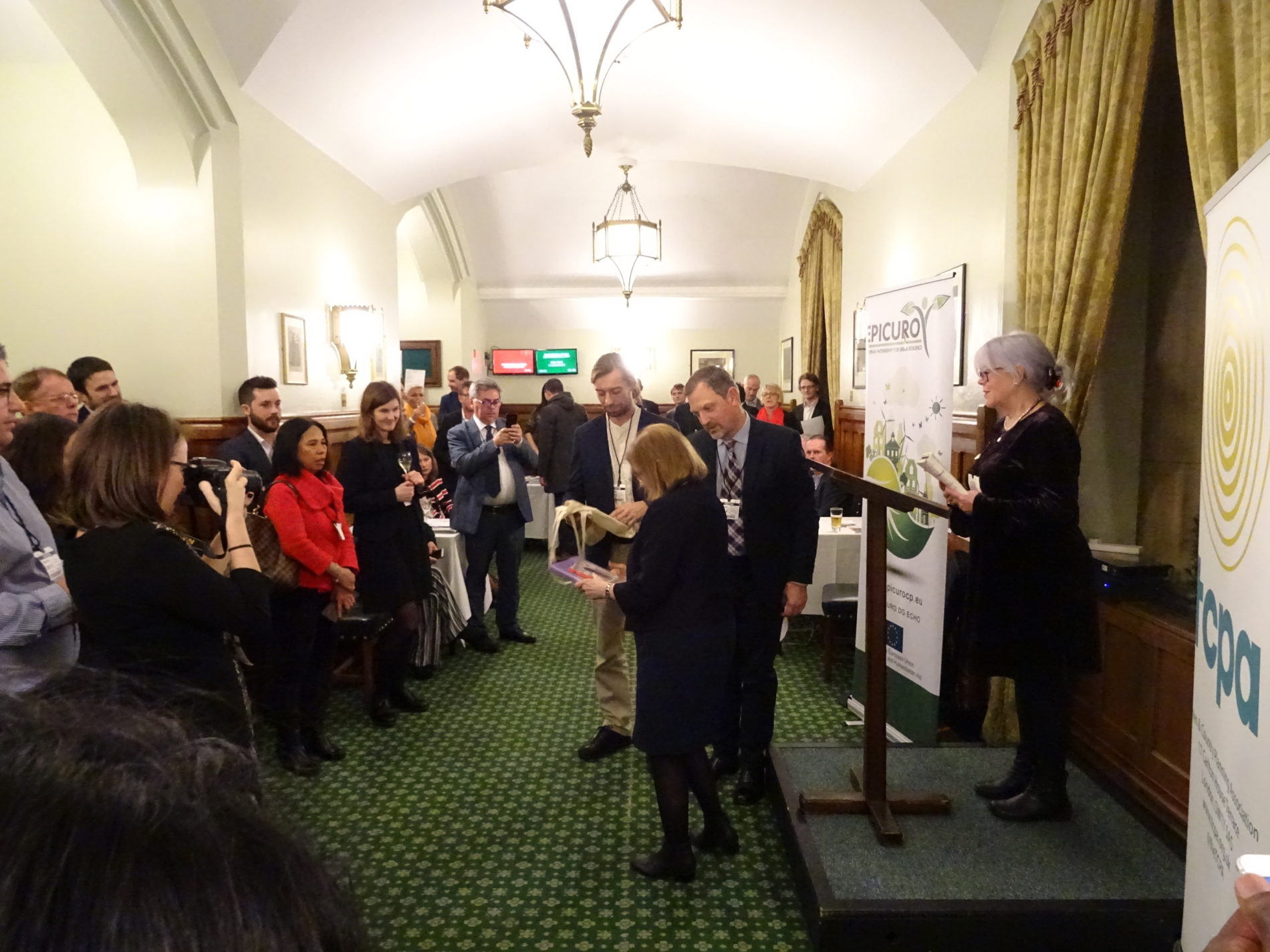
In the photo: Dr Roberta Blackman – Woods MP welcomes the attendees at the Houses of Parliament. Photo Credits: Dr Anastasia Nikologianni

During the Parliamentary launch the debate turned around the new data revealed by the Intergovernmental Panel on Climate Change (IPCC) last October for 1.5oC temperature target as well as the notion that we have 12 years to limit the climate change catastrophe. We need to act fast and with a strong focus to try and limit these phenomena. Working on a national and international scale is necessary, however this guide makes clear that cities and towns, local and combined authorities are the first to face the climatic effects and therefore at the cutting edge of environmental challenges. While following national and international goals, local governments are responsible for some of the key decisions on local plans that are vital to the resilience of the cities and towns. The Rising to the Climate Crisis; A Guide for Local Authorities on Planning for Climate Change document demonstrates the significance of design and planning to the decision making for sustainable development and presents several existing innovative case studies which aim to address climate change. The wide range of pioneer cases focus on mitigation and adaptation and address various scales and locations. The policy context is emphasised and several plan stages in relation to the adaptation and mitigation compliance frameworks are listed.

Overall, the document is a comprehensive package of strategies and measures aiming to become a tool for local and combined authorities supporting the transition to a climate resilient era. There is a continuous need for many more similar initiatives that will strengthen our understanding and response to climate extremes. This collaboration has shown that the available expertise has great potential, and therefore is our responsibility to the planet, the current and future generations to make good use of it!



Editors Note: The opinions expressed here by Impakter.com columnists are their own, not those of Impakter.com. Cover Photo Credit:  Ming Jun Tan
Tags: actionClimate ChangeDesignempowerEnvironmentlocalSustainability
Previous Post

Millennial Scientists in a Segregating World — The Role of Science in Shaping Society

Next Post

Populism’s Promises: Are Populist Leaders Delivering on Them?

Related Posts

women and extreme heat
Climate Change

Women and Extreme Heat: Simple Adaptations Make a Big Difference

One of the more damaging impacts of climate change is extreme heat. From Spain to Bolivia to Burkina Faso, unusual...

byKate Schecter - CEO of World Neighbors
December 17, 2025
ESG News regarding Microsoft signs long-term deal for 3.6 million tons of CO₂ removals from C2X’s Louisiana BECCS project., New York finalizes mandatory GHG reporting rules for major emitters beginning in 2027.
Business

Microsoft Signs 3.6 Million Ton CO₂ Removal Deal

Today’s ESG Updates Microsoft Signs 3.6M-ton CO₂ Removal Deal: Long-term CRUs secured from C2X’s Louisiana BECCS project. New York Mandates...

byAda Omar
December 16, 2025
How Climate Change Could Help Foster Peace in Yemen
Climate Change

How Climate Change Could Help Foster Peace in Yemen

Yemen's tragedy is traditionally depicted through the limited perspective of humanitarian need and political divisiveness, but there is a greater...

byTareq Hassan - Executive Director of the Sustainable Development Network Canada (SDNC)
December 15, 2025
ESG news regarding Deforestation Mandate Being Pushed; EUs Acceleration on Hydrogen and Net Zero Revolution; AT&T Will End All DEI; UK Watchdog Blocks Nike and Lacoste Ads Over Green Claims.
Business

U-Turn in Europe: Deforestation Mandate Pushed Back Again

Today’s ESG Updates EU Lawmakers Agree to Delay Deforestation Rules: The EU has delayed and simplified its Deforestation Regulation until...

byEge Can Alparslan
December 5, 2025
ESG News regarding Flooding in Indonesia; Glencore promises copper production boost; Trump proposes slashing fuel efficiency standards, and Vulcan Energy receives $2.57bn of funding for lithium project
Business

Indonesians Blame Deforestation for Recent Floodings

Today’s ESG Updates: More than 700 Lives Lost in Recent Indonesian Floods: A combination of mass deforestation and heavy rainfall...

byAriq Haidar
December 4, 2025
How a Framework Convention Could Address Climate and Socio-Economic Displacement
Editors' Picks

How a Framework Convention Could Address Climate and Socio-Economic Displacement

The unprecedented shift in human (im)mobility has seen over 120 million forced to flee their homes due to war, violence,...

byDr. Shepherd Mutsvara - Research Fellow at the University of Münster, Germany
December 3, 2025
ESG News regarding the UK’s Updated Environmental Improvement Plan, modernizing Mauritania’s railway system, the EU carbon border tax, and the EU’s cross-border energy projects
Business

UK Unveils Updated Environmental Improvement Plan

Today’s ESG Updates UK Accelerates Nature Recovery: The government commits £500m to Landscape Recovery and targets 250,000 hectares of restored...

bySarah Perras
December 1, 2025
fossil fuel subsidies
Business

How G20 Nations Can Make Progress After the Group Stalls on Fossil Fuel Subsidy Reform

The 2025 G20 Leaders’ Summit in South Africa sent mixed signals on climate action. In this year’s Leaders’ Declaration, climate change...

byInternational Institute for Sustainable Development (IISD)
November 28, 2025
Next Post
Populism’s Promises: Are Populist Leaders Delivering on Them?

Populism's Promises: Are Populist Leaders Delivering on Them?

Recent News

As power generation methods like natural gas, nuclear, and renewables continue to become more viable, the demand for coal is expected to decline.

Global Coal Demand Has Plateaued and Might Decline by 2030

December 18, 2025
ESG News regarding Microsoft’s wind power deal with Iberdrola in Spain, OECD and EPO findings on the quantum sector’s maturation, SBTi’s pilot of a net-zero standard for power companies, and the European Commission’s proposed expansion of the Carbon Border Adjustment Mechanism.

Microsoft Signs 150 MW Wind Power Agreements in Spain With Iberdrola 

December 17, 2025
Australia Social Media Age Ban

What Australia’s Social Media Age Ban Really Means

December 17, 2025
  • ESG News
  • Sustainable Finance
  • Business

© 2025 Impakter.com owned by Klimado GmbH

No Result
View All Result
  • Environment
    • Biodiversity
    • Climate Change
    • Circular Economy
    • Energy
  • FINANCE
    • ESG News
    • Sustainable Finance
    • Business
  • TECH
    • Start-up
    • AI & Machine Learning
    • Green Tech
  • Industry News
    • Entertainment
    • Food and Agriculture
    • Health
    • Politics & Foreign Affairs
    • Philanthropy
    • Science
    • Sport
  • Editorial Series
    • SDGs Series
    • Shape Your Future
    • Sustainable Cities
      • Copenhagen
      • San Francisco
      • Seattle
      • Sydney
  • About us
    • Company
    • Team
    • Global Leaders
    • Partners
    • Write for Impakter
    • Contact Us
    • Privacy Policy

© 2025 Impakter.com owned by Klimado GmbH