Buried within the gargantuan Inflation Reduction Act is a long-in-the-making climate policy poised to supercharge the green banks’ ability to support the US ambitious climate goals while making the energy transition more inclusive.
The bill’s landmark $369 billion climate and energy spending package entails the Greenhouse Gas Reduction Fund providing $27 billion for the Environmental Protection Agency (EPA) to kick-start projects aimed at lowering the country’s greenhouse gas emissions.
To date, it represents the largest green lending program ever addressed to public-private investments. With the majority of the funds – roughly $20 billion – the EPA is expected to seed a national green bank within a few months.
The national green bank will partner with the private sector and community lenders to invest in clean energy technologies and energy efficiency improvements.
The bank could ultimately distribute the money to the existing regional and state green banks and other organizations, such as community development finance institutions and minority depository institutions (banks and credit unions that are either owned or directed primarily by members of certain minority groups) that strive for the development of disadvantaged communities but rarely cross paths with the ordinary energy finance channels.
Representing great progress in the government’s role in confronting the climate crisis, the fund could produce massive opportunities for innovative businesses and stimulate domestic clean energy supply chains while evening out the benefits of a sustainable transition across the whole population.
Why it is a big deal
Much of the Greenhouse Gas Reduction Fund will be dedicated to installing solar panels, heat pumps and other clean energy infrastructure, and to kick-starting building retrofits and sustainable mobility projects in communities that ordinary finance disregards: outskirts, low-income and disadvantaged neighbourhoods.
Such types of interventions can greatly contribute to reducing greenhouse gas emissions and distributing the economic benefits of renewables, yet private investors are generally dissuaded by high credit risk and long payback time.
Besides, some projects such as community solar typically lack the size to generate economies of scale. Hence those can be seen as unattractive even though they are critically important to ensure an inclusive transition, unlock huge savings through higher energy efficiency in the buildings sector, and ultimately maximize the chances of reaching the climate and energy security goals.
Truly, given that emissions can’t be confined someplace, these objectives are only possible if everyone makes the transition, everywhere.
Green banks’ financial model of leveraging limited public resources to attract private investors for clean energy projects is conceived to lend where others don’t, increasing access to funding for communities left behind.
Related articles: How the World Could Save $12 Trillion by 2050 | Earth is Dying: UN Chief Accuses World Leaders of Zero Action | Three Bills Provide US With $500 Billion in Climate Funding Over Next Decade
US green banks: Many exist in several states but they can upscale action thanks to a “central” green bank
National banks already exist in several countries including Rwanda, Japan and Australia (currently home to the world’s largest). The UK used to have one which, before it got sold in 2017, helped boost its offshore wind industry.
In the US there are already 23 green banks spread across 17 states, with another 25 states in the process of opening their own. With about $1.9 billion of own capital, these smaller scale banks have activated some $7 billion in private money for green projects since 2011, thus leveraging on average $3.70 in external capital for every $1 the banks invested.
However, under the coordination of a “central” green bank, the investment process could accelerate and prove more cost-effective, improving the likelihood of keeping the US in line with the Paris Agreement.
The Coalition for Green Capital has identified $21 billion worth of backlogged clean energy projects at state and local green banks. A national green bank would help address that backlog with a more streamlined process to sustain projects at the local level while providing financial support to improve supply chains and help lower technological costs.
Green banks could play an even more relevant role in reducing the nation’s emissions after the recent Supreme Court decision limiting the EPA’s ability to regulate carbon emissions.
Green banks: A proven model to jumpstart and speed up the green transition
Unlike government grants or tax credits, green banks lend money to develop clean energy or energy-efficiency projects with an expected return on investment, leveraging a relatively small amount of public funds to make them more attractive to private investors.
They can employ low-interest loans and green liberty bonds (offered to retail investors through lower-dollar denominations — e.g., no more than $1,000 – making it easier for everyday citizens to invest in projects with environmental and employment benefits), as well as credit enhancements such as loan-loss reserves and loan guarantees and highly concessional finance to rapidly deploy clean technology in places where the actual cost of adding insulation, solar panels or a heat pump may be higher than some households’ income.
The existing state and local green banks in the US have shown that such strategies can be a sound investment. According to the Coalition for Green Capital, 99.62% of state and local green bank loans in the US have been paid back.
This makes the model self-sustaining, creating value through profitable investments. A federal green bank could be even more effective as a national clean energy accelerator with a national mandate to finance the transition and help develop local markets and supply chains in every state.
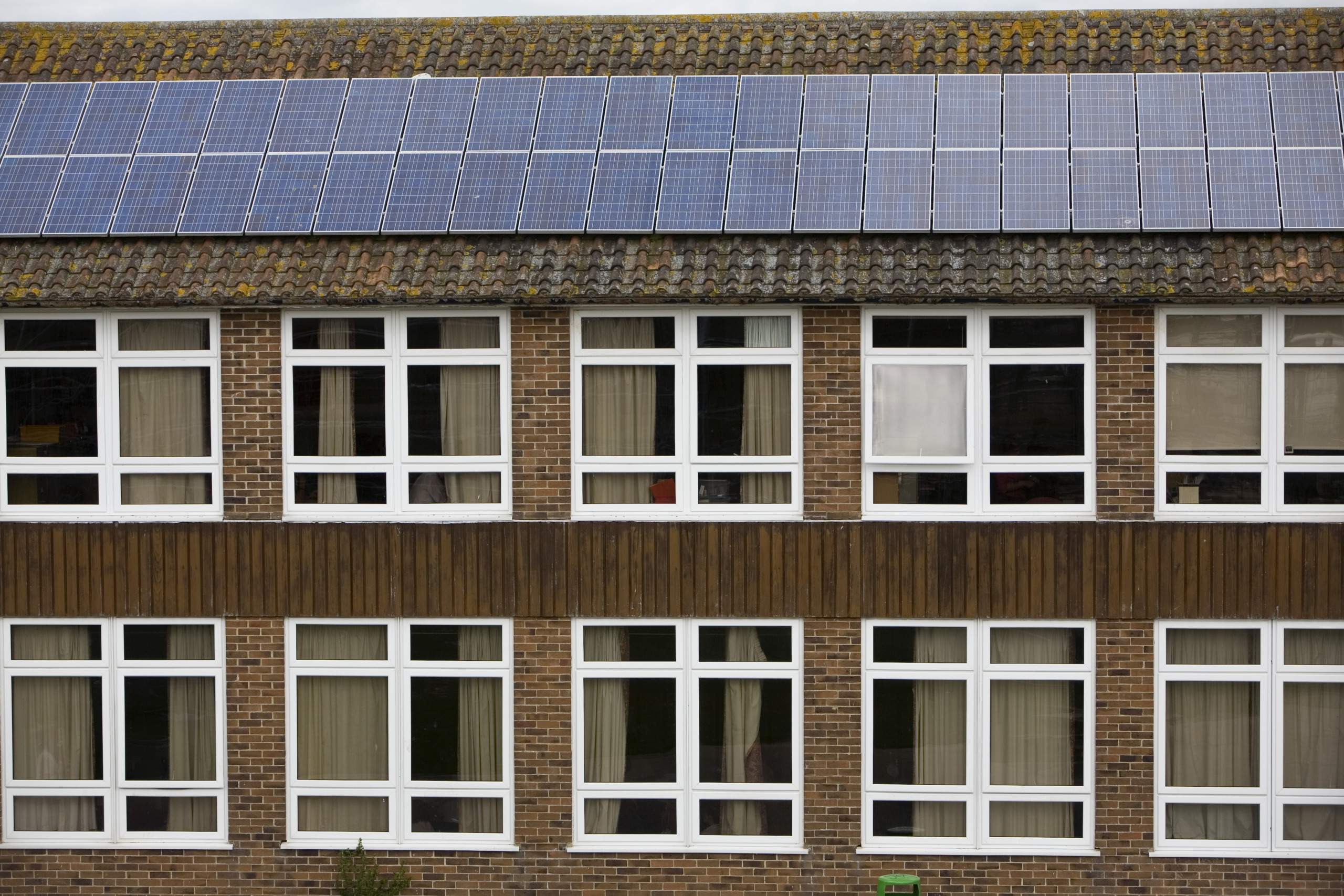
Editor’s Note: The opinions expressed here by the authors are their own, not those of Impakter.com — In the Featured Photo: Ringmer Community College – 2008 Ashden Award winner. Featured Photo Credit: Ashden.