
Impakter
  • Environment
    • Biodiversity
    • Climate Change
    • Circular Economy
    • Energy
  • FINANCE
    • ESG News
    • Sustainable Finance
    • Business
  • TECH
    • Start-up
    • AI & Machine Learning
    • Green Tech
  • Industry News
    • Entertainment
    • Food and Agriculture
    • Health
    • Politics & Foreign Affairs
    • Philanthropy
    • Science
    • Sport
  • Editorial Series
    • SDGs Series
    • Shape Your Future
    • Sustainable Cities
      • Copenhagen
      • San Francisco
      • Seattle
      • Sydney
  • About us
    • Company
    • Team
    • Partners
    • Write for Impakter
    • Contact Us
    • Privacy Policy
No Result
View All Result
Impakter logo
No Result
View All Result
Shipping Emissions tax

Global Tax on Shipping Emissions: Support Remains Strong Despite Slow Negotiations

A proposed tax on greenhouse gas emissions from the shipping sector has garnered large-scale support from the world’s biggest economies, but some argue it will hurt developing nations

Alessandro CamillobyAlessandro Camillo
February 28, 2025
in Energy, Environment
0

A new global tax on shipping emissions is growing in support and is expected to be agreed on in the coming weeks. The tax, which would see a flat fee imposed for each tonne of carbon emitted by commercial vessels, has seen backing from over 50 countries across the globe, accounting for a large amount of the world’s fleet. However, initial talks at an International Maritime Organization (IMO) conference last week provided little tangible progress.

Shipping has long been one of the largest sources of greenhouse gas (GHG) emissions. In 2018, it accounted for over 1 billion tonnes of CO2 emissions and was responsible for around 2.9% of man-made global emissions. These emissions are only expected to grow: By 2050, they are projected to be 130% of 2008 levels.

The European Commission and the International Chamber of Shipping, along with large shipping nations such as Japan, Korea, Greece, and the United Kingdom, have stated that the tax should be in the range of $18-150 per tonne of emitted greenhouse gas.

A study conducted in 2024 by UN Trade and Development and the IMO concluded that a levy of between $150 and $300 per tonne of greenhouse gas would limit the negative impact on the global economy. This would only be the case, however, if the tax revenue were then distributed to the countries most vulnerable to climate change. Considering that shipping accounts for the carriage of 90% of goods in world trade, the worry is that the tax would be inflationary and detrimental to the world economy. Although with or without the proposed tax revenue redistribution, global GDP growth would be expected to slow marginally, by slightly less than 0.1%.

“The industry fully supports the adoption by IMO of a GHG pricing mechanism for global application to shipping,” stated Gu Platten, Secretary General of the International Chamber of Shipping. “The joint text put forward by this broad coalition is a pragmatic solution and the most effective way to incentivise a rapid energy transition in shipping to achieve the agreed IMO goal of net zero emissions by or close to 2050.”

The goal of the levy would be to incentivize shipping companies to look for cleaner energy alternatives, as traditional fossil fuel usage would become more expensive. In theory, this would mean a transition to more sustainable fuels such as biofuels, methanol, hydrogen, or ammonia. 
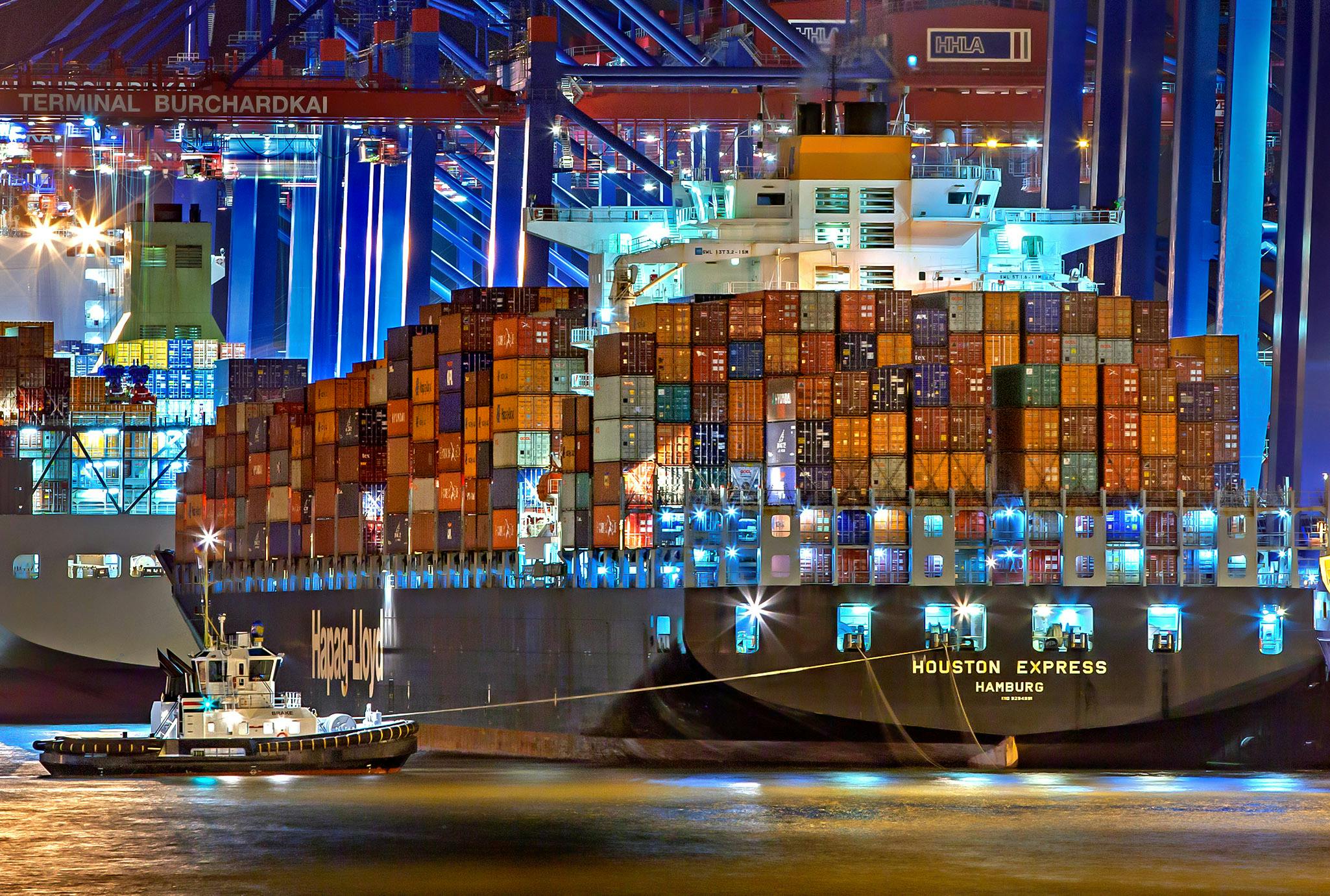
In the photo: A ship in Hamburg, Germany. Photo Credit: Julius Silver.

The ongoing debate now within the IMO is whether the levy’s revenues should be used only for shipping-related activities or if they could be used more broadly at the discretion of national governments. For example, a study released by University College London, along with two French think tanks IDDRI and CIRAD, found that the tax would naturally raise transportation costs, disproportionately impacting Small Island Developing States (SIDS) and other developing countries. In turn, this could affect food security and public health in certain nations in the short- and medium-term. Many therefore argue that any shipping tax revenue that is redistributed should be freely used to combat any spillover effects from higher shipping costs.

Even with the overwhelming support for the levy itself, the negotiations at last week’s IMO meeting in London were key to addressing the economic consequences of any tax imposed. Little concrete progress was made, with details still to be negotiated. At the moment, there are differing views on the exact amount that should be charged per tonne of emissions and what the revenue should be spent on.


Related Articles: How Can a Fossil Fuel Levy Cut Emissions and Finance Climate Action? | Powered by the Wind: First Cargo Ship With ‘WindWings’ Sets Sail

Still, support for the proposition as a whole remains strong.

“With 70% of tonnage now supporting a global fuel standard along with a carbon levy, it is crucial that the upcoming round of negotiations focuses on discussing the distribution of revenues, both within and outside the shipping sector,” explains Dr. Annika Frosch, a Research Fellow at University College London’s Energy Institute.

Should the levy be agreed to in the coming months, it is expected to take effect in 2027. The work now is “no longer about whether a levy is needed,” according to Albon Ishoda, Marshall Islands Special Envoy for Maritime Decarbonization. Instead, it is “about ensuring [the levy] is strong enough to be effective.”


Editor’s Note: The opinions expressed here by the authors are their own, not those of Impakter.com — Cover Photo Credit: Dominik Reiter.

Tags: Climate ChangeGHG emissionsGlobal Tax on Shipping EmissionsGlobal warmingIMOInternational Maritime Organizationshippingshipping emissionsShipping Emissions levy
Previous Post

Trumpocracy 2.0 and the Inevitability of History

Next Post

COP 16 Concludes with Key Biodiversity Agreements

Related Posts

A picture with a wind power generator
Society

Emissions and Economic Growth: Is There Still a Link?

In prior decades, economic growth and emissions co-existed. As countries grew richer, they produced more and emitted more. This relationship...

byFedor Sukhoi
February 3, 2026
How Climate Change Is Forcing Evolution
Climate Change

How Climate Change Is Forcing Evolution

As global temperatures continue to rise at alarming rates, climate change threatens to wipe out entire groups of animal species....

byYuxi Lim
February 2, 2026
Three sponsors for the 2026 Winter Olympics in Italy could generate 1.3 million tons of CO2
Climate Change

Winter Olympics Sponsorship Emissions: Who Are the Main Offenders?

The 2026 Winter Olympic Games are set to begin in Italy next month. Scattered across towns in northern Italy, from...

bySarah Perras
February 2, 2026
WEF Report Ranks Environmental Challenges as Greatest Long-Term Threat to Global Stability
Business

WEF Report Ranks Environmental Challenges as Greatest Long-Term Threat to Global Stability

The World Economic Forum’s Global Risks Report 2025 found that environmental risks are deteriorating faster than other threats and challenges.  ...

byBenjamin Clabault
February 2, 2026
Thames Water closes in on rescue deal;
Environment

Thames Water Closes in on £16bn Rescue Deal

Today’s ESG Updates: Thames Water Closes in on £16bn Rescue Deal: Thames Water is edging closer to a multibillion-pound rescue...

byAriq Haidar
February 2, 2026
The Era of ‘Global Water Bankruptcy’ Has Begun
Climate Change

The Era of ‘Global Water Bankruptcy’ Has Begun

Humanity’s long-term water usage and damage have exceeded nature's renewal and safe limits, a situation scientists and the media have...

byNmesoma Ezetu
January 30, 2026
Food Waste in India
Climate Change

India’s Food Waste Is Turning Into an Environmental Time Bomb

India, a key player in this fight, is currently battling a confluence of climate-driven disasters. Last year’s punishing extreme heatwave,...

byPranjali Chowdhary - Research and Policy Associate at the Institute for Governance and Sustainable Development, Indiaand1 others
January 30, 2026
One Health Education Is Essential for Pandemic Preparedness and Global Security
Education

One Health Education Is Essential for Pandemic Preparedness and Global Security

The One Health concept/approach offers a powerful tool for public health and biomedical research globally. The combined integration of human medicine,...

byDr. Bruce Kaplan - Epidemiologist formerly at the CDC/EIS and USDA-FSIS Office of Public Health and Science & Co-Founder of the One Health Initiativeand2 others
January 29, 2026
Next Post
ESG news regarding COP16 biodiversity agreements, Blackstone closes energy transition fund, BP expands oil and gas investments, US Senate blocks proposed methane tax

COP 16 Concludes with Key Biodiversity Agreements

Recent News

Forklift Rentals service in St.Louis

How Forklift Rentals Support Short-Term Operational Needs

February 3, 2026
Personal Injury Lawyer dealing with his clients.

What To Expect During the First Visit With a Personal Injury Lawyer

February 3, 2026
ESG news regarding a new EU initiative that lets companies operate seamlessly across all EU member states, U.S. and India reaching major trade deal after tariff reductions, Spain fining Repsol €20.5 million for unfair fuel pricing practices, and Ørsted’s $7 billion Sunrise Wind project being cleared to resume construction.

EU-INC Introduces a Unified Legal System to Simplify Business Across Europe

February 3, 2026
  • ESG News
  • Sustainable Finance
  • Business

© 2025 Impakter.com owned by Klimado GmbH

No Result
View All Result
  • Environment
    • Biodiversity
    • Climate Change
    • Circular Economy
    • Energy
  • FINANCE
    • ESG News
    • Sustainable Finance
    • Business
  • TECH
    • Start-up
    • AI & Machine Learning
    • Green Tech
  • Industry News
    • Entertainment
    • Food and Agriculture
    • Health
    • Politics & Foreign Affairs
    • Philanthropy
    • Science
    • Sport
  • Editorial Series
    • SDGs Series
    • Shape Your Future
    • Sustainable Cities
      • Copenhagen
      • San Francisco
      • Seattle
      • Sydney
  • About us
    • Company
    • Team
    • Partners
    • Write for Impakter
    • Contact Us
    • Privacy Policy

© 2025 Impakter.com owned by Klimado GmbH