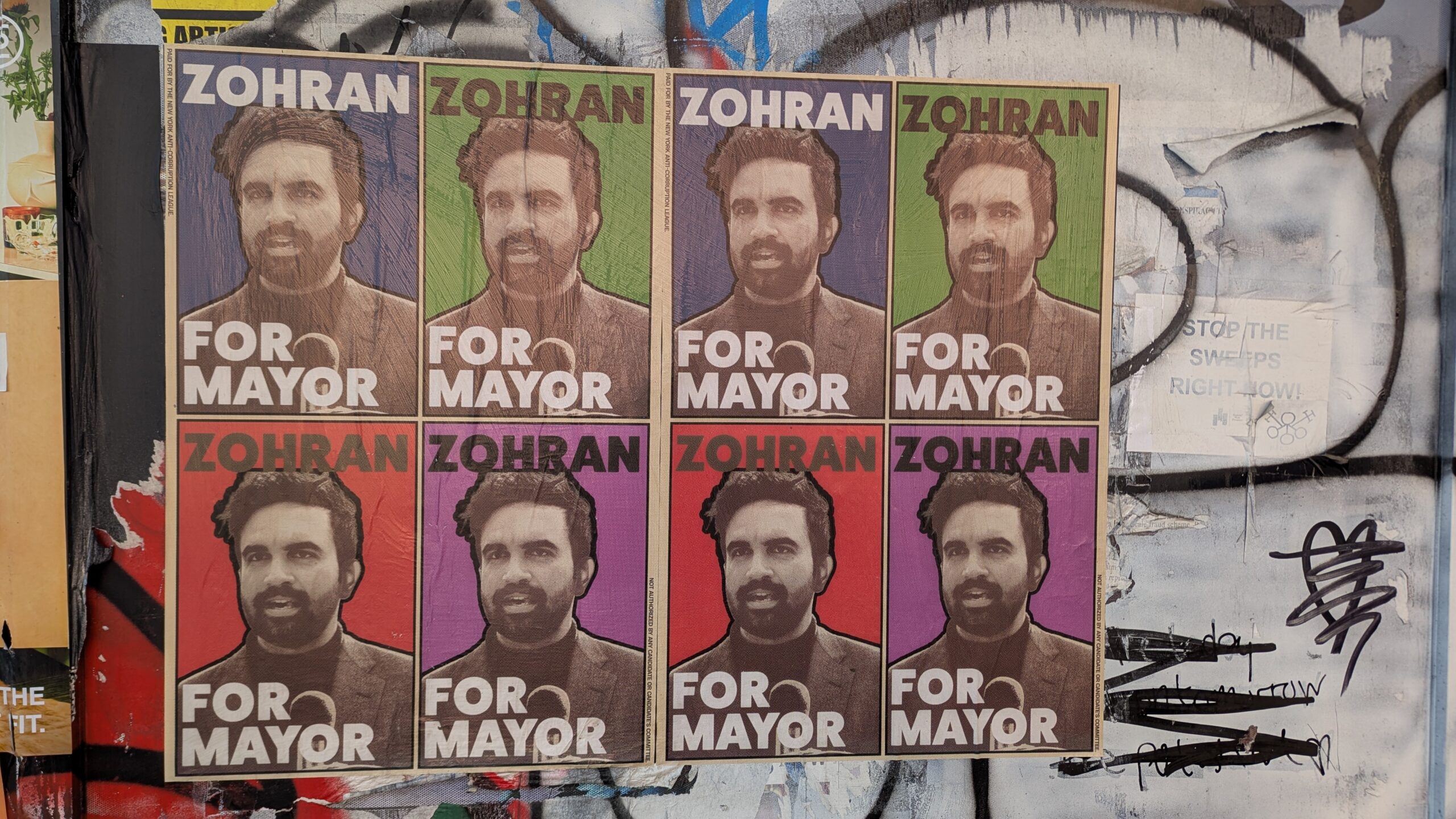
Zohran Mamdani has won a globally-watched election to become the first South Asian mayor of New York City. En route, the Democratic party candidate and son of Indian-origin immigrants — filmmaker Mira Nair and academic Mahmood Mamdani — had to face various kinds of attacks, including a smear campaign that targeted him for eating a rice dish with his hands.
Colonialism produced and reproduced several stereotypes and myths — chiefly, those in relation to race and ethnicity. Some of these continue to rear their heads in our present world, shaping how we judge bodies, habits, and gestures.
The recent online uproar over Mamdani eating with his hands shows just how alive these old hierarchies remain. When conservative American commentator Vince Dao, who is of Vietnamese origin, mocked Mamdani on social media for eating rice with his hands, the reaction spiraled into a debate on civilisation, race, and cultural belonging. It has also laid bare the internal dissonances among those who claim to be truly “Asian.”
Nineteenth century colonial travelogues, reports, and ethnographic accounts often lingered on descriptions of Asians and Africans eating with their chopsticks and hands — an image that became central to racist notions of filth and backwardness. It also fed into their ideological project of constructing the myth of the “lazy native” and “lazy Asian” — those alleged to be lethargic and unproductive in tropical climes, with rice-heavy diets, and resistant to the discipline of modernity.
These myths were not regarding diet alone but fundamentally about power. They worked by linking bodily habits to hierarchies of civilisation and hygiene. In contrast, the European preference for forks, knives, and napkins — objects that only became widespread in elite European circles from the sixteenth century onward — became markers of refinement.
Mamdani’s ancestry complicates the story further. Across the regions of Asia and Africa from which he traces his roots, the practice of eating with hands has long been associated with intimacy, communal eating, and the sensory pleasures of consumption. As a minority political candidate in the United States, he represents this multicultural, multi-religious heritage that refuses easy classification. Mamdani and those like him must then navigate their identity carefully within Western public life while still representing their communities authentically.
What has been most striking, though not surprising, is that some conservative Asian-Americans such as Dao were among those quick to distance themselves from Mamdani’s culinary gesture. They took the opportunity, based on self-proclaimed cultural authority, to showcase how “superior” they were, echoing the very colonial hierarchies once used to demean their own ancestors.
It is an old script: defining respectability by disavowing the “less civilised” within one’s own racial or cultural group. In that sense, colonial categories of civility now operate inwardly, between Asians themselves. Even as certain sections of South, Southeast and East Asians push back against Western ridicule, many continue to perpetuate racist prejudices through films, social media, and popular culture, where lighter skin, specific accents, food habits, and certain “beauty norms” are valorised over others.
In the early twentieth century, thinkers and artists such as Okakura Kakuzō and Rabindranath Tagore imagined an alternative — an Asia united not by mimicry of the West but by shared spiritual and artistic values. Their dream of pan-Asianism sought to challenge Europe’s monopoly on civilisation. But geopolitical rivalries and economic inequalities have eroded that vision.
Whose etiquette?
Meanwhile, the internet today has become a stage for performing and educating people into higher standards of etiquette. Several influencers and tutors have videos on how to conduct oneself, including the “right” use of cutlery, even for the simplest of fruits. However, this growing cult of self-grooming has been met with humour and resistance.A Malay comic, for instance, shared videos countering a British etiquette expert who advises viewers to use forks to eat a banana and rice, among other everyday foods.
Historians of food have traced how debates over hygiene, race, and culture across centuries have shaped culinary habits, showing how boundaries of purity and pollution were carefully constructed within South and East Asia and in their encounters with Europeans.
Food is customarily eaten with the right hand while the left is reserved for personal hygiene. This is not a matter of ignorance but of embodied ethics and cultural norms. This is recognised by several tourists who express fascination and curiosity at this practice, with countless videos online and travelogues documenting their attempts to master this dexterous habit.
Against this backdrop, the outrage against Mamdani is more than about manners. Despite his mixed Ugandan-Indian ancestry (his father is Ugandan of Indian heritage) he is reduced, in crude terms, to the brown, foreign, and most sharply, Muslim man. The trope of the “uncivilised” or violent Muslim male remains a recurring theme in Western political and media discourses and the extreme hatred and vitriol against him is one such manifestation.
Related Articles
Here is a list of articles selected by our Editorial Board that have gained significant interest from the public:
These anxieties also resurfaced during the COVID-19 pandemic, when fears of contamination disproportionately targeted Asian populations, especially Chinese communities. Yet, contradictions deepen when we see elite diasporic groups abroad with South Asian and Asian roots siding with conservative political and economic interests to malign opponents on cultural terms.
This position of in-betweenness has led many diasporic groups to act hypocritically — defending “tradition” while practicing forms of xenophobia, casteism, and racism in their own cultures as well as seeking validation from those in power to mark themselves as “more deserving.” Mamdani, in this sense, is not an isolated target but part of a wider pattern of harassment faced by minorities in public life.
That hierarchy is now revived online by those eager to police manners in the name of modernity.
It is a curious irony that the country that is home to “finger-lickin’ good” meals should be the one condemning eating with hands as contrary to global standards for dining civility. Mamdani’s act was not some eccentric gesture of authenticity but an ordinary, practical way of eating rice — efficient, elegant, and culturally grounded.
** **
This article was originally published by 360info™.
Editor’s Note: The opinions expressed here by the authors are their own, not those of Impakter.com — In the Cover Photo: Posters showing recently elected Mayor of New York, Zohran Mamdani, New York, United States, May 26, 2025. Cover Photo Credit: Edenpictures/CC-BY-2.0