Impakter
  • Environment
    • Biodiversity
    • Climate Change
    • Circular Economy
    • Energy
  • FINANCE
    • ESG News
    • Sustainable Finance
    • Business
  • TECH
    • Start-up
    • AI & Machine Learning
    • Green Tech
  • Industry News
    • Entertainment
    • Food and Agriculture
    • Health
    • Politics & Foreign Affairs
    • Philanthropy
    • Science
    • Sport
  • Editorial Series
    • SDGs Series
    • Shape Your Future
    • Sustainable Cities
      • Copenhagen
      • San Francisco
      • Seattle
      • Sydney
  • About us
    • Company
    • Team
    • Global Leaders
    • Partners
    • Write for Impakter
    • Contact Us
    • Privacy Policy
No Result
View All Result
Impakter logo
No Result
View All Result
EU CO2 Emissions Hit 30-Year Low: Can it Be Sustained?

EU CO2 Emissions Hit 30-Year Low: Can it Be Sustained?

With the world’s use of coal set to reach a new record this year, November 2022 marks an impressive low for CO2 emissions in the EU, made possible by reduced demand and a thriving renewables industry

Grace SmithbyGrace Smith
December 27, 2022
in Climate Change, Society
0

Last month, the European Union (EU) produced less CO2 than it has done in November for the past 30 years. A new three-decade low was also reached for gas consumption, power sector CO2 emissions, and power generation from fossil fuels.

These statistics, based on CREA’s near-real-time tracking of EU CO2 emissions, contradict the widespread expectations that the fossil fuel crisis, which escalated earlier this year following Russia’s invasion of Ukraine, would result in an increase in the bloc’s emissions.

This drop in greenhouse gases (GHGs) is said by Lauri Myllyvirta, lead analyst at CREA, to have been caused in large part by a combination of two factors:

  • The impact that high energy prices have had on reducing levels of demand.
  • The record wind and solar output that has been observed since March 2022 in 19 EU member states.

The unusually mild weather also played a role in the reduced demand for energy, however this is a far smaller factor than may be expected, accounting for only around one-third of the lowered demand whilst higher prices claimed the majority.

As well as forming a key contributing factor to these lowered emissions, the high fossil fuel prices are also encouraging a dramatic acceleration in investments in clean energy and energy efficiency, which will doubtlessly play a major role in emissions reduction over time.

📢NEW
⚠️🇪🇺EU CO2 emissions hit 30-year low in Nov. 2022

Nov. 2022 EU values lowest in some 30 years for:
✅Total CO2 emissions
✅Gas consumption
✅Power sector CO2 emissions
✅Fossil fuel power generation

See analysis & CREA EU CO2 emissions tracker 👇 https://t.co/6r9IBkDYHX

— Centre for Research on Energy and Clean Air (@CREACleanAir) December 23, 2022

Within the EU, Spain, Belgium, and Italy all demonstrated significant increases in renewable power generation as well as stark decreases in levels of total energy demand.

This resulted in a reduction in fossil fuel use this November, compared to November 2021, of around three times for Spain, 1.5 times for Belgium, and five times for Italy.


Related Articles: A Record Year for Solar Power in Europe: Is Our Renewable Energy Future Closer Than Expected? | Cutting Emissions: Can The Rich Pay the Poor To Do it On Their Behalf?

France and Germany demonstrated dramatic reductions in nuclear output, with wind power supplementing this energy need to a far greater extent in both nations this November compared to last November.

The Czech Republic, Poland, Finland, Sweden, and the Netherlands did not show an increase in clean power generation. However, the reduction in overall energy demand resulted in these nations consuming less fossil fuels and producing fewer CO2 emissions than they did in November 2021 regardless.

How sustainable is this lowered CO2 emissions rate?

As Lauri Myllyvirta says, “everything is conditional on the weather. If we have a big cold spell, we will see more gas burning,” so it will likely be the case that, should temperatures drop again, these impressive statistics will falter.

However, it is certainly still possible that CO2 emissions will remain lower than is typical for the time of year given the results that December has produced so far.

Despite the drop in temperatures this December compared to December 2021, the month’s total emissions remain below their 2021 level, suggesting that the high gas prices are continuing to drive demand down.

Though this is positive in terms of our GHG emissions, there are obvious concerns produced regarding how the vulnerable members of society are being impacted by the combination of cold weather and energy prices that are above their means.

To this end, Myllyvirta has urged governments to manage the transition away from fossil fuels equitably, to ensure the dangerous social and economic impacts of this shift are minimised.
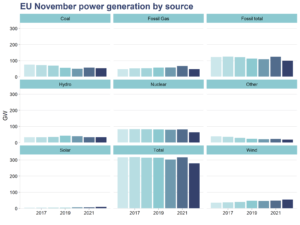
 

Source: CREA analysis.

How is the rest of the world faring?

Coal use around the world is set to reach a new record this year, according to the International Energy Agency, in a disappointing though perhaps unsurprising contrast to the EU’s positive news.

It seems unlikely that this will see any change in the near future as China, the world’s largest consumer of coal, recently reported that it plans to boost production through 2025 to prevent last year’s power shortages from recurring.

This attitude is certainly not visible everywhere outside the EU though, as South Africa, Indonesia, and Vietnam have recently signed investment agreements with wealthy partner countries that will help them speed up their shift towards renewables.

Though global progress is moving at a slower pace than that within the EU, the bloc’s improvements can serve as an example of what is achievable in terms of addressing climate change within a short space of time. 

As Myllyvirta says, “if anyone had said a year ago that Europe could nearly eliminate reliance on Russian fossil fuels in 10 months, they would have been taken for a complete lunatic, but we have come quite close to doing so, and that is quite remarkable.”


Editor’s Note: The opinions expressed here by the authors are their own, not those of Impakter.com — In the Featured Photo: Sherco Generating Station. Featured Photo Credit: Wikimedia Commons.
Tags: Carbon Emissionseu energy crisisEuropean UnionGreenhouse Gas EmissionsRenewable energy
Previous Post

Meta to Pay Millions for Data Leak That Enabled Psychological Political Warfare

Next Post

LGBTQ Rights: Is the EU a Better Place Now Than it Was Last Year?

Related Posts

ESG News regarding U.S. lifting more sanctions on Venezuela, Egypt securing $1.8 billion renewable energy deals, U.S. pushing G7 allies to reduce reliance on China for critical minerals, richest 1% exceeding annual carbon share in just 10 days.
Business

U.S. Considers Lifting More Venezuela Sanctions

Today’s ESG Updates US May Lift Venezuela Sanctions to Boost Oil & IMF Aid: US could ease sanctions to support...

byAnastasiia Barmotina
January 12, 2026
ESG News regarding Trump backing sanctions on Russian oil buyers, Norway’s oil and gas output declining, dog food linked to UK emissions, Trump climate treaty exit facing legal scrutiny
Business

U.S. Targets Russian Oil Buyers with New Sanctions Bill

Today’s ESG Updates Trump Backs Sanctions on Russian Oil Buyers: A bipartisan U.S. bill would impose tariffs of up to...

byAnastasiia Barmotina
January 9, 2026
ESG News regarding critical minerals and Greenland
Business

Greenland’s Melting Ice and the Race for Critical Minerals

Today’s ESG Updates Vast Resources Under Greenland's Ice: Untapped critical and rare-earth mineral deposits emerge, along with questions about mining...

byAriq Haidar
January 8, 2026
Solid-State Batteries: The Bet Promising to Change Electric Vehicles
Energy

Solid-State Batteries: The Bet Promising to Change Electric Vehicles

The way we power cars is changing. Not only because electric vehicles are becoming more common, but because the technologies...

byLuis Guillermo Valdivia Chavez
December 25, 2025
What’s Next for Sustainable Development in 2026
Climate Change

What’s Next for Sustainable Development in 2026

As governments confront rising misinformation, constrained budgets, and intensifying climate risks, the need for evidence-based policy has never been greater....

byInternational Institute for Sustainable Development (IISD)
December 23, 2025
Canada Sets Green Investment Rules; UK Regulator Probes WH Smith; Louvre Workers Call Off Strike;Trump Allies Clash With Fannie, Freddie Staff.
Business

A New Rulebook for Green Capital: Canada

Today’s ESG Updates Canada Sets Green Investment Rules: Canada will introduce a sustainable investment taxonomy by 2026 to label green...

byEge Can Alparslan
December 19, 2025
Can Government Efforts to Regulate AI in the Workplace Make a Difference?
AI & MACHINE LEARNING

Can Government Efforts to Regulate AI in the Workplace Make a Difference?

An overview of AI regulations and laws around the world designed to ensure that the technology benefits individuals and society,...

byRichard Seifman - Former World Bank Senior Health Advisor and U.S. Senior Foreign Service Officer
December 18, 2025
ESG News regarding Microsoft’s wind power deal with Iberdrola in Spain, OECD and EPO findings on the quantum sector’s maturation, SBTi’s pilot of a net-zero standard for power companies, and the European Commission’s proposed expansion of the Carbon Border Adjustment Mechanism.
Business

Microsoft Signs 150 MW Wind Power Agreements in Spain With Iberdrola 

Today’s ESG Updates Microsoft Signs 150 MW Wind Power Deal With Iberdrola: The agreement will supply clean energy for AI...

byLuis Guillermo Valdivia Chavez
December 17, 2025
Next Post
LGBTQ Rights: Is the EU a Better Place Now Than it Was Last Year?

LGBTQ Rights: Is the EU a Better Place Now Than it Was Last Year?

Recent News

President Donald Trump delivers remarks at a press conference at Mar-a-Lago in Palm Beach, Florida, following Operation Absolute Resolve in Venezuela

Regime Change in Venezuela and the Crisis of Global Order

January 12, 2026
ESG News regarding U.S. lifting more sanctions on Venezuela, Egypt securing $1.8 billion renewable energy deals, U.S. pushing G7 allies to reduce reliance on China for critical minerals, richest 1% exceeding annual carbon share in just 10 days.

U.S. Considers Lifting More Venezuela Sanctions

January 12, 2026
Full-Cycle Engineer at work

Why Full-Cycle Engineering Is Becoming Critical for Sustainable Innovation

January 11, 2026
  • ESG News
  • Sustainable Finance
  • Business

© 2025 Impakter.com owned by Klimado GmbH

No Result
View All Result
  • Environment
    • Biodiversity
    • Climate Change
    • Circular Economy
    • Energy
  • FINANCE
    • ESG News
    • Sustainable Finance
    • Business
  • TECH
    • Start-up
    • AI & Machine Learning
    • Green Tech
  • Industry News
    • Entertainment
    • Food and Agriculture
    • Health
    • Politics & Foreign Affairs
    • Philanthropy
    • Science
    • Sport
  • Editorial Series
    • SDGs Series
    • Shape Your Future
    • Sustainable Cities
      • Copenhagen
      • San Francisco
      • Seattle
      • Sydney
  • About us
    • Company
    • Team
    • Global Leaders
    • Partners
    • Write for Impakter
    • Contact Us
    • Privacy Policy

© 2025 Impakter.com owned by Klimado GmbH