The European Union (EU) has agreed on a new law that will ban the sale of new CO2-emitting cars and vans by 2035.
The original law, approved by the European Parliament in February 2023, was expected to ban the sale of new cars and vans with internal combustion engines completely. However, an exception won by Germany means the law as is would allow the sale of cars and vans that run on e-fuels.
Why was a deal with Germany needed?
Depending on what issue is being decided, the Council of the EU needs a simple majority (14 member states voting in favour) or a qualified majority (55% of member states representing at least 65% of the EU population voting in favour).
The original vote was planned for March 7 on a law to ban the sale of cars with internal combustion engines, however, it was blocked by Germany, which previously supported the law. With Poland and Bulgaria saying they would vote against the approval of the law, and Italy that it would abstain, Germany’s vote was needed to secure the qualified majority needed for the EU Council to pass the law.
Germany’s condition to vote in favour was that the Commission comes up with a watered-down version of the initial agreement that would allow the sale of some cars and vans with internal combustion engines — those that run on e-fuels — even after 2035.
“The European Commission must deliver to enable a registration of combustion engine vehicles even after 2035,” German Transport Minister Volker Wissing said.
On March 25, Brussels and Berlin reached an agreement, and on March 28, the EU Council voted to pass the law.
“We have found an agreement with Germany on the future use of e-fuels in cars,” the Commission’s Green Deal chief Frans Timmermans said on Twitter. “We will work now on getting the CO2 standards for cars regulation adopted as soon as possible.”
We have found an agreement with Germany on the future use of efuels in cars.
We will work now on getting the CO2-standards for cars regulation adopted as soon as possible, and the Commission will follow-up swiftly with the necessary legal steps to implement recital 11.
— Frans Timmermans (@F__Timmermans) March 25, 2023
The deal won by Germany means new cars with internal combustion engines running on e-fuels will still be able to be sold after 2035.
Cars are responsible for about 12% of total EU emissions of CO2 and vans 2.5% according to the European Commission.
Related Articles: EU ‘Greening Corporate Fleets’ Initiative: Progressive or State-Sponsored Greenwashing? | E-Fuels or E-Vehicles, Which Road to Take? | Climate Change’s Catch-22 | How Close Are The Most Sustainable Car Brands To Achieve Net Zero by 2050?
What is the law?
The new law requires all new cars and vans sold after 2035 to not produce CO2. It also requires new cars sold from 2030 to have 55% lower CO2 emissions and new vans 50% lower CO2 emissions compared to 2021.
“The direction of travel is clear: in 2035, new cars and vans must have zero emissions,” the EU climate policy chief Frans Timmermans said.
The law is part of the EU’s “Fit for 55” package. Outlined in 2021, the package aims to have the EU reduce its net greenhouse gas emissions by 55% by 2030 compared to 1990 levels and to achieve climate neutrality in 2050.
To meet Germany’s requirement for e-fuels, it was promised a separate legal pathway would be made for allowing the sale of e-fuel powered cars after 2035. A new EU vehicle category for cars that can only run on e-fuels will be created.
Good to see this has now been rubber-stamped.
We'll continue to apply pressure across EU institutions and national governments to make sure ambitious climate targets are upheld.https://t.co/yVGyMmA83B https://t.co/n5GWtcSnLf
— Climate Group (@ClimateGroup) March 29, 2023
Why e-fuels and not biofuels?
E-fuels are produced by synthesising CO2 taken from the atmosphere and hydrogen produced using renewable electricity. When burned in a combustion engine like those used by cars, CO2 would be released into the atmosphere. However, the key point is that emissions released should be equal to the amount taken out of the atmosphere to make the fuel — so in theory carbon neutral.
Biofuels meanwhile are fuels used for vehicles like cars made from biomass — such as plants or algae. While they tend to release less CO2 than traditional fuels, they are not carbon neutral.
Italy had pushed for the new law to create an exemption for biofuels as well, albeit unsuccessfully.
How will the EU ban on the sale of CO2-emitting cars impact the rollout of electric vehicles?
Just how much of an effect the e-fuels exception will have on electric vehicles remains to be seen.
Many companies like Volkswagen, Mercedes-Benz and Ford are already shifting towards a focus on electric vehicles with plans in place.
However, high-end car manufacturers are the big winners. Both Porsche and Ferrari are keen on e-fuels and have praised the exception won by Germany.
A big issue remains how expensive it is to produce e-fuels and that they are not yet produced at scale.
While it will be years before we see the effects of the law, the exception won by Germany has paved the way for new CO2-producing cars with internal combustion engines to be sold after 2035. This is certainly a bonus for some car manufacturers and a step down from the original plan of a complete ban on new cars with internal combustion engines.
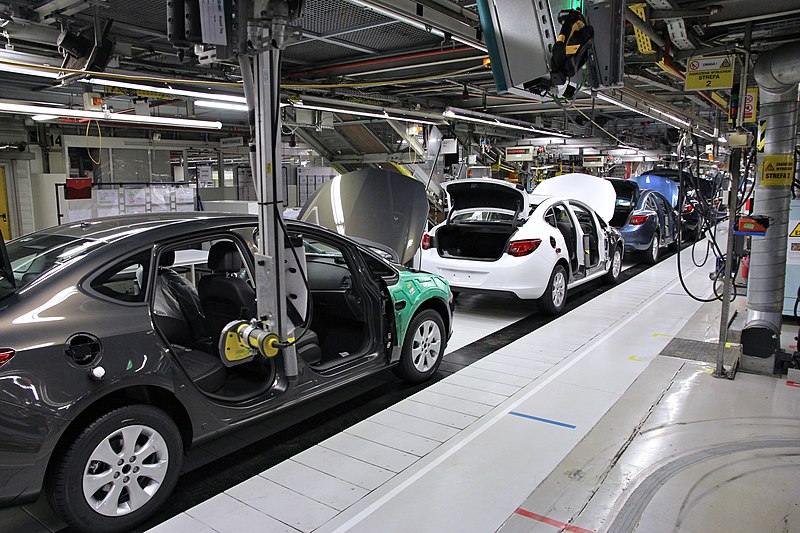
Editor’s Note: The opinions expressed here by the authors are their own, not those of Impakter.com — In the Featured Photo: Car factory assembly line in Poland. Featured Photo Credit: Wikimedia Commons