Today’s ESG Updates:
- Trump Threatens Tariffs Over Digital Regulations: President Trump has threatened to impose steep tariffs and export restrictions on countries that enforce digital rules he views as discriminatory against U.S. tech companies.
- China to Introduce Absolute Carbon Emissions Caps by 2027: China will begin setting absolute carbon emissions limits across key industries starting in 2027, expanding its emissions trading scheme beyond the power sector.
- Norway’s Northern Lights Carbon Storage Project Launches: Shell, TotalEnergies, and Equinor have begun operations on the Northern Lights project, storing CO2 deep beneath the seabed.
- Japan Delays Offshore Wind Project to Lure Investment: Japan has proposed a 10-year extension on offshore wind leases to ease financial pressures and attract broader investor participation.
Klimado – Navigating climate complexity just got easier. Klimado offers a user-friendly platform for tracking local and global environmental shifts, making it an essential tool for climate-aware individuals and organizations.
Strict digital regulation could lead to Trump tariffs
In a recent Truth Social post, U.S. President Donald Trump threatened to impose new tariffs on countries with digital regulations he deemed discriminatory for American tech companies. In the post he wrote, ”I put all Countries with Digital Taxes, Legislation, Rules, or Regulations, on notice that unless these discriminatory actions are removed, I, as President of the United States, will impose substantial additional Tariffs on that Country’s Exports to the U.S.A., and institute Export restrictions on our Highly Protected Technology and Chips.” This declaration follows Reuters‘ report that the U.S. is considering visa restrictions on officials who enforce the EU’s Digital Services Act (DSA). The Trump administration has expressed dislike of the policy, claiming “Orwellian” levels of censorship. Companies can utilize ESG solutions to ensure their operations align with country-specific policies.
***
Further reading: Trump threatens ‘substantial’ new tariffs against countries with ‘discriminatory’ digital rules
China to launch absolute emissions caps in 2027

Beginning in 2027, Chinese industries with steady carbon emissions will face absolute emissions caps. Currently, China’s carbon trading market operates on both free and paid carbon emissions allowances (CEAs), allowing companies to purchase additional CEAs if they exceed their allocated free allowance quota. The new strategy is to combine absolute caps with CEAs by 2030. China has recently expanded its emissions trading scheme (ETS) to include aluminium, cement, and steel industries, previously limited to the power sector. According to analysts, the new scheme will include domestic aviation, papermaking, chemicals, and petrochemicals. China is committed to lowering carbon emissions, and corporations seeking to reduce their CO2 emissions can look to ESG tools for guidance.
***
Further reading: China’s carbon market to introduce absolute emissions caps from 2027
Northern Lights stores first CO2 off the coast of Norway

Owned by major oil companies Shell, TotalEnergies, and Equinor, the Norwegian carbon capture project, Northern Lights, has officially launched. The project encompasses capturing CO2 and injecting it into a reservoir 2,600 metres below the seabed off the coast of Norway. The CEO of Equinor, Anders Opedal, stated, “This demonstrates the viability of carbon capture, transport, and storage as a scalable industry. With the support from the Norwegian government and in close collaboration with our partners, we have successfully transformed this project from concept to reality.” This first phase of the project has the capacity for 1.5 million tonnes of CO2 annually. Phase two of the project will increase that capacity to 5 million tonnes per year.
***
Further reading: Norway’s Northern Lights CCS project begins operations
Japan to delay offshore wind project by 10 years
In an effort to manage increasing costs, a panel of experts from Japan’s Ministry of Land, Infrastructure, Transport and Tourism (MLIT) and Ministry of Economy, Trade and Industry (METI) submitted a proposal on Tuesday. The proposal suggested a 10-year extension on the current 30-year offshore wind project leases. Experts argue that this extension would attract a wider range of investors, boost electricity sales, and improve cash flow for loan repayments. Japan’s government hopes to increase offshore wind capacity to 45 gigawatts (GW), from the current 0.3 GW, by 2040. Companies can ensure their ESG goals are met with the help of ESG tools.
***
Further reading: Japan proposes 10-year extension for offshore wind farm leases to ease cost pressures
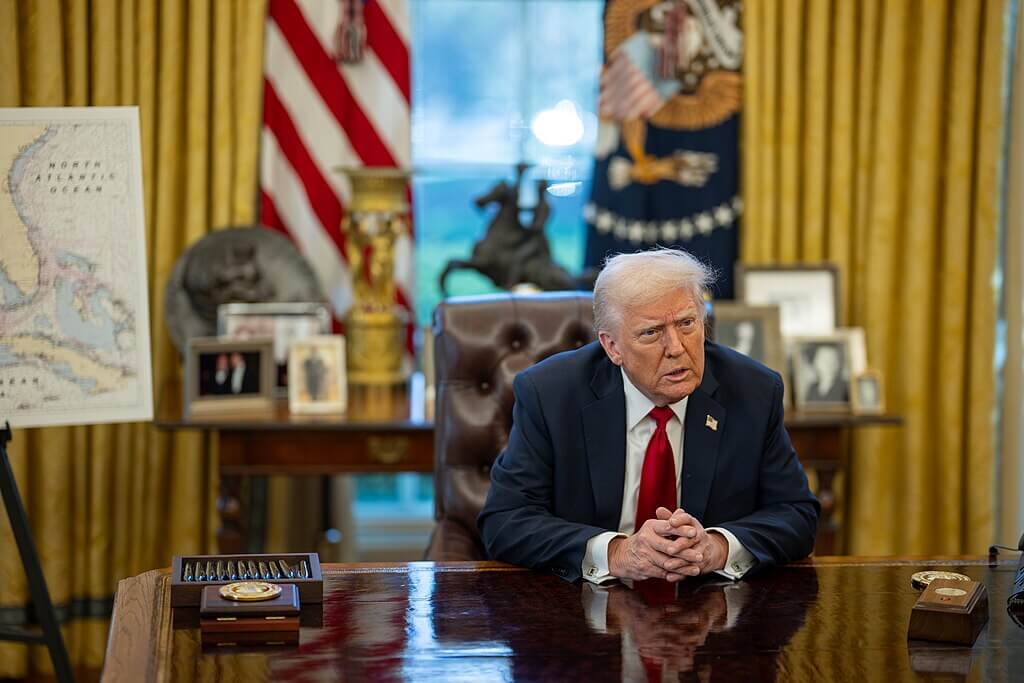
Editor’s Note: The opinions expressed here by the authors are their own, not those of impakter.com — In the Cover Photo: Trump sits in the Oval Office in the White House. Cover Photo Credit: Wikimedia Commons