The United Nations sets out an inspiring ambition in Sustainable Development Goal (SDG) 5:
“Achieve gender equality and empower all women and girls”
This bold goal is supported by targets and indicators that help define what it means in more practical terms. Encouragingly, empowering women acts as a tremendous catalyst, helping achieve many of the other SDGs. In fact, a recent policy brief points out, “Among the 230 unique global SDG indicators, 53 explicitly reference women, girls, gender, or sex.”
Some of these are obvious, others might surprise you. For example, ensuring women’s participation and leadership in decision making can help address inequalities (SDG 10) and contribute to more peaceful and inclusive societies (SDG 16). It can also lead to improved social outcomes, like family health (SDG 3) and education (SDG 4). But giving women voice and agency can be transformative even in environmental management – from ecosystem conservation to climate change mitigation.
IN THE PHOTO: Gold Standard projects anchor gender equality at the core of their design: Stakeholder engagement for a cookstove project in Burkino Faso. CREDIT: Gold Standard
Assessing gender impact
Despite these linkages, according to UN Women, “there are no internationally established methodologies or standards for 23 out of the 53 gender-related indicators.” So how do we leverage gender equality for all to help us deliver on the broader Agenda 2030? Even more fundamentally – how do we measure progress?
This is the problem we’re aiming to solve with Gold Standard’s newly launched Gender Equality Framework.
Gold Standard works at the intersection of climate and development, setting the standard for climate protection projects that deliver sustainable development benefits. This means that projects that cut greenhouse gas emissions also lead to new jobs, better health, or women’s empowerment. The new Gender Equality Framework is designed to harness the power that comes from closing gender gaps.
One of the most compelling examples of where we can see this multiplier effect lurks in an unsuspecting place: the kitchen.
The hidden link between cooking and climate change
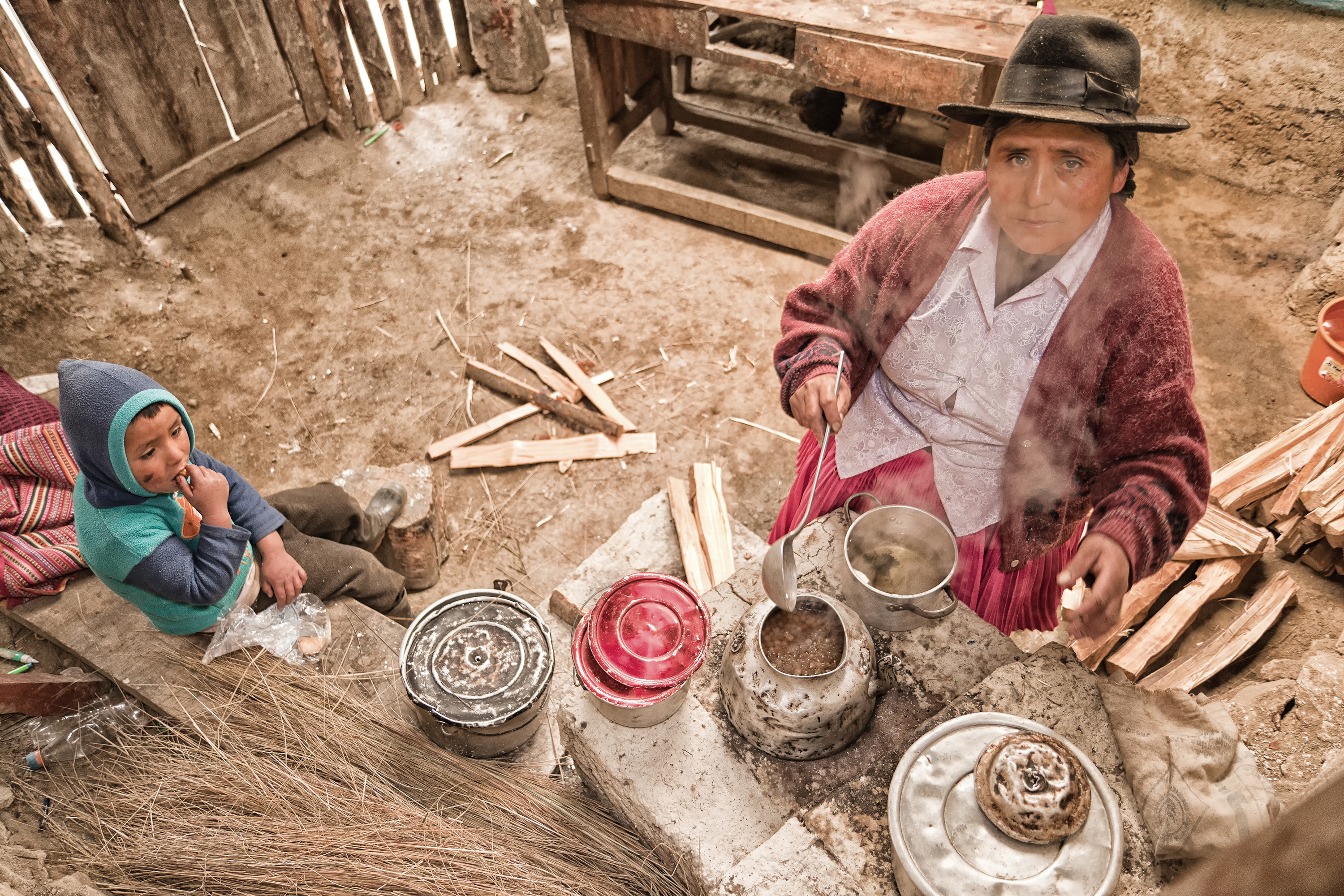
Most people don’t know that about 3 billion people – almost 40 percent of the world’s population – still rely on cooking over an open fire to feed their families. Those of us in the developed world might find this charming while on a camping weekend or roasting marshmallows under the stars. But if you’ve sat around that campfire when the wind turned in your direction, imagine breathing in this smoke for 8 hours a day, every day. Inhaling toxic fumes and soot leads to about 4 million premature deaths each year, primarily women and children. Yes, moms and their kids are dying because of this daily chore.
Beyond dire health impacts, the inefficiency of this cooking method consumes hours of women’s time each day. It even has implications on sexual violence, as women and girls often must travel dangerous distances alone to collect fuel for cooking. A recent UN blog also highlighted gender-based violence in refugee camps that stems from shortages in fuel.
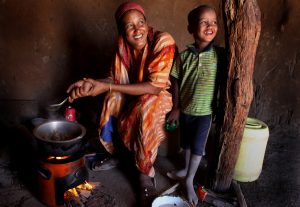
IN THE PHOTO: Clean cooking solutions contribute positively to gender equality and many other SDGs. CREDIT: Paradigm Project
And where does climate change come in? Burning biomass for cooking not only emits greenhouse gases and black carbon, a more potent but shorter-lived climate pollutant. The collection of wood for fuel also means cutting down trees – depleting local forests along with their ability to pull carbon out of the atmosphere. A climate change double whammy.
Women’s responsibilities in households and communities, as stewards of natural and household resources, positions them well to contribute to livelihood strategies adapted to changing environmental realities
– UN Women
Measuring – and maximising – progress
Gold Standard-certified projects have always been required to contribute positively to climate protection plus two additional development benefits. So for years, projects that deliver clean and efficient cooking solutions to communities have tackled many of these social, economic and environmental challenges. These efforts have helped lower household spending on fuel, minimise women’s ‘drudgery’ or the many hours spent on unpaid work like fuel collection and long cooking times, and reduce their exposure to toxic fumes.
But now with clearly defined SDG 5 indicators and more evidence of the transformative potential for women’s empowerment to fight climate change and achieve other development goals, Gold Standard’s Gender Equality Framework takes this to the next level.
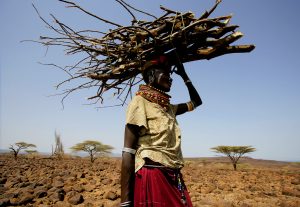
IN THE PHOTO: Taking the weight of the world off her shoulders. CREDIT: Paradigm Project
The Framework’s ‘Gender Sensitive Requirements’ ensure that projects anchor gender equality at the core of their design by following the latest best practices in, for example, consulting with a representative cross-section of local women and men, and ensuring gender-sensitive safeguards are followed. With a strong project design, the Framework’s ‘Gender Responsive Guidelines’ then help assess impact to a wide range of SDG 5 indicators, for example:
- Increase in school enrolment and graduation rates
- Increase in income generation opportunities and equal pay
- Improved access to financial mechanisms
- Incentives to recruit women, increase capacity and provide career development
- Time saved in collecting and carrying water, fuel and forest products and putting it to better use
First application of the Framework: Gender equality and clean water access
The first projects to apply the full Gender Equality Framework is a CO2Balance project in northern Uganda that rehabilitates boreholes to provide clean water access. These communities previously had limited options: drink unsafe water from nearby streams and suffer from life-threatening waterborne illness. Or, travel long distances for clean water or fuel to boil water, exposing women and girls to the hazards previously mentioned and keeping them from being able to dedicate more time to work or schooling.
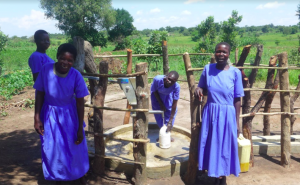
IN THE PHOTO: Gender Responsive Borehole Rehabilitation Project, Northern Uganda. CREDIT: CO2 Balance
Not only will time savings be monitored, but CO2Balance, and their project implementation partners in Uganda, will look at how these free hours are then used. This will assess whether time savings translate to education or income-generating activities that lead to economic empowerment – measurable impact toward SDG5. Even more compelling, they will investigate how this then affects gender dynamics within a family. The project proponents also aim to evaluate how women’s representation on water resource committees can help improve their agency and empowerment in the community.
![Goretti[1]](https://impakter.com/wp-content/uploads/2018/01/goretti1-264x300.png) Goretti Zavuga Amuria, Program Manager for the Gender and ICT Policy advocacy program at Women of Uganda Network and rural development specialist will provide local expertise and insights to design the borehole rehabilitation project in a way that maximises positive impacts for women.
Goretti Zavuga Amuria, Program Manager for the Gender and ICT Policy advocacy program at Women of Uganda Network and rural development specialist will provide local expertise and insights to design the borehole rehabilitation project in a way that maximises positive impacts for women.
To assess these impacts, CO2Balance is working with a local gender expert who is attuned to the complex gender norms and dynamics unique to these communities. With this expertise, the project can survey local households in the best way to get reliable data, which will then be verified by an independent third party and certified by Gold Standard.
Quantification to unlock funding
We’ve all heard, “what gets measured gets managed.” By quantifying and certifying gender impacts, projects can tap into additional funding from an increasing pool of gender-lens investors and a rising demand to credibly report on what dollars have delivered. The Gold Standard Gender Equality Framework is flexible and indicators can be selected according to what funders or projects prioritise.
This gender-disaggregated impact data can also be used to track progress at a regional or national level, helping policymakers to develop effective evidence-based policies and enabling tracking of progress toward the SDGs in initiatives like the Global Partnership for SDGs.
What’s clear is that gender issues are complex, but addressing them can be transformative. Indeed, closing gender gaps can accelerate progress towards many other Sustainable Development Goals.
Conversely, poverty, education, health, jobs and livelihoods, food security, environmental and energy sustainability will not be solved without addressing gender inequality. If we’re serious about the bold ambition of ‘gender equality for all’, we first need to know how we’re doing in the race to 2030 and, critically, get the most out of every development dollar we spend
Editors note: The opinions expressed here by Impakter.com columnists are their own, not those of Impakter.com — Featured photo credit: Microsol