
Impakter
  • Environment
    • Biodiversity
    • Climate Change
    • Circular Economy
    • Energy
  • FINANCE
    • ESG News
    • Sustainable Finance
    • Business
  • TECH
    • Start-up
    • AI & Machine Learning
    • Green Tech
  • Industry News
    • Entertainment
    • Food and Agriculture
    • Health
    • Politics & Foreign Affairs
    • Philanthropy
    • Science
    • Sport
  • Editorial Series
    • SDGs Series
    • Shape Your Future
    • Sustainable Cities
      • Copenhagen
      • San Francisco
      • Seattle
      • Sydney
  • About us
    • Company
    • Team
    • Global Leaders
    • Partners
    • Write for Impakter
    • Contact Us
    • Privacy Policy
No Result
View All Result
Impakter logo
No Result
View All Result
Digital Sobriety: How the Internet is Harming the Environment

Digital Sobriety: How the Internet is Harming the Environment

byEarth.Org
March 5, 2020
in Society, Tech
0

International treaties such as The Paris Agreement commit governments to drastically reduce greenhouse gas emissions. Meeting this challenge demands a rethinking and restructuring of the world’s energy consumption, which demands a review of the functioning of each sector of activity. Digital technology- including the internet- is one such sector that is oft-overlooked by the public and policy makers, but the environmental harm linked to this sector demands attention as urgent as that which is given to others, which calls for a ‘digital sobriety’ approach.

Digital technologies are responsible for 4% of greenhouse gas emissions, a figure expected to double by 2025, and the energy required for this sector is increasing by 8% a year. Watching a half-hour show online leads to 1.6kgs of carbon emissions. 


The Environmental Impact of Video

The Internet poses a threat to climate change, however it is extremely hard to regulate, as so many people use it for so many different things. One of the most energy-intensive of the Internet is video. Ten hours of high-quality video comprises more data than all of the English articles on Wikipedia in text format. Online videos represented 80% of global data flows in 2018, with the remaining 20% representing websites, data, video games, etc. Categories of these online videos include streaming, such as Netflix, Amazon Prime, etc, ‘Tubes’, such as Youtube, and social networks.

This variety of categories illustrates how difficult it is to regulate video usage as there are multiple factors that need to be considered for each category. The increase in video consumption results in massive amounts of data being stored, damaging the environment further and going against the aims of the Paris Agreement.  

Digital Sobriety

Environmental experts from Paris created a think tank called “The Shift Project,” which proposes the idea of ‘digital sobriety’. Digital sobriety promotes using the Internet and technology in a more mindful and responsible way as opposed to cutting it out entirely; the think tank acknowledges the implausibility of this, adding that it ignores the positive contributions of digital technologies. 
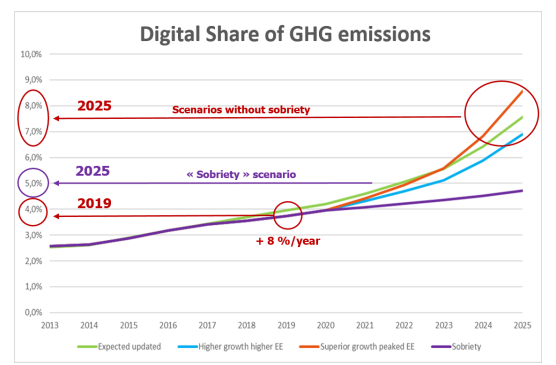
Earth.org the internet is harming the environment

In the photo: A graph showing the digital share of greenhouse gas emissions under a ‘digital sobriety’ scenario and a scenario without ‘digital sobriety’. Photo Credit: The Shift Project. 

Maxime Efoui-Hess, a member of the think tank, says,

The ‘good effects’ of digital technologies, in terms of energy consumption and associated greenhouse gas emissions, are constantly neutralised at global scale by the fact that we use these technologies without thinking about the right way to do it.

He discusses the need to use technology efficiently, “We cannot deny how much the Internet has become a part of our daily lives, but it is about becoming aware of how to use technology more sustainably.”

The think tank believes that humanity is the victim of ‘addictive design,’ a concept in which websites employ mechanisms such as ‘autoplay’ and the ‘recommended section’ of streaming sites to maximise the amount of time spent by a user on the platform.

It allows for a continuous flow of video rather than a timed usage, which boosts the consumption of a large amount of content and generates an increase in the volumes of associated data. For example, the ‘autoplay’ functionality on Netflix encourages the user to watch more episodes than they would have intended, as there is little time to opt out before the next episode starts playing. Consumers need to be aware of how website design can influence them to spend more time online than is necessary. 

The Shift Project asserts that ‘regulation by content’ is needed, which ‘would aim at redimensioning the design of platforms to orient behaviours to a more precise selection of the content consumed. It would reduce the volume of content consumed and be more consistent with the user’s needs’.

This approach makes it possible to act directly on the product consumed- video content- and therefore adapt regulatory tools to its specific characteristics. It would allow users to take into account the processes at the source of the consumption of data in order to act on them.

 In the photo: Youtube application. Photo Credit: Unsplash.

Regulating internet usage

China is one country attempting to crack down on over usage of the internet, albeit not with the intention of curbing emissions. In November 2019, the nation announced that it would impose curfews on minors playing video games to combat what it says is an addiction ‘harming the physical and mental health of minors’. Gamers under 18 are now barred from playing online games between 10pm and 8am and during the week, minors are allowed to play for 90 minutes a day, an allotment that extends to three hours on weekends and public holidays. While it is too early to ascertain if this is a beneficial move, it may encourage game makers, and website designers broadly, to reduce their use of addictive design mechanisms.

However, no broad legislative action has been taken as most laws and political discussion surrounding the Internet concern data protection. There are difficulties in regulating content on the internet, as this would require an examination on the implications in terms of freedom of expression and the accessibility of contents, which raises the question of Net Neutrality. 

While there are certainly challenges in reducing the carbon footprint of digital technologies, especially when considering the ethical aspects, as well as the practical aspects regarding increasing global access to the internet and an increasing population, there needs to be more consideration of how these technologies are impacting on the planet. Regulations need to be implemented on a policy level that balances mitigation of environmental harm and people’s right to information and freedom of speech. 

In the cover photo: Person using MacBook Pro. Photo Credit: Unsplash.

Editor’s Note: The opinions expressed here by Impakter.com columnists are their own, not those of Impakter.com. Photo Credit: Earth.Org.
Tags: DigitalSobrietyenergyEnergyConsumptionGreenhouseGasesInternetvideo
Previous Post

How Honest is Green Finance? A Look into Goldman Sachs

Next Post

Biodiversity Talks: Kickstarting a Paris-style Nature Agreement?

Related Posts

Couple in their living room, dealing with their home internet connection.
Architecture

Simple Ways to Improve Your Home Internet Experience

A stable internet connection is vital, especially when working from home. Slow speeds, frozen videos, or dropped connections are problems...

byHannah Fischer-Lauder
January 9, 2026
AM Green and Mitsui explore investment and offtake opportunities for renewable-powered aluminium production in India
Business

India and Japan Consider Joint Move Into Green Aluminium

Today’s ESG Updates India and Japan Explore Green Aluminium Collaboration: AM Green and Mitsui are assessing investment and offtake opportunities...

byJana Deghidy
December 18, 2025
As power generation methods like natural gas, nuclear, and renewables continue to become more viable, the demand for coal is expected to decline.
Business

Global Coal Demand Has Plateaued and Might Decline by 2030

Today’s ESG Updates: The IEA Forecasts That Coal Demand Might Decline by 2030: Other power generation methods like natural gas,...

byAriq Haidar
December 18, 2025
ESG News regarding Germany’s fast-tracking of infrastructure, rollback of the heating law, digital-only approval reforms, and revised building emissions policy ahead of 2026 elections
Business

Germany Moves to Fast-Track Infrastructure, Retreats From Heating Law

Today’s ESG Updates Germany Overhauls Climate Rules: Germany moves to fast-track major infrastructure projects while replacing its contested heating law...

byJana Deghidy
December 11, 2025
Home Heating and Cooling performance
Architecture

Energy-Saving Tips for Better Heating and Cooling Performance

It creates comfort inside while also helping to lower the utility bills due to efficient temperature control. Most homes want...

byHannah Fischer-Lauder
December 9, 2025
ESG News regarding climate-driven agricultural disruption, extreme weather impacts on commodities, and supply chain risks. Visuals include flooded rubber plantations, farmers navigating waterlogged fields, and maps highlighting affected southern Thailand regions.
Energy

Severe Floods Threaten $140M of Thailand’s Rubber Production

Today’s ESG Updates Serentica Plans $8B Clean Energy Expansion in India: KKR-backed Serentica aims to more than double its renewable...

byJana Deghidy
November 27, 2025
ESG News regarding: only 16% of companies on track to hit net zero targets by 2050 per Accenture report, Orsted completes green transformation, EU and UK to begin carbon market link negotiations, China to expand renewable energy sector
Business

Only 16% of Large Companies on Track for Net Zero

Today’s ESG Updates Accenture Report Highlights Net Zero: While 89% of the world’s largest companies link decarbonization to business value,...

bySarah Perras
November 12, 2025
Blue Economy Yemen
Biodiversity

Can the Blue Economy Save Yemen?

Editor’s note: This article is the second in a two-part series exploring the profound potential of the Blue Economy as...

byTareq Hassan - Executive Director of the Sustainable Development Network Canada (SDNC)
November 6, 2025
Next Post
Biodiversity Talks: Kickstarting a Paris-style Nature Agreement?

Biodiversity Talks: Kickstarting a Paris-style Nature Agreement?

Recent News

ESG News regarding China restricting industrial renewable exports, UN warning that US climate treaty exit harms economy, UK firms lowering wage forecasts despite inflation, Meta partnering with TerraPower for new nuclear reactors.

To Save the Grid, China Forces Industries to Go Off-Network

January 9, 2026
Cleaner Air in Hospitals

How Cleaner Air in Hospitals Can Cut Infections and Climate Impact at the Same Time

January 9, 2026
Search cleanup, key activity to protect your data and tech devices.

A Simple “Search Cleanup” Plan for Busy People

January 9, 2026
  • ESG News
  • Sustainable Finance
  • Business

© 2025 Impakter.com owned by Klimado GmbH

No Result
View All Result
  • Environment
    • Biodiversity
    • Climate Change
    • Circular Economy
    • Energy
  • FINANCE
    • ESG News
    • Sustainable Finance
    • Business
  • TECH
    • Start-up
    • AI & Machine Learning
    • Green Tech
  • Industry News
    • Entertainment
    • Food and Agriculture
    • Health
    • Politics & Foreign Affairs
    • Philanthropy
    • Science
    • Sport
  • Editorial Series
    • SDGs Series
    • Shape Your Future
    • Sustainable Cities
      • Copenhagen
      • San Francisco
      • Seattle
      • Sydney
  • About us
    • Company
    • Team
    • Global Leaders
    • Partners
    • Write for Impakter
    • Contact Us
    • Privacy Policy

© 2025 Impakter.com owned by Klimado GmbH