Recent announcements of the availability of COVID vaccines have uncovered both the “me-first” nature of humans and countries and at the same time our better angels.
For the human side of selfishness, there is much to be told, but one such item is the apparent use of enough money to jump ahead of the queue.
In Canada, the elderly natives, the “First Nation” communities, have limited health care access and poor health. As a result, they are a priority group for the COVID vaccines in Canada. These high-risk people live in remote areas and have limited access to health care facilities.
This did not stop a wealthy Vancouver casino executive and his young actress wife to fly to an airport in Canada’s Yukon and charter a private plane to take them to an indigenous community, where they were attended to by a mobile vaccination clinic to get their shots. According to The Vancouver Sun, the couple presented themselves as “visiting motel workers to mislead clinic staff.”
For the other side of the coin, we can look to Laurent Duvernay-Taradif, a professional athlete from Canada who was a member of the American Superbowl team in 2019, the Kansas City Chiefs. He holds a medical degree from McGill University and chose to trade his pro-football jersey and his big salary, for scrubs to fight on the front lines of the COVID-19 pandemic. He felt a responsibility to support something he believes in, the health of others and “the greater good of the community”, as he explains in this video:
What’s Happening on the “Me-First” Front
Far more damaging to large swaths of people and instructive is the behavior of countries and regions who espouse high moral ground, but when it comes to vaccine pokes, find no problem to push out their neighbors. Their own political future and citizens win hands down.
The contrast is with the grand design put in place by the global community to answer the call of vaccine equity. The argument for global access is simple: If developing countries don’t have access to COVID vaccines, then the virus is given a chance to mutate further, possibly becoming more dangerous and posing a renewed challenge for public health in developed countries.
In June 2020, the World Health Organization (WHO) launched an initiative, COVAX, to help poor countries buy COVID vaccines at reduced prices and get the vaccines delivered once onstream.
Virtually all the big and small countries signed on, including the United States, a latecomer that did so once the Biden Administration came into office. Like other major donor countries, the U.S. promised money – not vaccines from its own stash. It was less money than needed, but more is expected in 2021. This WHO-sponsored initiative has as one of its goals to deliver 2 billion vaccine doses by 2022, its slogan: “No one is safe unless everyone is safe”.
The reality is far different, and it is even not just the money honey, it’s the time…when a country can get it. So far, the poor guys are far down in the poking order.
According to a 2020 Duke Global Health Institute report, 16 percent of the world’s population has pre-purchased 60 percent of the available vaccines.
By the end of 2020, the European Union secured the rights to 400 million doses of COVID vaccines for member countries, potentially later seeking to raise that number to almost two billion.
The United States, not initially making COVAX commitments, already had agreements to purchase enough doses to cover 230% of its population and could eventually control 1.8 billion doses — about a quarter of the world’s near-term supply of known approved vaccines.
Canada, as of now, is the only G7 country set to receive doses from COVAX. To defend the decision, Minister of International Development, Karina Gould, says the vaccine deliveries are a part of the country’s wide-ranging diverse portfolio:
COVAX itself had only been able to purchase roughly 250 million vaccines. Now that vaccination campaigns in Europe, the U.S. and elsewhere are failing to achieve political promises, there is much less willingness to be more sharing, and therefore not much left for the COVAX vulnerable.
This beggar-thy-neighbor for the-good-of-my-people approach has not been without battles among the rich:
“Britain is on a collision course with the European Union over vaccine shortages after Brussels refused to accept that people in the UK have first claim on Oxford/AstraZeneca doses produced in British plants. Stella Kyriakides, the EU’s health commissioner, said the UK should not earn any advantage from signing a contract with AstraZeneca early. “We reject the logic of first come, first served,” Kyriakides said. “That may work in a butcher’s shop but not in contracts and not in our advanced purchase agreements.”
Ironically, this latter comment from the EU’s Health Minister depends on to whom one’s logic applies; certainly not to how the EU treats developing countries.
And there is a further aspect worth mentioning. Many developed and developing countries have cut spending in social services and public health. This has led to policy weaknesses, reduced capacity, and ineffective management of the COVID crisis. As Marianna Mazzucato puts it her new book Mission Economy: A Moonshot Guide to Changing Capitalism:
“landing a man on the moon required both an extremely capable public sector and a purpose-driven partnership with the private sector. Because we have dismantled these capabilities, we cannot hope to repeat earlier successes, let alone achieve ambitious targets such as those outlined in the Sustainable Development Goals (SDGs) and the Paris climate agreement.”
Ditto for handling the covid pandemic.
On Our Better Angels’ Side:
On the “sort of” good news side, COVID vaccines are increasingly available to developing countries outside COVAX, from China, Russia, and India. Neither the Chinese nor Russian vaccines have yet run the full gamut of providing the data to have comprehensive analysis in terms of safety and efficacy to get the WHO good housekeeping seal of approval.
China has probably been the first to offer its version, perhaps to overcome the geopolitical stain of being the COVID country-of-origin-without-transparency, and to show its technological capacity.
For Russia, it is a way to strengthen its soft power, in so doing to underscore the miserly nature of its Western competitors at a time when developing country leaders and their people hunger for any possible help to contain the pandemic tsunami. As I write, The Lancet has just revealed that an “interim analysis of a randomised controlled phase 3 trial” on more than 20,000 participants has shown that the Russian vaccine Sputnik V offers 91.6% protection against the virus. That’s on par with some of the leading vaccines now in use.
So far, Sputnik V has been given regulatory approval in 16 countries including Hungary, which (unsurprisingly) was the first EU member to break ranks and approve it last month. EMA, the European regulator, is now set to review the latest data.
Then there is the Indian vaccine producing powerhouse, with major vaccine manufacturing capacity and a capitalist government, recently giving more than 3 million doses of COVID vaccine to its South Asian neighbors, because as Prime Minister Narendra Modi put it, his country was prepared to “protect humanity.”
And truly on the good news side, Pfizer, Moderna, AstraZeneca, and new vaccines such as Johnson and Johnson, Novavax and Sputnik V are reported to have drastically reduced hospitalizations and deaths. Admittedly, the increased number of vaccines accompanied by a divergent panoply of vaccine efficacy can cause confusion. Debates around who should get which vaccine can explode, as we have recently seen in Italy where the AstraZeneca vaccine has been restricted to under-55. Italian authorities see it as “preferable” for that age group, because so far there are not enough trial results concerning the older population to make a final decision.
Other vaccines are moving forward with phase trials and approvals to expand the options to get the better of this horrific virus.
It is not hard to see the proverbial glass half empty. But remember these vaccines emerged in record time, requiring huge investments by governments and the private sector, and broke new and exciting new ground. More breakthroughs will happen and other vaccines coming onstream to deal with mutations or new challenges, lessening the pressure on those with the gold to make the rules and decide on distribution.
As long as we invest in science and relevant research, there is reason to be measured optimists. Of course, generosity and prayer never hurt.
Editor’s Note: The opinions expressed here by Impakter.com contributors are their own, not those of Impakter.com
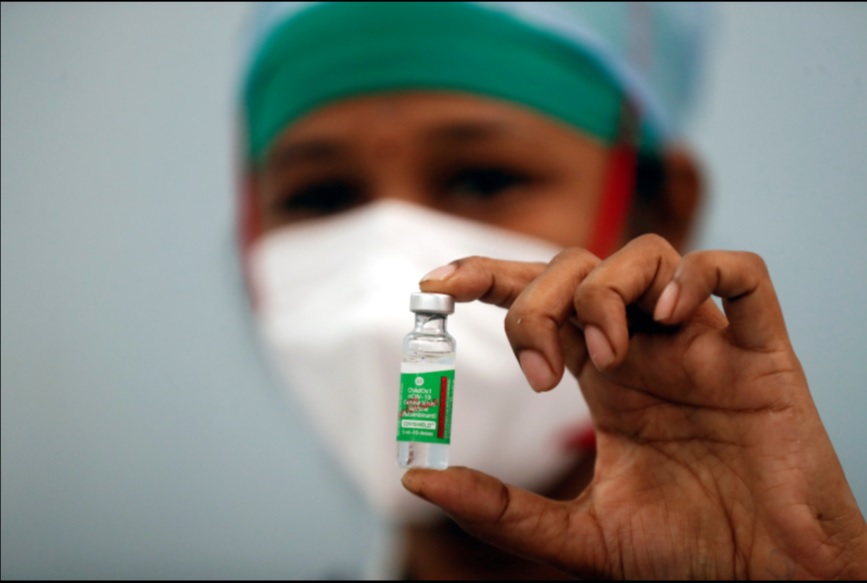
In the cover picture: Vial of COVISHIELD, the AstraZeneca Covid vaccine produced by Serum Institute of India, Mumbai, February 2, 2021, displayed by a nurse. Source: Reuters photo.