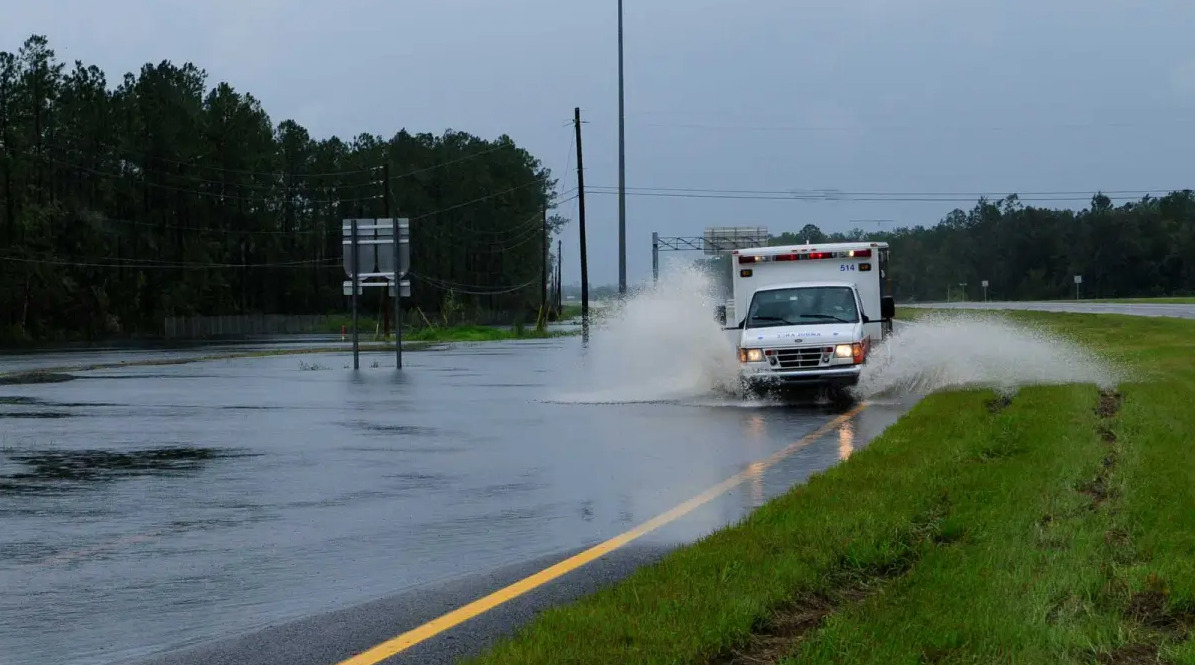
In August 2023, time was running out for health care workers along Florida’s Gulf Coast. Hospital administrators and staff had to decide how they would prepare themselves, their patients, and their facilities as Hurricane Idalia — a Category 4 — closed in on the coastline.
Faced with the possibility of a six-foot storm surge that would engulf streets and potentially flood the lower levels of the hospitals, four hospitals and eight free-standing emergency rooms in the Tampa Bay metro area were shut down. The hospitals transported patients to safer ground by ambulance.
Within a month, health care leaders in two other major U.S. cities would confront similar tests. On the West Coast, historic rainfall cut power to a hospital in Los Angeles, while in New York, torrential downpours caused a power outage and electrical damage at a hospital in Brooklyn — both incidents prompting emergency evacuations.
The recent hospital closures in the United States illustrate a larger trend that’s already in motion. Human-driven climate change has increased the risk of damage to hospitals by 41% between 1990 and 2020, according to a December 2023 report published by XDI, or Cross Dependency Initiative, an Australian climate risk data company.
Thousands of health care facilities around the world are buckling under the effects of climate change, a trend experts predict will worsen in the coming decades as extreme weather increases pressure on hospital infrastructure and simultaneously creates more demand for care.
Expert warnings
In a May 2024 report, the United Nations Population Fund estimated that nearly 1,500 hospitals are located in low-lying coastal areas of Latin America and the Caribbean that already endure life-threatening storms and flooding. More than 80% of hospitals in Aruba, Bahamas, Cayman Islands, Guyana, and Suriname are in these danger zones.
Hundreds of hospitals in the U.S. are at risk from flooding, according to a 2022 study by Harvard researchers. Along the Atlantic and Gulf Coasts, hospitals in Delaware, Florida, Louisiana, New Hampshire, Massachusetts, Maryland, New Jersey, New York, and Pennsylvania were most at risk of flooding caused by a Category 2 hurricane.
On the other side of the globe, surging floods and landslides shuttered 12 health care facilities in five provinces in southern Thailand in 2023. The year before that, Pakistan’s devastating floods limited the function of at least 1,460 health care facilities, about 10% of the country’s total.
Looking at the climate risk to roughly 200,000 hospitals from flooding, fires, and cyclones, the XDI researchers estimated that by the end of this century, one in 12 hospitals worldwide could be at risk of total or partial shutdown due to extreme weather.
Some regions are more vulnerable than others. The report estimated more than 5,800 hospitals in South Asia alone — an area that includes India, the world’s most populous country — would be at high risk of shutting down under a 4.3 degrees Celsius global warming scenario.
Other regions are not immune, however. Over half of hospitals in the Central African Republic and more than one-quarter of hospitals in the Philippines and Nepal would face the same fate.
Compounding the pressure with extreme heat
Summer 2023 was the hottest on record. Scorching temperatures brought deadly heat waves and wildfires that tore through forests and surrounding towns and cities — all potentially impacting human health as well as the hospitals and clinics where people seek care.
“The northern hemisphere just had a summer of extremes — with repeated heat waves fueling devastating wildfires, harming health, disrupting daily lives, and wreaking a lasting toll on the environment,” World Meteorological Organization Secretary-General Petteri Taalas said in a statement.
That summer, in Arizona, for example, extreme heat put pressure on power grids and spurred an influx of people in need of medical care for heat stress.
A 2021 study found that heat-related emergency room visits in Taiwan rose by 50% on days that reached a wet-bulb temperature — which accounts for both heat and humidity — of at least 89.6 degrees Fahrenheit. At that level, it’s more difficult for sweat to evaporate and therefore harder for people to cool themselves.
Looking ahead to future risk
In the coming decades, health care infrastructure will face increasing strain from the impacts of extreme weather and temperature rise — power outages, hospital closures, and damage to buildings.
At the same time, demand for care could grow. Climate change is expected to worsen more than half of known human pathogenic diseases over the next 25 years, expanding the range of fungal infections and increasing the risk of viruses and mosquito-borne diseases. Meanwhile, extreme heat will likely increasingly send people to the hospital.
Making significant changes to the way hospitals operate may seem daunting, but facilities can start small in their adaptations and create solutions unique to their needs.
Related Articles: 5 Visible Signs of Climate Change in Antarctica | Connections That Matter: Climate Change and Gender Equality | How Climate Change Affects Health and How Countries Can Respond | Climate Change’s Catch-22
An example of this approach can be found in Vietnam. About half of all hospitals in that country do not have a reliable source of water, whether that’s due to droughts, floods, or creeping saltwater intrusion. A result: patients often have to bring their own. Faced with this major obstacle to care, three rural hospitals in Vietnam embarked on projects to get more climate resilient by addressing water availability. The institutions each found innovative ways to obtain more water using solutions like rainwater catchment and storage systems, saline filtration, and better infrastructure to capture nearby streamflows.
“Unfortunately, we can expect climate change to increasingly threaten water supplies at health care facilities throughout Vietnam, so it is critical to act quickly with adaptation measures,” Angela Pratt, a WHO Representative in Vietnam, said in a news release.
As climate change impacts push health care systems into higher levels of risk, it’s vital that hospital leadership teams globally begin shaping plans for climate resiliency related to infrastructure and personnel to safeguard health care on a changing planet.
** **
This article by Yale Climate Connections is published here as part of the global journalism collaboration Covering Climate Now (CCN). It was authored by Kaitlin Sullivan, a freelance journalist covering health, science, and the environment, and was produced in partnership with Energy Innovation and the Aspen Global Change Institute. Both organizations are Yale Climate Connections content-sharing partners.